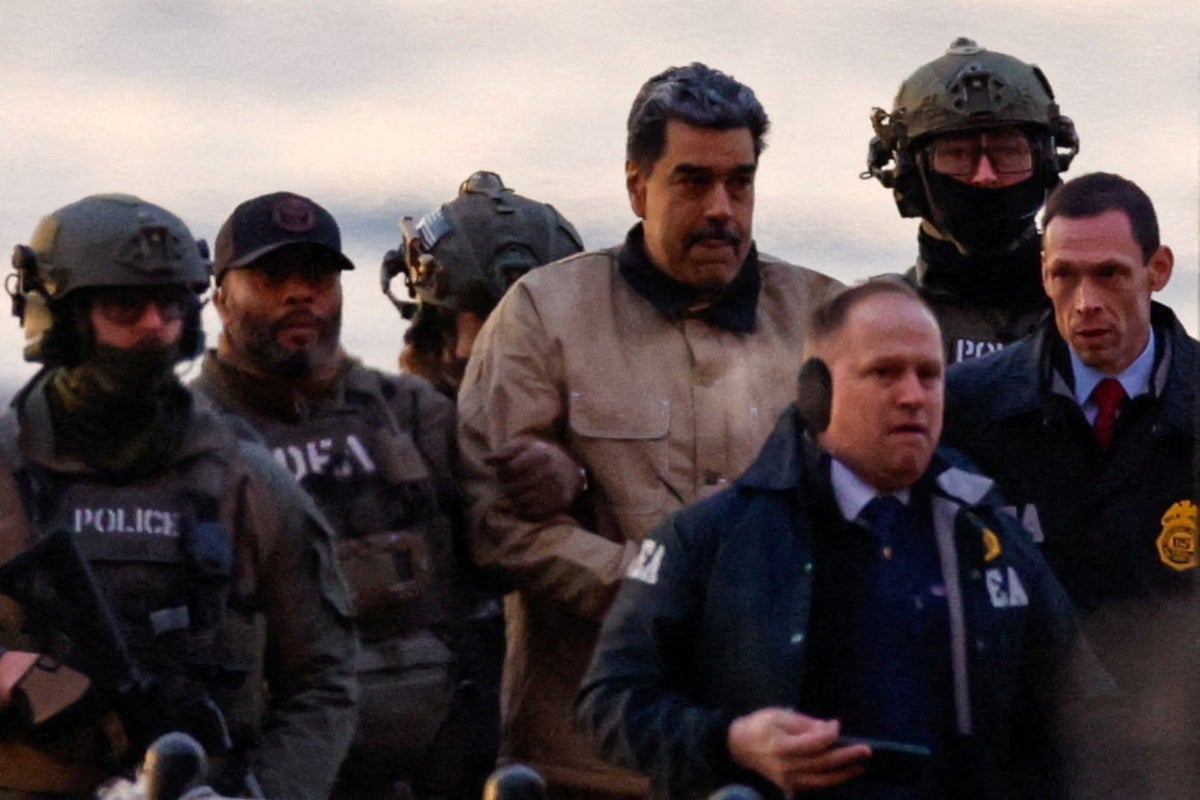
The appearance of Nicolás Maduro and Cilia Flores in a United States federal courtroom represents a terminal breakdown in the traditional barriers of Westphalian sovereignty. This event is not merely a criminal proceeding; it is the culmination of a multi-decade intersection between state-sanctioned extraction and global narcotics logistics. To understand the gravity of these charges, one must analyze the structural integration of the Venezuelan executive branch with the "Cartel de los Soles" (Cartel of the Suns), an organization where the state apparatus serves as the primary infrastructure for transnational crime.
The Architecture of State-Sponsored Narco-Terrorism
The indictment rests on a three-pillar framework of systemic corruption that transformed Venezuela from a petro-state into a transit-state. These pillars define the operational reality of the Maduro administration:
- Infrastructure Weaponization: The use of military airbases and commercial maritime ports as "dark hubs" for the departure of cocaine shipments. By utilizing state assets, the organization minimizes the friction of traditional smuggling—eliminating the need for clandestine strips or high-risk border crossings.
- Judicial Shielding: The systematic removal of independent oversight within the TSJ (Supreme Tribunal of Justice) to ensure that investigative leads into the Cartel of the Suns are neutralized before they reach a discovery phase.
- Strategic Alliances with Non-State Actors: The logistical synergy between the Venezuelan military and the remnants of the FARC (Revolutionary Armed Forces of Colombia). This partnership created a seamless supply chain from the laboratories in Catatumbo to the Caribbean coastline.
The "Cartel of the Suns" is a misnomer if viewed as a traditional gang. It is a vertical hierarchy within the Fuerza Armada Nacional Bolivariana (FANB). The suns refer to the insignias on the epaulets of Venezuelan generals. The participation of high-ranking officials creates a "low-variance risk profile" for traffickers; when the police, the coast guard, and the air force are the business partners, the probability of seizure drops to near zero within domestic borders.
The Economic Incentive of the Cocaine Hedge
The shift toward narco-trafficking was not an ideological choice but a fiscal necessity driven by the collapse of Petróleos de Venezuela, S.A. (PDVSA). As oil production cratered from approximately 3 million barrels per day in the early 2000s to lows beneath 400,000 during the height of the crisis, the regime faced a liquidity trap.
Cocaine provided a high-density, portable, and dollar-denominated asset that functioned as a hedge against hyperinflation. Unlike oil, which requires massive capital expenditure, specialized engineering, and transparent global shipping manifests, narcotics can be managed through a shadow economy. This transition created a "dual-state" reality:
- The Formal State: Operates on a devalued Bolivar, manages crumbling public services, and faces international sanctions.
- The Shadow State: Operates on USD and Gold, manages the security of trafficking routes, and funds the loyalty of the military high command.
This shadow economy functions through a mechanism known as "The Bolichicos’ Filter." Wealth is extracted from the state through currency manipulation and then laundered through shell companies in jurisdictions with weak AML (Anti-Money Laundering) enforcement. The federal charges against Cilia Flores specifically target this intersection of family influence and financial obfuscation, alleging that her "nephews" and wider circle were instrumental in the logistics of moving product in exchange for hard currency to maintain the regime's inner circle.
Jurisdictional Reach and the Extraterritoriality of US Law
The ability of a US federal court to try a sitting or former head of state hinges on the "Effects Principle" of international law. The Department of Justice argues that because the narcotics were destined for American streets and the transactions often touched the US financial system (via SWIFT or dollar-clearing houses), the US has a direct interest that overrides sovereign immunity.
The legal mechanism used here is the RICO (Racketeer Influenced and Corrupt Organizations) Act, originally designed to dismantle the American Mafia. In this context, the Venezuelan government is being treated as a "criminal enterprise." This classification has significant implications for the defense:
- Vicarious Liability: Under RICO, the prosecution does not need to prove Maduro personally touched a shipment of cocaine. They only need to prove he managed, directed, or knowingly benefited from the enterprise's illegal activities.
- The Cooperating Witness Variable: The most significant threat to the defense is the "De-escalation of Loyalty" among mid-level officials already in US custody. Former generals like Hugo Carvajal or Cliver Alcalá Cordones provide the granular, day-to-day operational details that link executive orders to specific drug flights.
The Geopolitical Fallout of Judicial Intervention
The return of Maduro and Flores to a federal courtroom signals a pivot in US foreign policy from "Diplomatic Pressure" to "Judicial Enforcement." This creates a bottleneck for any future negotiations regarding the lifting of sanctions or a transition of power.
From a strategic standpoint, the indictment serves as a "commitment device." By unsealing these charges, the US government makes it legally impossible to offer Maduro a comfortable exile in a country that honors extradition treaties with the United States. It forces a zero-sum outcome: either the regime maintains total control over its territory to avoid arrest, or it collapses into the hands of international law enforcement.
The presence of Cilia Flores in the proceedings is a tactical "pressure point." In many autocracies, the family serves as the ultimate repository of trust and asset management. By targeting the "First Combatant" (as she is titled in Caracas), the prosecution is targeting the regime's internal cohesion. History suggests that when the inner family is at risk, the likelihood of internal fractures—or "palace coups"—increases, as subordinates begin to calculate the cost-benefit ratio of remaining loyal to a leadership that can no longer guarantee its own safety.
Operational Constraints of the Prosecution
Despite the high-profile nature of the case, the prosecution faces distinct evidentiary hurdles. Much of the evidence is classified, derived from signals intelligence (SIGINT) and human intelligence (HUMINT) from within the FANB.
- The Chain of Custody for Intelligence: Turning a classified satellite intercept into an admissible piece of evidence in an open courtroom requires "cleansing" the data to protect sources and methods.
- Credibility of "Snitches": Defense attorneys will inevitably paint cooperating witnesses as opportunistic criminals seeking sentence reductions. The prosecution must corroborate their testimony with "hard" data, such as flight logs, bank records, and intercepted communications.
The defense will likely lean on the "Act of State" doctrine, arguing that the actions taken were matters of national security or sovereign policy, not criminal activity. However, precedent in cases like that of Manuel Noriega suggests that US courts are increasingly unwilling to recognize "sovereignty" as a valid defense for large-scale narcotics trafficking that impacts US domestic safety.
The Calculus of Regime Survival
The Maduro administration’s current strategy is one of "Judicial Defiance." By framing the court appearance as an "abduction" or an "imperialist kidnapping," they seek to consolidate their domestic base through a narrative of external aggression.
However, the structural reality is that the regime is now operating within a shrinking geographic and financial "safe zone." As more officials are named in indictments, the pool of people willing to engage in international travel or use global banking diminishes. This creates a "Pariah Stagnation," where the state continues to exist but is functionally severed from the global economy, leading to further reliance on illicit extraction—gold mining, drug transit, and fuel smuggling—to survive.
The strategic play for the international community is to monitor the "Loyalty Tax." As the US increases the cost of remaining loyal to Maduro through these legal actions, the regime must pay its generals more to keep them from defecting. Eventually, the "Shadow State" will no longer generate enough USD or gold to pay this tax, at which point the internal security apparatus of the Venezuelan executive branch will reach a point of systemic failure.
The judicial process against Nicolás Maduro and Cilia Flores is the first stage in this "Cost-Incurrence Strategy." It is not just about the rule of law; it is about the economic and political exhaustion of a regime that has over-leveraged its sovereignty to protect its criminal assets.
The Strategic Path Forward
The United States must now prioritize the "Information War" surrounding the trial. By systematically unsealing evidence that links the regime to the FARC and the ELN (National Liberation Army), the US can delegitimize the Venezuelan government’s claim to revolutionary purity in the eyes of its remaining regional allies.
The final strategic move is the "Sanctions-for-Cooperation" offer to lower-level regime officials. By providing an off-ramp for those who turn state's evidence, the prosecution can create a "Domino Effect" within the Cartel of the Suns. The goal is to make the cost of remaining a defendant in a US federal court higher than the reward of remaining a general in a failing narco-state.
Would you like me to analyze the specific economic impact of the "Cartel of the Suns" on regional inflation and black-market exchange rates in Venezuela?