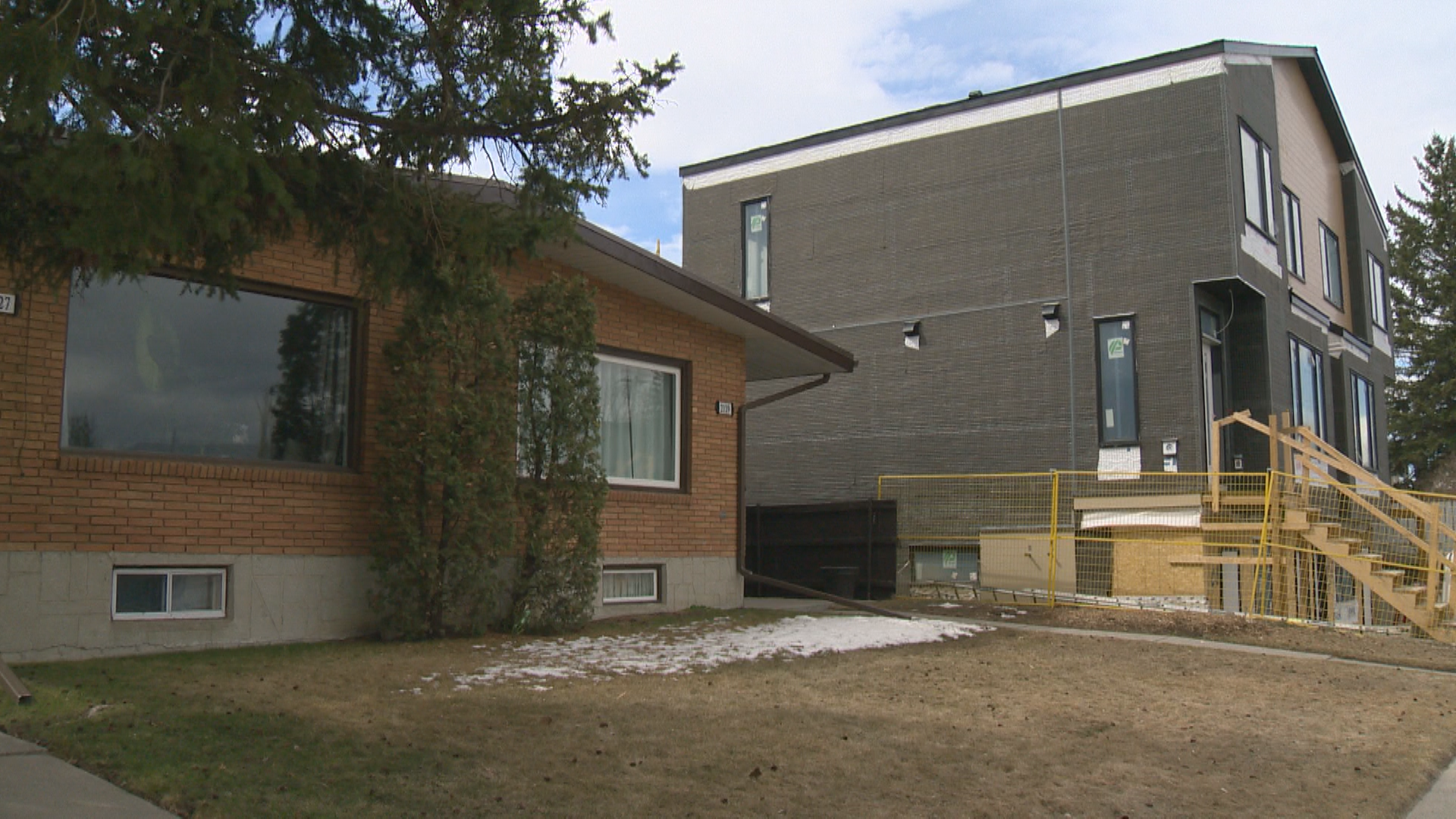
The Calgary City Council’s proposal to ban midblock rowhouses under the guise of repealing citywide rezoning represents a fundamental breakdown in urban economic logic. By isolating rowhouses to corner lots, the city is not merely adjusting a zoning map; it is artificially inflating the cost of entry-level homeownership and de-optimizing the utility of existing infrastructure. This move shifts the burden of density from a distributed model to a concentrated, inefficient one, creating a "Corner-Lot Premium" that effectively cancels out the affordability gains intended by the original R-CG (Residential—Grade-Oriented Infill) district.
The mechanism at play is a reversal of the Density Distribution Curve. When a city allows rowhouses midblock, it enables a contiguous stretch of high-efficiency land use. Restricting this to corners creates a jagged, under-utilized urban fabric where the most expensive parcels—those with the most street frontage and sunlight—are the only ones permitted to host multi-family units. This policy failure is driven by three distinct structural pressures: political risk mitigation, infrastructure load concerns, and the preservation of single-family aesthetic hegemony. For a more detailed analysis into similar topics, we suggest: this related article.
The Economic Distortion of the Corner-Lot Mandate
Restricting rowhouse development to corner parcels introduces a binary constraint on the real estate market that ignores the basic mathematics of land assembly. To understand why this fails, one must examine the Yield Per Linear Foot of street frontage.
- The Assembly Bottleneck: Midblock developments allow for larger land assemblies. By prohibiting these, the city forces developers to compete for a finite supply of corner lots. In any given residential block of 20 lots, only two are corners. This 90% reduction in eligible land supply leads to an immediate price spike for those specific parcels.
- Infrastructure Under-utilization: Municipal services—water, sewage, and gas—run beneath the entire length of a street. A midblock ban ensures that these high-fixed-cost assets operate at a lower capacity for the majority of the block's length, while placing peak-load stress exclusively on the corner nodes.
- The Luxury Floor: Because corner lots are more expensive to acquire and often require more complex setbacks and side-yard landscaping, the "minimum viable price" for a rowhouse unit on a corner is higher than it would be midblock. This eliminates the "starter" segment of the rowhouse market, pushing those buyers back into the competition for aging, single-family bungalows.
Operational Mechanics of the Rezoning Repeal
The proposal to revert or significantly modify the R-CG and H-GO (Housing—Grade-Oriented) zoning is framed as a response to community feedback, yet it ignores the Supply-Demand Elasticity of the Calgary housing market. The repeal operates through two primary regulatory levers: lot coverage restrictions and frontage requirements. For additional information on the matter, detailed reporting is available on NBC News.
The Floor Area Ratio (FAR) Compression
By banning midblock rowhouses, the city effectively lowers the aggregate Floor Area Ratio of the neighborhood. If a midblock lot is restricted to a single-family home with a secondary suite versus a four-unit rowhouse, the square footage of "living yield" drops by approximately 60% to 75% per lot. This compression forces the remaining demand into the suburbs, accelerating sprawl and increasing the city's long-term maintenance liabilities for new roads and pipes.
Parking and Access Constraints
Midblock rowhouses frequently utilize rear-lane access for parking. The argument that these units congest street parking is often used as a political shield. However, from a logistics standpoint, corner units often face more stringent "sightline" requirements and "corner-cut" setbacks that actually reduce the available parking footprint compared to a standardized midblock lot. The repeal creates a paradox where the city demands density but prohibits the lot types best suited to accommodate it without disrupting street-side traffic flow.
The Social Cost of Aesthetic Protectionism
The push to ban midblock rowhouses is frequently categorized as a defense of "neighborhood character." In analytical terms, this is a Substitution Effect where the subjective value of visual consistency is prioritized over the objective value of housing liquidity.
- Generational Displacement: When midblock density is illegal, the natural progression of a neighborhood stalls. Young families are priced out because the only available stock is either "luxury corner rowhouses" or "prohibitively expensive single-family detached."
- The Infill Paradox: By limiting rowhouses to corners, the city ensures that the interior of the block remains stagnant. This prevents the gradual, organic renewal of housing stock, leading to a "hollowed-out" block structure where renewal only happens at the edges.
The proposed policy assumes that density is a pollutant that must be diluted. In reality, density is the fuel for local commercial viability. A midblock ban reduces the walkable catchment area for local businesses by capping the population density of the "inner block," which is the largest component of any residential district.
Quantifying the Strategic Failure
To assess the impact of this rezoning repeal, we must look at the Marginal Cost of Housing Production (MCHP). In a standard R-CG environment, the MCHP is lowered by spreading the land cost across four or more titles.
$MCHP = (L + C + S) / N$
Where:
- $L$ = Land Acquisition Cost
- $C$ = Construction Cost
- $S$ = Soft Costs (Permits, Levies)
- $N$ = Number of Units
When $N$ is forced to 1 or 2 for midblock lots, the $MCHP$ for those lots remains high. When $N$ is 4 but only allowed on corner lots where $L$ is inflated by 20% to 30% due to scarcity, the $MCHP$ for the rowhouses also rises. The net result is a market-wide increase in the price of new housing, regardless of form.
Tactical Implications for Developers and Residents
The shift in Calgary’s policy landscape necessitates a pivot in investment and advocacy strategies. The "corner-only" model creates a high-stakes environment where developers will be forced to overbid for specific assets, leading to "over-improvement" of those sites to justify the land cost. This results in ultra-luxury townhomes rather than the missing-middle housing the city ostensibly claims to support.
Residents favoring the ban must account for the Infrastructure Tax Lag. As density is restricted, the per-capita cost of maintaining the neighborhood's existing infrastructure increases. Lower density means fewer taxpayers per kilometer of pipe and road, which inevitably leads to either property tax hikes or a decline in municipal service quality.
The Feedback Loop of Policy Volatility
The most significant damage caused by the proposed repeal is the destruction of Regulatory Certainty. Real estate development operates on 3-to-5-year cycles. By introducing a massive zoning shift and then threatening to repeal it within a year, the city has introduced a "Political Risk Premium." Lenders and developers will now demand higher returns to compensate for the possibility of future "down-zoning," which further inflates the cost of every new unit built in Calgary.
Strategic Recommendation: The Hybrid Density Model
Rather than a binary ban on midblock rowhouses, the city should employ a Performance-Based Zoning framework. This would allow midblock density contingent on specific objective criteria rather than geography:
- Lane-Load Balancing: Permit midblock rowhouses only where rear lanes meet specific width and structural integrity standards to handle increased traffic.
- Solar-Access Tiering: Use shadow-mapping to determine the maximum height of midblock units, ensuring they do not deprive adjacent single-family lots of sunlight, rather than banning the form entirely.
- Variable Development Levies: Charge higher "Growth Off-Set" fees for midblock units to fund immediate localized infrastructure upgrades, allowing the market to decide if the density is worth the cost.
The current proposal is a blunt instrument attempting to solve a surgical problem. By stripping the "middle" out of the "missing middle," Calgary risks a decade of stagnant growth and escalating prices. The immediate move for stakeholders is to pivot away from "blanket" arguments and force the Council to address the specific Cost-per-Unit and Infrastructure-Yield metrics that this repeal will objectively degrade. Developers should accelerate any pending R-CG applications for midblock lots immediately, as the window for efficient land use in Calgary is rapidly closing.