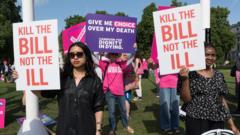
The heavy oak doors of the committee room didn't slam. They clicked. A soft, clinical sound that signaled the end of a thousand whispered conversations held in hospital corridors and over kitchen tables across the country. For months, the air had been thick with the frantic energy of a debate that touched the very marrow of what it means to be alive. Now, that energy has been earthed. The bill is dead.
It wasn't a dramatic defeat on the floor of the Commons, nor a cinematic standoff. Instead, the proposed legislation on assisted dying simply ran out of time, caught in the gears of a looming election and the rigid indifference of a parliamentary calendar. For the politicians, it is a matter of procedure. For the campaigners, it is a tactical pause. But for the people waiting in the shadows of terminal diagnoses, it is something else entirely. You might also find this connected article useful: Strategic Asymmetry and the Kinetic Deconstruction of Iranian Integrated Air Defense.
Consider a man we will call Arthur.
Arthur is not a statistic in a government briefing. He is a retired geography teacher who can tell you the exact sediment composition of every riverbed in the county. He has motor neurone disease. His world, once defined by long hikes and the expansive reach of the classroom, has shrunk to the dimensions of a motorized recliner. Arthur does not want to "go gently." He wants to know that when the breathing becomes a labor of Hercules and the swallowing becomes a gamble, he has a key to the exit. As discussed in latest coverage by USA Today, the results are significant.
The news from Westminster reached Arthur via a flickering television screen. The broadcast explained that both proponents and opponents of the bill now agree: there is no path forward in this Parliament. The debate is shelved. The voices are hushed.
Arthur looked at his hands, which no longer obey his mind. For him, the "parliamentary process" isn't a dry exercise in democracy. It is the boundary of his autonomy.
The Great Hesitation
We are a society that has mastered the art of prolonging life, yet we remain terrified of presiding over its end. This latest stall in the legal process reflects a deep, collective shivering. On one side of the velvet rope stand those who view assisted dying as the ultimate civil liberty—the right to curate one's final chapter. They speak of dignity. They speak of mercy.
On the other side are those who see a "slippery slope" not as a logical fallacy, but as a genuine precipice. They worry about the "duty to die." They fear that a right to end one's life will, under the pressure of a crumbling social care system, slowly morph into a subtle expectation. If a grandmother feels she is a "burden" on her family’s finances or emotional reserves, does the "choice" to die remain a choice?
These are not trivial fears. They are the ghosts that haunt the halls of power.
The collapse of the current bill happened because the complexity of these fears collided with the simplicity of a deadline. When the Prime Minister called the election, the "wash-up" period—that frantic clearing of the legislative desk—began. In that narrow window, only the least controversial items survive. Assisted dying, perhaps the most intimate and divisive topic a human can contemplate, was never going to be "non-controversial."
So, the lobbyists packed their briefcases. The bishops and the doctors and the activists retreated to their corners. They will tell the cameras that they are "disappointed" or "relieved," depending on their badge. They will prepare for the next Parliament, the next battle, the next set of headlines.
But time, for some, is not a political commodity.
The Geography of Pain
Pain is a lonely country. When you are in it, the maps of the healthy no longer apply. The legal debate often treats suffering as a binary—either it is manageable or it isn't. But anyone who has sat by a hospice bed knows that suffering is a spectrum of sensory and psychological erosion. It is the loss of the ability to hold a spoon. It is the indignity of being turned like a piece of meat to prevent sores. It is the fear of the final gasp.
The current law in the UK is a patchwork of compassion and threat. It is technically illegal to help someone end their life, punishable by up to 14 years in prison. Yet, the Crown Prosecution Service rarely brings charges against those who act out of "reluctant compassion." We live in a grey zone. We allow the act, but we forbid the safety of a framework.
We force the "Dignitas flight"—the lonely, expensive pilgrimage to Switzerland. We turn grieving spouses into potential criminals. We ask doctors to walk a tightrope between their Hippocratic Oath and their humanity, often leaving them to provide "terminal sedation" that everyone knows is a slow-motion version of the very thing the law forbids.
This hypocrisy is the "invisible stake" of the debate. By failing to pass a bill, we haven't stopped people from dying on their own terms. We have simply ensured that they must do it in secret, in fear, or in a foreign country.
The Weight of the Wait
The leaders of the campaign for change, including prominent figures who have watched their own loved ones wither, argue that the public is far ahead of the politicians. Poll after poll suggests a significant majority of the population supports a change in the law for the terminally ill.
Why the disconnect?
Politics is built on the art of the avoidable. If a decision is difficult, if it risks alienating a core voting bloc, the instinct is to defer. By allowing the bill to wither on the vine, the current government avoided a definitive stance. They let the clock do the dirty work.
But the silence following the bill's demise is deafening. It is a silence filled with the ticking of clocks in bedrooms where the light is always dimmed.
Imagine, for a moment, the perspective of a palliative care nurse. She is the one who sees the reality when the cameras are off. She knows that "hospice care" is a miracle, but it is not a panacea. There are some types of pain—bone cancer that feels like being shattered from the inside, or the psychological terror of suffocation in respiratory failure—that even the strongest morphine cannot touch without erasing the person entirely.
She sees the families. She sees the "look" in a patient's eyes—a plea for an end that she is legally barred from providing. For her, the bill's failure isn't a matter of "party lines." It is another year of watching people she cares for endure the unendurable.
The Architecture of the Future
When the new government takes their seats after the election, the ghost of this bill will be waiting for them. It hasn't been defeated; it has been delayed. The advocates are already sharpening their arguments, pointing to the successful models in Oregon, Canada, and Australia. They will argue that safeguards—witnesses, psychiatric evaluations, multiple doctor sign-offs—can turn the "slippery slope" into a secure staircase.
The opponents will be ready, too. They will cite the expanding criteria in other nations as proof that once you open the door, you can never truly close it. They will talk about the sanctity of life and the danger of devaluing the disabled.
Both sides are right, and both sides are wrong. That is the agony of the subject. There is no perfect law because there is no perfect death.
But as the political machinery grinds back into gear, we must remember that the "sides" of this debate are not just ideologies. They are people. They are the survivors who carry the trauma of a "bad death" they were powerless to stop. They are the patients who are currently counting their remaining weeks, wondering if they will have to take matters into their own desperate, trembling hands.
The bill will not become law today. The status quo remains. The "grey zone" persists.
Arthur sits in his chair. The news segment has moved on to the weather. The sun is shining somewhere, but the rivers he used to map are flowing toward a sea he cannot reach on his own terms. He is tired. Not just with the fatigue of a failing body, but with the exhaustion of being a footnote in someone else’s political timing.
The hallway is quiet now. The doors are locked. The activists have gone home to sleep in beds they know they can leave in the morning. Somewhere, a man stares at a bottle of pills or a window or a plane ticket to Zurich, realizing that the "mercy" of the state is a slow, bureaucratic ghost.
We are left with the silence. It is not the silence of peace. It is the silence of a question that we are still too afraid to answer.
One day, the doors will open again. Until then, we wait. We wither. We wonder.
Would you like me to look into the specific legal safeguards proposed in the next iteration of the bill or perhaps explore the palliative care statistics that both sides use to bolster their arguments?