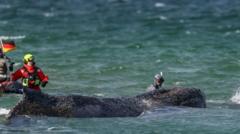
The recent sight of a humpback whale thrashing in the shallow, brackish waters of the German Baltic coast triggered a predictable media frenzy. Crowds gathered, cameras clicked, and a massive logistics operation swung into gear to guide the massive mammal back to the open sea. It was a victory for conservation, or so the headlines claimed. But for those of us who have spent years tracking the shifting health of our oceans, this "rescue" feels less like a triumph and more like a stay of execution.
The whale made it out. This time. But the narrative of a successful rescue obscures a much darker reality about why these giants are entering the Baltic Sea in the first place and the physiological toll of "saving" them. You might also find this similar coverage interesting: The $2 Billion Pause and the High Stakes of Silence.
The Shallow End of the Pool
The Baltic Sea is essentially a giant, low-salinity bathtub with a very narrow drain. For a humpback whale, an animal built for the crushing depths and high salt content of the Atlantic, entering this environment is a biological nightmare. Most casual observers see a majestic creature on a detour. An industry analyst sees a navigation error caused by environmental stressors that are becoming the new baseline.
Humpbacks rely on sophisticated acoustic mapping to navigate. The Baltic is one of the loudest, most congested maritime corridors on the planet. Between the constant thrum of container ships, the construction of offshore wind farms, and military sonar exercises, the acoustic "visibility" for a whale drops to near zero. When a whale ends up in the shallows off the German coast, it isn't exploring. It is lost, disoriented, and likely deafened by the industrial cacophony. As discussed in recent reports by Reuters, the results are notable.
The German rescue teams, comprised of police, fire departments, and marine biologists, used small boats to "nudge" the whale toward deeper water. While the optics are heartwarming, the mechanical reality of the operation is brutal. Every minute a whale spends in shallow water, its own body mass begins to crush its internal organs. Buoyancy is not just a convenience for a whale; it is a life-support system. In the shallows, gravity becomes a slow-motion killer.
The Low Salinity Crisis
Water density plays a critical role in how these animals move and breathe. The Baltic Sea has a significantly lower salt concentration than the Atlantic Ocean. This means the water is less dense. For a whale, swimming in the Baltic is like a human trying to run through waist-deep mud compared to a clear track.
They have to work twice as hard to stay afloat. This leads to rapid exhaustion and a spike in body temperature. If the animal is already stressed by noise and lack of food—since the Baltic does not provide the massive quantities of krill or small schooling fish a humpback requires—the rescue becomes a race against metabolic collapse. We celebrate when they cross the invisible line back into the North Sea, but we rarely talk about the permanent muscle damage or the long-term effects of lactic acid buildup in their tissues during the struggle.
Biological Costs of Displacement
| Factor | Open Atlantic Environment | Baltic Coastal Environment | Impact on Whale |
|---|---|---|---|
| Salinity | 35 parts per thousand | 7-10 parts per thousand | Loss of buoyancy, increased energy expenditure |
| Acoustic Profile | Low-frequency ambient noise | High-density industrial/military noise | Severe navigational disorientation |
| Food Supply | High-density prey patches | Minimal/Incompatible prey | Rapid depletion of blubber reserves |
| Depth | 2,000m+ average | 10-20m near coast | Internal organ compression from body weight |
The Infrastructure Conflict
We are currently witnessing a massive push for green energy in the Baltic, specifically through the expansion of offshore wind. This is necessary for the energy transition, but we must be honest about the trade-offs. The percussion drilling required to seat these turbines creates underwater shockwaves that can be felt for miles. For a whale, these sounds aren't just annoying; they are physically painful.
Germany has implemented "bubble curtains"—walls of rising air bubbles designed to dampen sound—but their effectiveness is debated among marine acoustic specialists. If the "rescue" efforts of today are meant to be more than a PR exercise, the maritime industry needs to acknowledge that our presence has turned the Baltic into a gauntlet.
There is also the matter of the "rescue" itself. In many cases, human intervention can actually prolong the suffering of an animal that is already dying from underlying sickness or age. We have a deep-seated psychological need to "save" the whale because it makes us feel like we are compensating for the damage we do to the ecosystem. Sometimes, the most humane action is to monitor and stay back, rather than forcing an exhausted animal into another 50 miles of swimming that its heart cannot sustain.
The Problem With Success Stories
The danger of the "whale swims to freedom" headline is that it creates a false sense of security. It suggests that as long as we have enough boats and dedicated volunteers, the system is working. It isn't. The frequency of large cetaceans entering the Baltic is increasing, and that is a symptom of a broken migratory pattern.
Changing ocean temperatures are pushing prey further north and east, drawing whales into pockets of the ocean that were historically avoided. When they hit the narrow straits of Denmark and enter the Baltic, they are entering a dead-end street.
The German authorities did everything right according to the standard operating procedure. They kept the public back, they coordinated with scientists, and they used non-invasive herding techniques. But until we address the industrial noise and the shifting thermal boundaries of the North Atlantic, these rescues will become more frequent, more expensive, and less successful.
Hard Decisions on the Coastline
If we want to actually protect these animals, we have to look beyond the immediate drama of a rescue. This means establishing "quiet zones" where maritime traffic is strictly limited during peak migration months. It means reconsidering the pace of offshore construction. Most importantly, it means accepting that we cannot save every animal that wanders into our backyard.
The next time a whale appears on the German coast, don't just look at the boats and the splash of the tail. Look at the water. Notice the lack of space. Recognize that the "freedom" we are herding them toward is an ocean that is becoming increasingly hostile to their survival.
We need to stop treating marine rescues as feel-good local news and start treating them as emergency alarms for a maritime infrastructure that is fundamentally at odds with biology.
Would you like me to analyze the specific underwater acoustic regulations currently in place for the Baltic Sea to see if they meet the threshold for protecting large mammals?