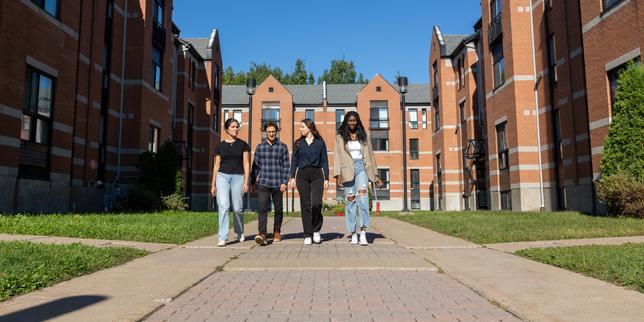
Walk into any university corridor in Canada right now and you will hear a specific kind of silence. It isn’t the studious quiet of a library or the restful pause of reading week. It is the sound of an exhale—long, shaky, and full of dread. For years, the red-brick walls of our institutions were held together by more than just mortar. They were fortified by a global dream. Students from Chandigarh, Lagos, and Guangzhou didn't just bring their tuition; they brought the literal future of the Canadian academic model in their suitcases.
Now, that dream is being packed away.
Consider a hypothetical student named Arjun. He is nineteen, sitting in a cold room in a suburb of Delhi, staring at a laptop screen. For three years, his family saved every rupee. They viewed a Canadian degree not just as an education, but as a golden ticket to a stable life. But as he reads the latest news about housing caps, permit restrictions, and the sudden, sharp cooling of the Canadian welcome mat, he closes the laptop. He starts looking at Germany. He looks at Australia. He looks away from us.
When Arjun decides not to come, the impact isn't just a missing name on a specialized roster. It is a structural failure that ripples through the entire economy of a small college town.
The Math of a Broken Promise
For decades, the Canadian government encouraged universities to operate like businesses while simultaneously tightening the taps on provincial funding. It was a clever shell game. To keep tuition low for domestic students, schools leaned heavily on international recruits who paid three, four, or five times the standard rate. We built a system where the local philosophy major was essentially subsidized by the international business student.
It worked. Until it didn't.
The numbers are stark. Recent policy shifts aimed at curbing the housing crisis have led to a massive reduction in study permits. In some provinces, the intake is projected to drop by half. For a mid-sized university, that represents a sudden, catastrophic hole in the budget. We are talking about tens of millions of dollars vanishing in a single fiscal year.
But talk of "revenue streams" and "fiscal gaps" is too sterile. It ignores the human cost of the budget cut. When the money disappears, the first things to go are the things that make a university a community. The mental health counselor’s position isn't renewed. The late-night library hours are trimmed. The specialized lab equipment stays broken for another semester. The "business" of education begins to cannibalize the "quality" of education.
The Invisible Migration
We often treat international students as a monolith—a data point in a migration statistic. But look closer at the labs where groundbreaking cancer research is happening. Look at the teaching assistants who stay late to help a struggling freshman understand organic chemistry. Look at the tech startups in Waterloo or the clinics in rural Nova Scotia.
A huge percentage of that talent arrived on a student visa.
By making it harder for these students to stay, or by making them feel like they are merely "temporary residents" blamed for a national housing shortage, we are signaling a retreat. We are telling the world’s most ambitious young minds that our doors are only halfway open.
There is a particular kind of heartbreak in watching a professor realize their department might not survive the next five years. I spoke with a faculty member in the Maritimes who described the mood as "mournful." They aren't just worried about their paycheck. They are worried about the loss of perspective. A classroom filled only with people who grew up in the same three postal codes is a classroom that has stopped breathing. It becomes an echo chamber, devoid of the friction that sparks true innovation.
The Housing Scapegoat
The prevailing narrative suggests that by cutting student numbers, we suddenly solve the housing crisis. It’s a seductive, simple lie. If we remove the people, the houses will be affordable, right?
But the reality is far more tangled. International students didn't create the decades-long failure to build medium-density housing. They didn't invent the bureaucratic red tape that keeps new apartments from breaking ground. They are, however, an easy target. It is much simpler to deny a visa than it is to fix a broken zoning law.
While we point fingers at the "over-concentration" of students in Brampton or Surrey, we ignore the fact that these students are often the ones working the service jobs that keep those cities running. They are the delivery drivers, the kitchen staff, and the weekend cleaners. When they leave, the labor market doesn't just "tighten"—it bruises.
The Cultural Erosion
Education is Canada’s most successful export, but we’ve forgotten that it is a two-way street. When a student from Kenya spends four years in a small town in Saskatchewan, that town changes. The local grocery store starts carrying different spices. The local kids hear stories about a world they’ve never seen. The "other" becomes a neighbor.
If we continue on this path of drastic reduction without a secondary plan to fund our institutions, we are choosing a path of isolationism. We are deciding that the "Canadian experience" should be a gated community rather than an open forum.
The universities are scared because they know the math doesn't add up. You cannot cut your primary source of income by 35% and expect to provide the same level of service. You cannot tell the world you are closed for business and then wonder why the brightest minds are heading to the United States or the UK.
The Echo in the Hallway
The real tragedy isn't found in the spreadsheets or the policy papers. It’s found in the quiet moments on campus. It’s the empty chair in the senior seminar. It’s the research project that never got started because the lead student couldn't get their papers processed in time. It’s the sense that something vibrant and essential is being bled out of our culture in the name of a quick political fix.
We are currently watching the dismantling of a global reputation that took half a century to build. Once you tell a generation of students they aren't wanted, they don't forget it. They tell their siblings. They tell their friends. They post about it on social media.
The brand of "Welcome to Canada" is being replaced by "Closed for Renovations."
Tonight, in cities across the country, lights will stay off in student rentals. Budget committees will sit in windowless rooms, trying to figure out which programs to kill first. And somewhere, another student like Arjun is clicking "delete" on his application to a Canadian university. He isn't angry. He’s just disappointed. He expected more from us.
We should have expected more from ourselves.
The ink on the new regulations is dry, but the long-term impact is just beginning to soak in, leaving behind a stain that no amount of future rebranding will easily wash away.