An old man in Isfahan wakes up before the sun. His name is irrelevant for the sake of the geopolitics, but for the sake of the stone, he is everything. He walks to the Naqsh-e Jahan Square, not as a tourist, but as a witness. He watches the first light hit the turquoise tiles of the Shah Mosque. Those tiles have survived earthquakes. They have survived the slow erosion of time. They have survived the rise and fall of dynasties that thought they would last forever.
But they might not survive a Friday night in a situation room thousands of miles away. Recently making headlines in this space: Finland Is Not Keeping Calm And The West Is Misreading The Silence.
We talk about war in the language of "assets" and "targets." We map out coordinates. we calculate "collateral damage" as if it were a rounding error in a checkbook. But when the British Academy and the Council for British Research in the Levant recently issued a desperate warning, they weren't talking about silos or centrifuges. They were talking about the memory of our species.
The Geography of Ghost Stories
Iran is not just a country on a map. It is a palimpsest—a parchment that has been written on, erased, and rewritten for millennia. To drop a bomb on Iranian soil is not merely an act of modern kinetic warfare. It is an act of temporal vandalism. Further insights regarding the matter are detailed by The New York Times.
Imagine, for a moment, a hypothetical library containing the only copies of every book your ancestors ever wrote. Now imagine that library sits next to a guarded fence. If a fire starts, the books don't just burn; the very idea of where you came from turns to ash.
Scholars from the UK are currently sounding the alarm because the list of potential targets in a US-Israeli strike doesn’t just include military infrastructure. In the frantic, high-stakes game of deterrence, cultural heritage sites often find themselves in the crosshairs, either as accidental victims of proximity or as intentional targets meant to break the spirit of a nation.
We are talking about Persepolis.
Founded by Darius the Great around 518 BCE, Persepolis is the DNA of human governance. It is where the first declarations of human rights were etched into cylinders. It is a place where the stone bears the fingerprints of masons who died two and a half thousand years ago. If a bunker-buster hits a nearby facility, the seismic shock alone could shatter the Apadana Palace.
The stone doesn’t care about the ideology of the pilot. It just breaks.
The Invisible Threads of the Levant
There is a specific kind of silence that follows the destruction of a monument. It isn't the silence of peace; it’s the silence of an amputation.
I remember standing in a museum years ago, looking at a fragment of a frieze that had been rescued from a war zone. It was just a hand, carved in basalt, reaching for something that was no longer there. The rest of the body, the temple it belonged to, and the city that built it had been "neutralized."
The scholars warning us today—names like Dr. Bill Finlayson and Professor Dame Jane Francis—aren't just academics in ivory towers. They are curators of the human story. When they write letters to the UK Prime Minister, they are asking a question that we are often too afraid to face: What is left when the dust settles?
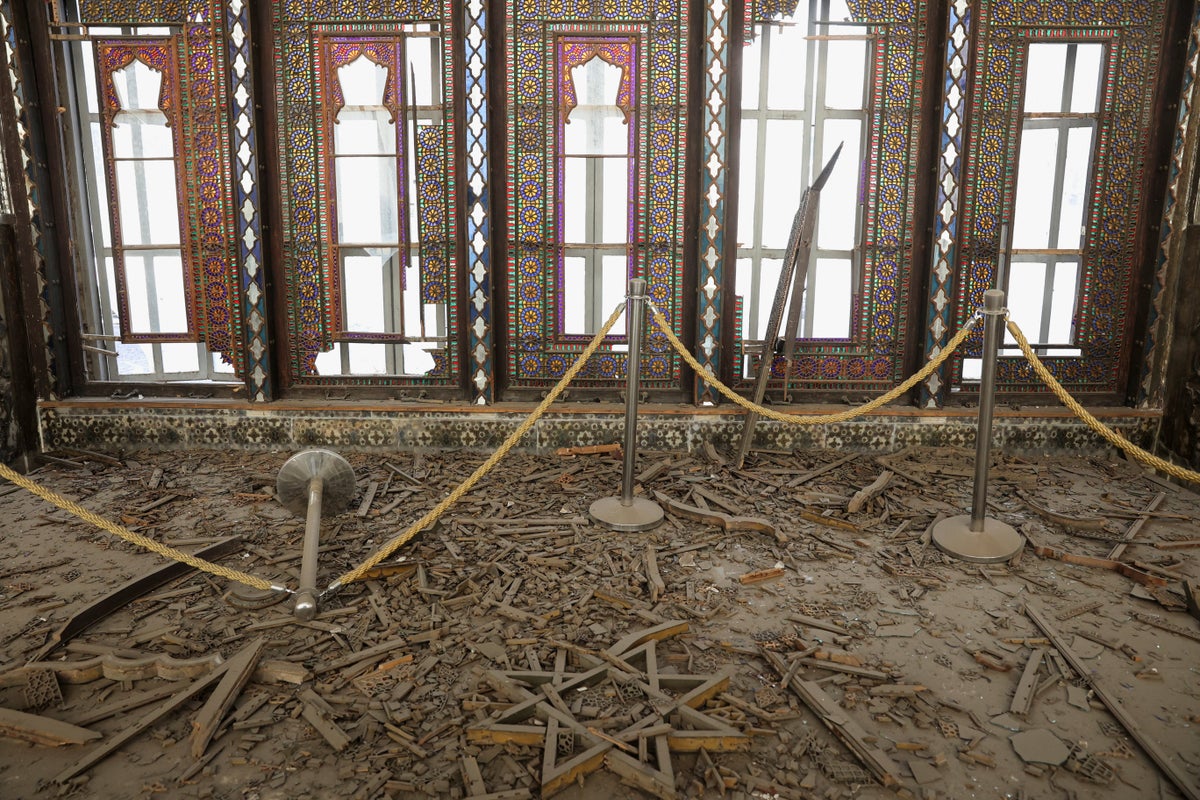
If we lose the sites in Iran, from the ancient ziggurats of Susa to the vibrant Golestan Palace in Tehran, we lose the map of how we became "us."
- The Tchogha Zanbil Ziggurat (13th Century BCE)
- The Shushtar Historical Hydraulic System
- The Bam Citadel
- The Tabriz Bazaar
These are not just names on a list. They are living systems. The Shushtar Hydraulic System is an ancient engineering marvel that still manages water for irrigation. To bomb it is to destroy the very food and water security of the people who live there now. It is to kill the present to punish the past.
The Psychology of Erasure
There is a psychological weight to this that goes beyond the physical stone. We rely on the past to orient ourselves in the present. We build our identities on the foundations laid by those who came before. When those foundations are systematically dismantled in a conflict, the displacement is not just physical—it is spiritual.
Consider a hypothetical mother in Yazd. Her city is one of the oldest in the world, built from sun-dried mud bricks and windcatchers that cool the desert air without a single watt of electricity. She takes her daughter to the Fire Temple. She tells her about the thousand-year-old flame. She is teaching her daughter that she is part of something eternal.
If that temple vanishes in a plume of smoke, the mother's lesson is undone. The message sent by the bomber is not "We are at war with your government." The message is "Your history does not matter. You do not exist beyond the present moment."
That is how you break a culture.
The Stakes of Silence
The UK academics' warning is more than a list of concerns. It is an indictment of our current approach to conflict.
International law—specifically the 1954 Hague Convention—theoretically protects cultural property during armed conflict. It mandates that parties must refrain from any act of hostility directed against such property. But treaties are paper. Missiles are steel.
The fear is that in the chaotic, split-second decisions of an escalation between the US, Israel, and Iran, these sites will be deemed acceptable losses. Or worse, their destruction will be framed as an unavoidable consequence of hitting a "legitimate" target.
We have seen this before. We saw it in Palmyra when ISIS systematically detonated temples. We saw it in the destruction of the Buddhas of Bamiyan. We saw it in the looting of the National Museum in Baghdad. Each time, we expressed "deep concern." Each time, the world grew a little smaller, a little more hollowed out.
But this time, it would be different. This wouldn't be the work of an extremist group in the shadows. This would be the calculated result of state-sponsored military strategy.
The Cost of a Clean Map
A war room map is clean. It’s a series of circles and squares on a screen. It doesn't show the texture of the turquoise glaze on a dome in Isfahan. It doesn't show the way the light filters through the stained glass of the Nasir al-Mulk Mosque in Shiraz, turning the floor into a kaleidoscope of red and gold.
It doesn't show the ghosts.
If we allow the destruction of Iran’s cultural heritage, we aren't just losing Iranian history. We are losing the history of the Silk Road. We are losing the history of the Achaemenid Empire, which once stretched from the Balkans to the Indus Valley. We are losing the bridge between East and West.
The scholars in London are screaming into the wind, hoping someone will listen before the first launch sequence begins. They know that once a site is gone, it is gone forever. You can rebuild a bridge. You can replace a power plant. You can even rebuild a city. But you cannot recreate a two-thousand-year-old soul.
Think back to the old man in Isfahan.
He stands in the square, watching the sky. He knows the news. He knows the threats. He looks at the mosque, a miracle of geometry and faith, and he sees more than stone. He sees the story of his people, written in a language that predates his own.
He sees us. All of us.
We are currently standing in a doorway. Behind us is a legacy that has survived the rise and fall of everything we thought was permanent. In front of us is the potential for a fire that leaves nothing but cinders.
The choice isn't just about politics or power. It’s about whether we want to be the generation that burned the library to the ground because we were angry at the librarian.
The stone is waiting. The sky is watching. And the dust of seven thousand years is already beginning to swirl.
Would you like me to create a detailed map showing the proximity of Iran's UNESCO World Heritage sites to its major urban centers?