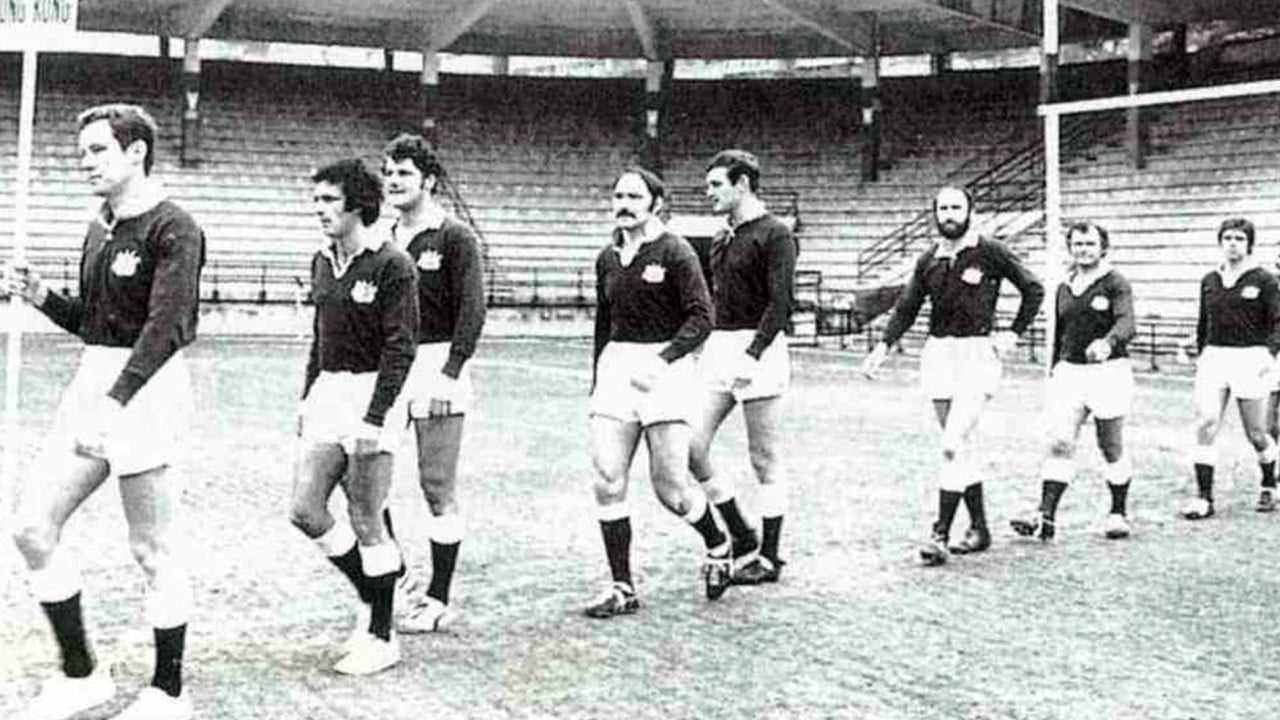
In 1976, the idea of professional rugby was a heresy that could get a player banned for life. The sport was a guarded fortress of amateurism, run by blazer-wearing traditionalists who viewed commercialism as a virus. Yet, on a humid spring afternoon at the Hong Kong Football Club, a group of ex-patriate businessmen and rugby obsessives ignored the status quo. They didn't just host a tournament; they built a prototype for the modern sports-entertainment complex.
The first Hong Kong Sevens wasn't born out of a pure love for the game. It was a calculated desperate move to save a flagging rugby union and put a tiny colonial outpost on the map of international commerce. While the SCMP archives might paint a nostalgic picture of local enthusiasts and friendly competition, the reality was a high-stakes play for influence in a region where the British Empire was beginning to see its sunset.
The Tobacco Money and the Amateur Shield
To understand how 1976 changed everything, you have to look at the money. Specifically, the Rothmans money. At a time when the International Rugby Board (IRB) treated sponsorship like a dirty secret, the Hong Kong organizers embraced it with both hands. They knew that flying twelve international teams to a remote corner of Asia required capital that the local union simply didn't have.
This was the first crack in the amateur wall. The organizers were largely expatriates working in the trading houses and banks of Hong Kong. They applied a mercantile logic to a sport that still clung to Victorian ideals. They didn't want a quiet club match; they wanted a spectacle. By securing a tobacco giant as a primary backer, they bypassed the stuffy fiscal constraints of the London rugby establishment.
It was a dangerous game. The IRB could have easily shut the whole thing down. But Hong Kong was far enough away from Twickenham to be ignored, until it became too big to suppress.
A Format Designed for Television Before It Had a Contract
The choice of Sevens was not accidental. Traditional 15-a-side rugby is a slow, grinding affair. It is hard to explain to a non-expert and even harder to market to a global audience with a short attention span. Sevens is different. It is fast. It is brutal. It ends in 15 minutes.
The 1976 tournament featured teams from South Korea, Japan, Fiji, and the Solomon Islands. This wasn't just about the rugby powerhouses; it was about regional dominance. By inviting Asian and Pacific nations, the organizers created a "World Cup" atmosphere years before the official Rugby World Cup even existed.
The sheer speed of the game allowed for a carnival atmosphere in the stands. This is where the "South Stand" culture began to take root, though in those early days, it was more about Gin and Tonics than fancy dress and beer snakes. The organizers realized that the product on the pitch was only 50 percent of the value. The other 50 percent was the networking in the VIP tents and the rowdy energy of the crowd.
The Fijian Catalyst
If one moment defined the 1976 tournament and ensured its survival, it was the arrival of the Fijians. Before this, Pacific Island rugby was largely a mystery to the Western world. When the Fijian team took the pitch at the Hong Kong Football Club, they didn't play the structured, rigid game favored by the British. They played a brand of "touch" rugby that was terrifyingly fast and incredibly fluid.
Fiji won that first tournament, beating Australia 24-12 in the final. But the scoreline mattered less than the style. They proved that Sevens was its own distinct discipline. They turned the tournament from a colonial social gathering into a legitimate sporting theater.
Suddenly, the world took notice. The "Hong Kong Model" showed that you could take a niche sport, add corporate backing, invite diverse international talent, and create a brand that people would travel across oceans to witness.
The Logistics of a Colonial Miracle
The technical execution of the 1976 Sevens was a nightmare of 1970s logistics. There were no digital booking systems or instant communications. The organizers relied on telex machines and personal favors from Cathay Pacific executives.
Participation Breakdown 1976
| Team | Region | Significance |
|---|---|---|
| Fiji | Pacific | Introduced the world to "Island Style" rugby |
| Australia | Oceania | Provided the necessary "Tier 1" credibility |
| South Korea | Asia | Proved the sport had growth potential in non-colonial markets |
| Hong Kong | Host | Used the event to bridge the gap between expats and locals |
The grass at the Football Club was not the manicured turf of modern stadiums. It was a patch of green surrounded by the towering concrete of a city that was rapidly expanding. Every time a player went into a tackle, they were doing so on a surface that was often more mud than grass. Yet, the grit of the environment added to the allure. It felt like an outpost. It felt like something new was being hammered out in the heat.
Why the IRB Hated Every Minute of It
For years after 1976, the rugby establishment in the UK and New Zealand looked at Hong Kong with suspicion. They saw the "Sevens" format as a circus act that threatened the purity of the 15-man game. More importantly, they were terrified of the "professional" vibe. Players in Hong Kong were treated like stars. They were given per diems that bordered on "payment for play"—a hanging offense in the 70s.
But the Hong Kong organizers had created something they couldn't stop. They had the money, they had the crowd, and they had the TV interest. By the early 80s, the Hong Kong Sevens was the most profitable rugby event in the world per square foot of stadium.
The tournament was a Trojan horse for professionalism. It proved that people would pay high ticket prices for rugby if the "event" was managed correctly. It forced the hand of the global unions, eventually leading to the professionalization of the sport in 1995. Without the 1976 experiment, rugby might still be a niche sport played in the muddy fields of the English Midlands rather than a global Olympic discipline.
The Myth of Local Integration
A common narrative in historical archives is that the Sevens "brought Hong Kong together." That is a romanticized half-truth. In 1976, the tournament was an unapologetically elite, expatriate affair. The local Cantonese population was largely indifferent to a game played by "Gweilos" (foreigners) chasing an oval ball in the heat.
The real "investigative" truth is that the Sevens served as a corporate playground for the "Hongs"—the great trading houses like Jardine Matheson and Swire. The tournament was a three-day boardroom. Deals were struck in the boxes while the players bled on the pitch. This corporate DNA is why the Sevens survived the 1997 handover when many other colonial institutions crumbled. The Chinese government recognized the tournament not as a British relic, but as a massive economic engine.
The Pivot Point of 1976
What makes the 1976 tournament a masterpiece of sports engineering was its timing. It happened just as global air travel was becoming accessible and just as television began looking for "color" content from exotic locations.
The organizers didn't just invite teams; they invited a lifestyle. They sold the idea that Hong Kong was the place where the East met the West for a party, and the rugby was the excuse. This was the "event-first" strategy that now dominates the world of Formula 1, the LIV Golf tour, and the modern NBA.
The brutal truth is that the rugby was secondary to the branding. If the first tournament had been a boring, 15-a-side match between two local clubs, it would have died in a year. Instead, they chose a format that emphasized speed, scoring, and star power.
The Unintended Legacy
When we look at the 1976 archive, we shouldn't see a quaint sports report. We should see the blueprint for the commercialization of the 21st century. The Hong Kong Sevens taught the world that you don't need a century of tradition to create a "major" event. You need a fast format, a willing corporate sponsor, and an atmosphere that makes the audience feel like they are part of something exclusive.
The 1976 tournament was the moment rugby lost its innocence and found its bank account. It was the day the sport realized it was an industry.
The next time you watch a Sevens match on a high-definition screen with gambling ads flashing on the perimeter boards, remember that it all started with a tobacco-funded gamble in a colonial backwater. The sport didn't just "foster" growth; it aggressively colonized the global sports calendar through sheer commercial willpower.
Go back and look at the photos of those 1976 players. They aren't just athletes; they are the unwitting pioneers of a multibillion-dollar shift in how we consume competition.
If you want to understand the modern sports economy, stop looking at the Super Bowl and start looking at what happened on that muddy field in Hong Kong fifty years ago.