The air in the Barclays Center usually carries a specific kind of New York chill, but tonight, it felt like a pressure cooker. You could see it in the way the sweat pooled on the hardwood and the way the lights reflected off the rim. On one end, LeBron James was putting on a clinic, a forty-year-old marvel defying time with a shooting display that felt less like basketball and more like a mathematical certainty. On the other, Luka Doncic was conducting an orchestra of chaos.
But the box score—Lakers 116, Nets 104—is a liar. It tells you who won the game, but it doesn't tell you who is losing the war.
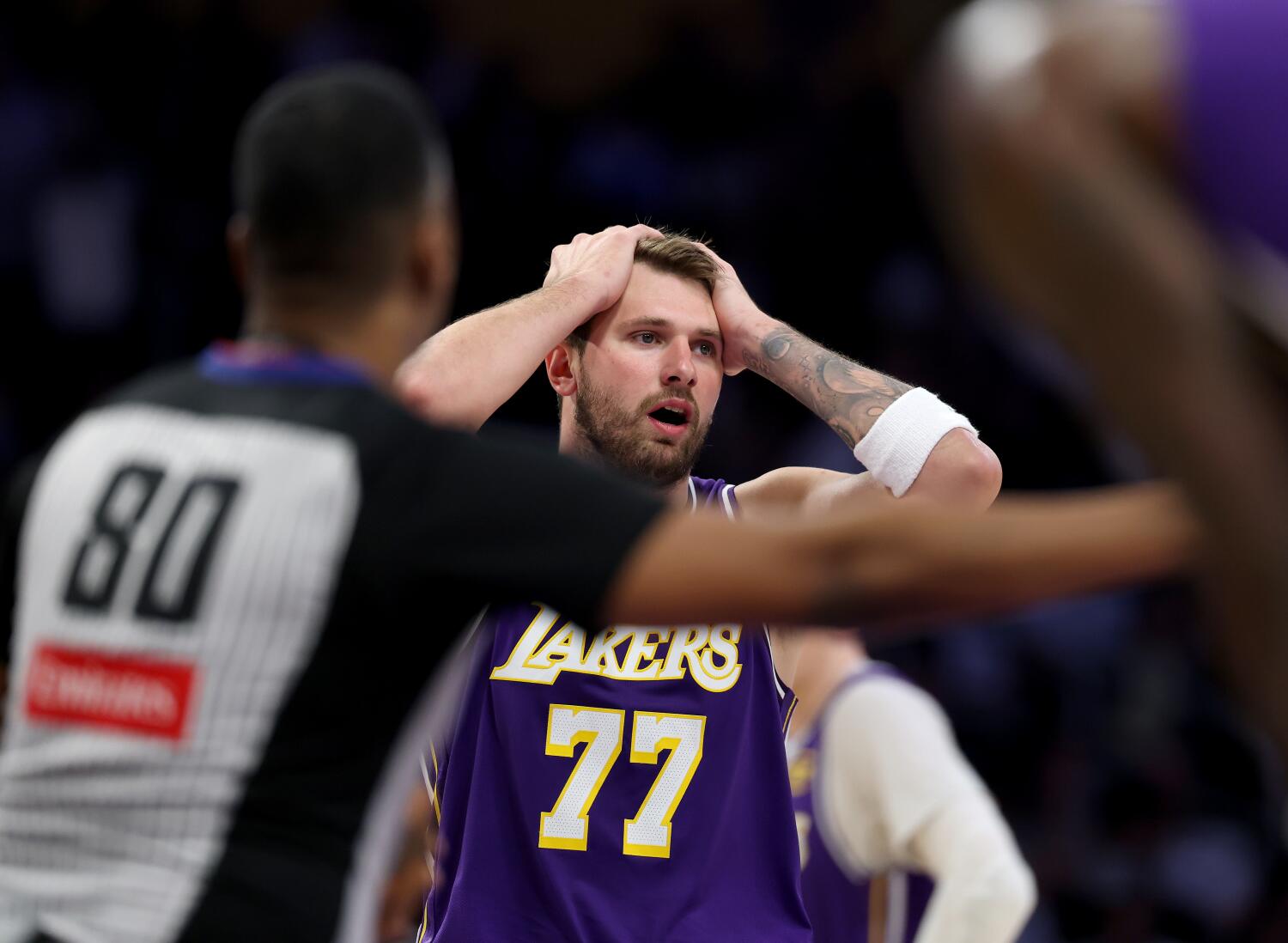
For Luka Doncic, the victory in Brooklyn was overshadowed by a short, sharp blast of a whistle in the second quarter. It wasn't for a foul. It wasn't for a travel. It was for a reaction. With that single puff of air from an official's lungs, Doncic earned his 16th technical foul of the season.
In the NBA, sixteen is a magic, miserable number. It is the threshold where the league decides that your passion has become a liability. It is the point where the jersey stays in the locker room, the shoes stay in the bag, and the superstar is forced to watch from the sidelines.
The Anatomy of a Technical
Imagine you are at the absolute peak of your craft. You are doing things with a leather ball that seem to violate the laws of physics. You are being poked, prodded, and hacked by elite athletes whose entire job is to stop you by any means necessary. You look for help from the three people in striped shirts who are paid to maintain order, and they see nothing.
The frustration doesn't start as a scream. It starts as a simmer. It’s a raised eyebrow. A sarcastic clap. A plea for logic in a game defined by split-second physical contact.
For Luka, the 16th technical came after he felt he was fouled on a drive. He didn't throw a punch. He didn't use profanity that would make a sailor blush. He simply didn't let it go. He followed the official, a shadow of discontent, demanding an explanation that was never going to come.
The whistle blew. The arena went quiet for a heartbeat.
This is the invisible tax on greatness. We demand that these players be fierce competitors, fueled by an obsessive need to win, yet we expect them to switch off that intensity the moment a call goes against them. It’s a psychological tightrope. If Luka doesn't care, he isn't Luka. If he cares too much, he’s suspended.
The LeBron Standard and the Luka Burden
While Luka was wrestling with his demons and the officiating crew, LeBron James was busy reminding the world why he is the gold standard for longevity. He finished with 40 points, hitting nine three-pointers on ten attempts. It was a masterclass in efficiency.
But watch LeBron closely. He talks to the refs constantly. He gestures. He grimaces. Yet, he rarely crosses that invisible line that leads to a league-mandated vacation. There is a diplomatic art to NBA stardom that LeBron mastered a decade ago. He treats the officials like partners in a high-stakes business negotiation.
Doncic is still in the "rebel" phase of his career. To him, every missed call is an injustice, a personal slight against the game he loves. He plays with his heart pinned to his sleeve, and sometimes, that sleeve gets caught in the gears of the league's disciplinary office.
Consider the stakes for the Dallas Mavericks. They are a team built entirely around the gravity of one man. When Luka is on the floor, the court opens up. Teammates who look like role players suddenly look like All-Stars because they are getting passes delivered with the precision of a laser-guided missile.
Take him away for even one game, and the entire structure collapses. The spacing vanishes. The confidence dips. The 16th technical isn't just a personal mistake; it's a hole in the hull of a ship trying to navigate the treacherous waters of the Western Conference playoff race.
The Human Cost of the "Crybaby" Narrative
It is easy to sit on a couch and call a multi-millionaire a "crybaby." It’s a convenient label. It fits in a tweet. It makes for a loud segment on a mid-day sports talk show.
But if you’ve ever been truly excellent at something—whether it’s carpentry, coding, or parenting—you know the white-hot rage that bubbles up when an outside force interferes with your excellence. Luka isn't complaining because he's spoiled. He’s complaining because he sees the game with a clarity that the officials, quite frankly, often lack.
He sees the foul before it happens. He feels the hip-check that the referee’s angle obscured. He is playing a game of four-dimensional chess, and he's being judged by people playing checkers.
The tragedy is that this narrative is starting to define him more than the step-back threes or the cross-court heaves. We are talking about his temper instead of his talent. We are counting his technicals instead of his triple-doubles.
The 16th technical is a mirror. It reflects a league that is increasingly obsessed with "optics" and a player who is fundamentally incapable of hiding his truth.
The Silence of the Suspension
Unless the league rescinds the technical—a rare act of mercy usually reserved for the most egregious of officiating errors—the Mavericks will have to face the music without their conductor.
There is a specific kind of quiet that haunts a practice facility when the star player isn't there. The ball doesn't pop the same way. The trash talk is muted. The coaches pace the sidelines with a bit more anxiety, clutching their clipboards like life rafts.
Luka will sit. He will likely be frustrated, perhaps even defiant. He might tell himself that he won't let it happen again, that he’ll keep his mouth shut and his hands down.
But then the game will start. Someone will grab his jersey. Someone will slap his wrist while he’s in the air. The referee will look the other way.
And the simmer will begin again.
The battle isn't really against the Lakers, the Nets, or the officiating crews. The battle is within Luka himself. It’s the struggle to balance the fire that makes him a god on the court with the cool-headedness required to stay on it.
The lights in Brooklyn dimmed as the crowds filed out, headed for the subways and the cold New York night. LeBron James walked off the floor a victor, his legacy further cemented in the history books. Luka Doncic walked off with a win in the column, but a weight on his shoulders.
He is the best show in basketball, a virtuoso who can turn a random Sunday night into a religious experience. But for one night, the show might be dark. The seat will be empty. And the only sound will be the echoes of a whistle that didn't need to be blown, for a frustration that couldn't be contained.
The game gives, and the game takes. Tonight, it took a little bit of the joy out of the win, leaving nothing but the cold, hard math of a sixteen-technical season.