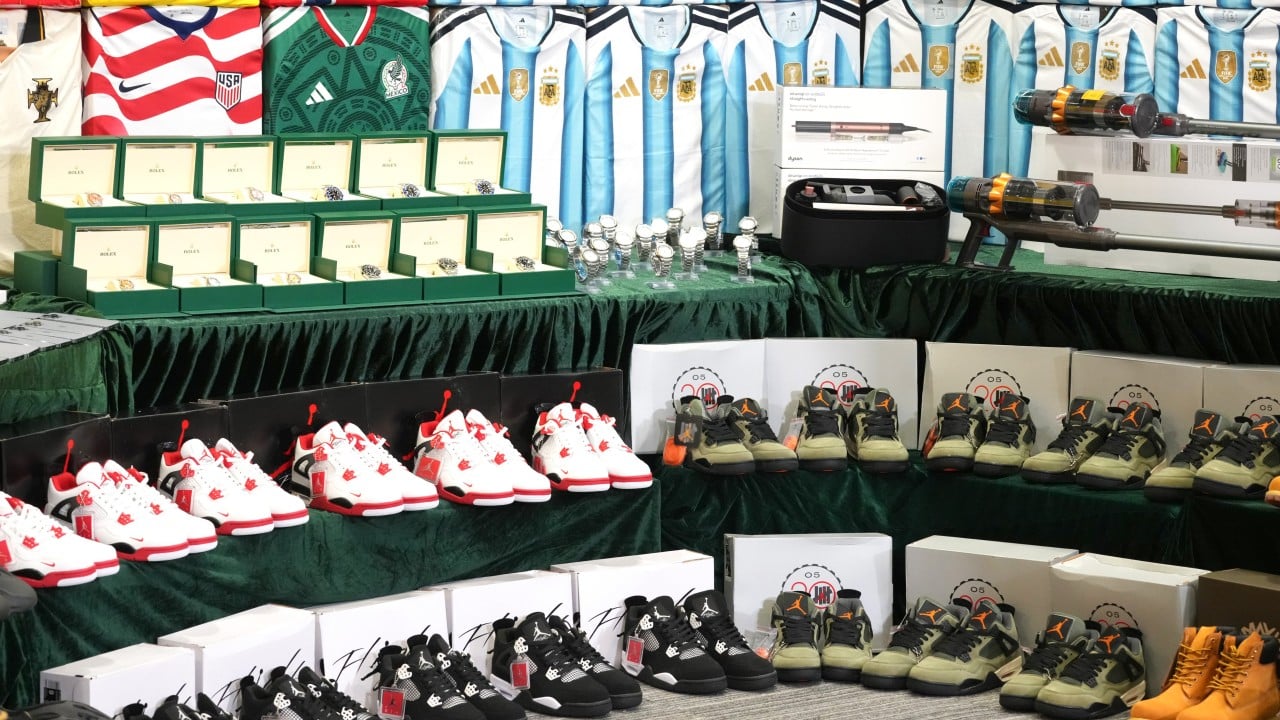
The seizure of 10,000 counterfeit football jerseys by Hong Kong Customs, valued at HK$64 million, represents more than a localized law enforcement victory; it serves as a high-fidelity data point for the surging unit economics of the "grey" and "black" sports apparel markets. This specific intervention highlights a sophisticated arbitrage model where counterfeiters exploit the extreme delta between the marginal cost of production and the retail price index (RPI) of authentic licensed merchandise.
To understand the mechanics of this HK$64 million valuation, one must analyze the convergence of high-frequency sports calendars—specifically the lead-up to major international tournaments—and the logistical bottlenecks inherent in global distribution hubs. The seizure reveals three distinct operational layers: the manufacturing arbitrage, the transshipment risk profile, and the digital storefront evasion tactics.
The Valuation Paradox: HK$6,400 per Unit
The most striking figure in the Hong Kong Customs data is the implied unit value. At HK$64 million for 10,000 items, the average value per jersey sits at approximately HK$6,400 (roughly US$820). This figure initially appears inflated relative to standard retail prices, which typically range from HK$600 to HK$1,200 for authentic kits. However, this discrepancy indicates that the seizure likely included "player version" premium kits, high-margin limited editions, and perhaps most importantly, a valuation based on the aggregate loss of brand equity and peripheral revenue rather than simple sticker price.
Customs departments often calculate "estimated market value" by factoring in the maximum potential retail price of the authentic equivalent. This creates a psychological and economic deterrent, but it also underscores the massive profit margins available to counterfeiters. If the manufacturing cost (COGS) of a high-quality "AAA" replica is estimated at US$5 to US$10, the ROI on a successfully smuggled unit sold at US$50 to US$100 exceeds 1,000%.
Structural Vulnerabilities in Global Transshipment
Hong Kong’s status as a premier logistics hub makes it a primary theater for these operations. The counterfeiters do not merely ship goods; they manage a complex risk-diversification portfolio.
- The Hub-and-Spoke Obfuscation: Goods are rarely shipped directly from the factory to the end consumer in high-risk jurisdictions. Instead, they move through intermediary hubs like Hong Kong to "wash" the origin of the bill of lading. This exploits the sheer volume of legitimate trade, where customs officials can only physically inspect a small percentage of containers based on risk-profiling algorithms.
- The Small-Parcel Proliferation: While this HK$64 million seizure targeted a large-scale shipment, the industry is shifting toward "micro-smuggling." By breaking down 10,000 jerseys into 5,000 individual postal packages, syndicates utilize de minimis value thresholds to bypass formal entry requirements. The large seizure suggests a failure in the syndicate’s risk-weighting—they prioritized the lower shipping costs of bulk freight over the safety of fragmented delivery.
- The Temporal Spike: Demand for sports apparel is cyclical and highly predictable. The timing of this seizure suggests a direct correlation with the ramp-up to the UEFA European Championship or similar high-visibility tournaments. Counterfeiters operate on a "Just-in-Time" (JIT) manufacturing schedule that mirrors the official sponsors, but without the constraints of licensing fees or ethical labor compliance.
The Technological Architecture of Market Evasion
The enforcement challenge is exacerbated by the evolution of the "Digital Counterfeit Ecosystem." This is no longer a matter of street-side stalls; it is an integrated software and logistics stack.
Algorithmic Marketing
Syndicates use social media metadata to target specific fanbases. If a football club announces a new signing, the counterfeit production cycle reacts within 48 to 72 hours. Digital ads are then served to users who have recently engaged with official club content. These ads often lead to "pop-up" e-commerce sites that exist for only 14 to 30 days—long enough to capture a wave of pre-orders, ship the goods (often from the seized batches in question), and disappear before trademark litigation can be filed.
Quality Convergence
The technical gap between authentic and "super-fake" merchandise has narrowed to the point of near-indistinguishability for the average consumer. Modern counterfeiters utilize similar synthetic polymers and heat-pressing technologies as official manufacturers. When the physical product parity is high, the brand's only remaining defense is the "aura" of authenticity and the ethical implications of the purchase—neither of which significantly deters the price-sensitive demographic that fuels the HK$64 million market.
The Economic Impact of Intellectual Property Dilution
The seizure of 10,000 units is a victory for the brand protection teams at Adidas, Nike, and Puma, but the broader economic implications are nuanced. Intellectual Property (IP) theft in the sports sector acts as a direct tax on innovation and sponsorship.
When counterfeit goods saturate a market, they create a "Price Anchor" effect. Consumers become accustomed to the US$30 price point for a jersey, making the US$120 official price seem like a predatory markup rather than a reflection of licensing costs, athlete endorsements, and R&D. This forces legitimate brands to increase their spend on anti-counterfeiting technologies (like RFID tags and holographic threads), which in turn pushes the retail price higher, inadvertently driving more consumers toward the counterfeit market. It is a feedback loop of value destruction.
Strategic Enforcement and the Limits of Seizures
While the HK$64 million seizure is significant, it represents a reactive strategy. To shift the equilibrium, enforcement must move from physical interception to financial and digital disruption.
- Financial De-platforming: The bottleneck for counterfeiters is not production, but payment processing. Most syndicates rely on mainstream credit card networks or digital wallets. Robust collaboration between customs and fintech firms to flag high-frequency, low-value transactions tied to known shipping hubs would be more effective than physical container inspections.
- Data-Driven Risk Profiling: Customs agencies must employ machine learning models that integrate sports league schedules, player transfer news, and shipping manifest anomalies to predict surge periods. A shipment of "polyester apparel" from a specific industrial zone in Southern China arriving three weeks before a major final should trigger an automatic red-flag status.
The HK$64 million seizure in Hong Kong is a diagnostic indicator of a thriving, resilient, and highly organized shadow economy. It proves that despite the rhetoric of "brand loyalty," the market is fundamentally driven by a cold calculation of price vs. perceived quality. Until the cost of risk for the smuggler (seizures, legal fees, loss of digital infrastructure) outweighs the 1,000% ROI, these shipments will continue to flow.
The strategic play for apparel giants is to shift their defense from the "product" to the "platform." Brands must integrate digital ownership—perhaps through blockchain-backed NFC chips embedded in the fabric—that provides utility the counterfeit cannot replicate, such as exclusive content, stadium access, or digital avatars. In a world where the physical product can be cloned, the value must reside in the un-clonable ecosystem surrounding it.