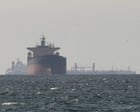
The United Kingdom’s proposal to host an international summit regarding the reopening and securing of the Strait of Hormuz is not a mere diplomatic gesture; it is a tactical response to a systemic failure in the global energy supply chain's primary choke point. At its narrowest, the Strait measures only 21 nautical miles, with shipping lanes reduced to two-mile-wide corridors. This geographic constraint creates a binary state for global markets: either the "Flow State" is maintained through high-cost naval deterrence, or the "Friction State" triggers an immediate, non-linear escalation in global oil prices and maritime insurance premiums.
The proposed summit aims to transition the current reactive security posture into a structured, multilateral framework. To understand the stakes, one must quantify the Strait's throughput. Approximately 20% of the world's total petroleum liquids—roughly 21 million barrels per day—pass through this corridor. The strategic objective is to decouple the physical security of these shipments from the fluctuating geopolitical tensions of the littoral states. Read more on a similar subject: this related article.
The Tripartite Architecture of Maritime Security
The success of any international agreement to secure the Strait depends on three distinct operational pillars. The UK's initiative must address these simultaneously to move beyond the superficiality of previous maritime coalitions.
1. The Deterrence Calculus
Naval presence in the Strait serves as a physical check against state-sponsored disruption. However, the cost function of maintaining a permanent carrier strike group or persistent destroyer patrols is immense. The summit must define a "Distributed Lethality" model where burden-sharing is proportional to a nation's energy import volume. This forces a shift from "Security Consumers" (nations that rely on the oil but provide no protection) to "Security Contributors." Further journalism by Associated Press highlights comparable perspectives on the subject.
2. Legal and Kinetic Rules of Engagement (ROE)
Ambiguity in international waters is a weapon. Current maritime law, under the UN Convention on the Law of the Sea (UNCLOS), provides the "Right of Innocent Passage," but this is frequently challenged by claims of environmental regulation or "security inspections" by regional actors. A primary output of the London summit must be a unified ROE that defines the exact threshold for kinetic intervention. Without a pre-defined trigger for response, the time-lag in decision-making becomes a tactical advantage for disruptors.
3. The Insurance and Risk Transference Layer
The real-world impact of a "closed" Strait is felt first in the London insurance markets. When the Joint War Committee (JWC) designates the Persian Gulf as a high-risk area, "War Risk" premiums can jump by 100% to 500% overnight. The UK, as the global hub for maritime insurance, is uniquely positioned to propose a "Sovereign Backstop" fund. This would involve participating nations pooling capital to underwrite shipping risks, effectively neutralizing the economic warfare of rising premiums.
Quantifying the Cost of Friction
When the Strait is threatened, the global economy enters a period of "Asymmetric Elasticity." While supply decreases linearly based on the number of blocked tankers, price increases are exponential due to speculative hedging.
- The Tanker Bottleneck: A standard Very Large Crude Carrier (VLCC) carries roughly 2 million barrels. If the Strait is blocked for 72 hours, the backlog of over 30 vessels creates a logistics "deadlock" that takes weeks to clear even after the passage is reopened.
- The LNG Dependency: Unlike oil, which can be drawn from Strategic Petroleum Reserves (SPRs), Liquefied Natural Gas (LNG) is a "just-in-time" commodity. Nations like Japan and South Korea rely on the Strait for nearly a third of their LNG. A disruption here creates an immediate energy deficit in the power grids of East Asia, for which there is no immediate substitute.
Technological Enablers of Open Passage
The UK proposal likely hinges on the deployment of advanced monitoring systems to replace the need for constant, visible hull-to-hull presence. This involves a shift toward an "Unmanned Security Mesh."
- Persistent ISR (Intelligence, Surveillance, Reconnaissance): Utilizing High-Altitude Long-Endurance (HALE) drones to provide 24/7 multispectral imagery of the shipping lanes. This creates a transparent operational environment where "dark ships"—vessels with disabled AIS (Automatic Identification System) transponders—are identified and tracked in real-time.
- Autonomous Mine Countermeasures (MCM): The greatest threat to the Strait is not a surface fleet, but the deployment of "dumb" bottom-moored mines. The summit should prioritize the standardization of autonomous underwater vehicles (AUVs) capable of rapid sweeping and neutralization without risking human crews.
- Cyber-Kinetic Hardening: Modern tankers are vulnerable to GPS spoofing and electronic interference. A multilateral agreement would include the establishment of terrestrial-based eLoran (Enhanced Long Range Navigation) stations to provide a non-satellite-dependent positioning backup for all commercial traffic in the region.
The Logic of the UK as Lead Facilitator
The UK’s role is not arbitrary. It is dictated by the intersection of three specific capabilities:
- Naval Heritage and Command Structure: The Royal Navy’s permanent presence in Bahrain (HMS Jufair) provides the localized command-and-control infrastructure necessary to coordinate a multi-flagged fleet.
- Maritime Law Hegemony: English law governs the vast majority of international shipping contracts. This gives the UK the legislative gravity to draft new protocols for "Escorted Passage" and "Neutrality Declarations."
- Intelligence Synthesis: Through the Five Eyes network, the UK can offer a level of signal intelligence and threat assessment that smaller regional powers cannot replicate, providing a "Common Operational Picture" to all summit participants.
Structural Barriers to Success
A rigorous analysis must acknowledge the "Free Rider" problem. Historically, the United States has shouldered the lion's share of Persian Gulf security. If the UK-led summit fails to secure binding financial or military commitments from major Asian energy consumers (China, India, Japan), the initiative will likely remain a toothless diplomatic exercise. Furthermore, the littoral states, particularly Iran, view internationalization of the Strait as an infringement on their sovereign territorial waters. Any security framework that does not account for the "Hybrid Warfare" tactics—such as the use of fast-attack craft and paramilitary boarding parties—will find itself obsolete upon the first encounter.
Strategic Action: The Multi-Tiered Escort Protocol
The most viable path forward for the summit is the implementation of a Multi-Tiered Escort Protocol (MTEP). This replaces the "all-or-nothing" approach to naval protection with a graduated response system:
- Tier 1: Continuous Surveillance: All participating nations fund a satellite and drone mesh that monitors every square meter of the Strait.
- Tier 2: Coordinated Transit: Commercial vessels are grouped into "convoys" during periods of heightened tension, reducing the surface area that naval assets must protect.
- Tier 3: Active Defense: In the event of an illegal boarding or kinetic strike, a pre-authorized "Rapid Response Task Force" is empowered to intervene under the aegis of the summit’s collective security agreement, bypassing the delay of UN Security Council deliberations.
Establishing this framework requires immediate technical integration of maritime data feeds between London, Manama, and Singapore. The summit's primary success metric will not be the signing of a communique, but the deployment of a unified, AI-driven traffic management system that treats the Strait of Hormuz as a global utility rather than a regional waterway.
Would you like me to generate a detailed risk assessment report for maritime insurers based on these proposed Tier 1-3 security protocols?