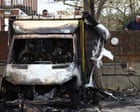
Geopolitics has become the ultimate crutch for lazy journalism. When a community-led ambulance gets vandalized in Golders Green, the immediate instinct is to draw a straight line to a map of the Middle East. It is a seductive narrative. It feels sophisticated. It suggests a high-level espionage thriller playing out on the streets of North London. It is also, in most cases, a total fantasy that ignores the messy, ground-level reality of modern radicalization and digital echo chambers.
Linking an isolated act of property damage to a state-sponsored hit squad in Tehran is a massive leap across a canyon of missing evidence. I have spent years tracking how small-scale street violence is reported versus how it is actually organized. The gap is widening. We are currently obsessed with "state actors" because it provides a clear enemy and a coherent story. The truth is far more chaotic, decentralized, and harder to solve.
The Myth of the Puppet Master
The prevailing consensus suggests that every act of antisemitism or civil unrest is part of a coordinated "hybrid warfare" strategy directed by a foreign intelligence agency. This "Tangled Trail" logic assumes a level of logistical competence and risk-to-reward calculation that simply does not exist for an ambulance attack.
Ask yourself: Why would a sovereign state, already under crippling sanctions and intense international scrutiny, burn a high-value asset or risk a diplomatic firestorm to spray-paint a vehicle or smash a window?
The Calculus of State Terror
- Asset Conservation: Intelligence assets are expensive and difficult to place. You do not use them for petty vandalism.
- Deniability: While "plausible deniability" is a goal, the current rhetoric suggests the trail is so "obvious" that a journalist can follow it. If a journalist can find it, MI5 found it six months ago. If it were a state operation, you wouldn't see the trail.
- Strategic Impact: Vandalizing an ambulance in a Jewish neighborhood does nothing to shift the needle on regional power. It is a tactical zero.
We are mistaking alignment for assignment. Just because a group’s actions benefit a foreign power’s narrative doesn’t mean that power signed the paycheck.
The Algorithm is Your Real Iranian General
The "lazy consensus" ignores the most potent weapon in the room: the algorithmic feedback loop. You do not need a handler in a dark room in Tehran to radicalize a 19-year-old in London. You only need a smartphone and a few hours of unchecked scrolling.
We are seeing the rise of Stochastic Terrorism. This isn't a top-down command structure. It is a bottom-up surge. A foreign state might pump inflammatory content into the digital ether—a process that is cheap, automated, and safe—but the individuals who act on it are usually "self-starters." They are local actors fueled by local grievances, hyper-charged by a global digital war.
When we blame Tehran, we give the local perpetrators a pass. We treat them as brainwashed drones rather than individuals making a choice. More importantly, we ignore the failure of local integration and domestic policing. If you blame a foreign ghost for every broken window, you never have to fix the cracks in your own sidewalk.
Follow the Money (Or the Lack of It)
In every investigation I have been part of, the "tangled trail" usually ends at a prepaid SIM card and a Telegram group with twelve members. Real state-sponsored operations, like the 2012 Burgas bus bombing, involve complex logistics, forged documents, and sophisticated explosives.
An attack on a Golders Green ambulance lacks the "signature" of professional intelligence work. It has the signature of a hate crime. There is a fundamental difference between a Geopolitical Operation and a Social Breakdown.
Distinguishing Signs
- Professional Ops: High lethality, clean exit, specific strategic target, minimal digital footprint.
- Amateur Hate Crimes: High visibility, messy execution, symbolic target, massive digital trail.
Calling this a Tehran-led operation isn't just a stretch; it's a dangerous distraction. It encourages the government to look outward at borders and embassies when they should be looking inward at the radicalization happening in suburban bedrooms.
The Danger of the "Great Game" Lens
Journalists love the "Great Game." They love casting London as a chessboard for global powers. It sells subscriptions. It makes the mundane feel epic. But this lens has a high cost.
When we frame local antisemitism as purely a product of foreign interference, we stop asking why that interference is finding such fertile soil in the UK. We stop looking at the education system, the failure of hate-speech moderation on platforms like X and Telegram, and the increasingly polarized political climate.
I have watched organizations blow millions on "threat intelligence" that monitors foreign state media while ignoring the fact that their own employees are being radicalized by TikTok influencers. We are looking for a sophisticated James Bond villain when the threat is actually a bored, angry neighbor with a can of spray paint and a curated feed.
Stop Asking "Who Sent Them?"
The question "Who sent them?" is the wrong starting point. It assumes there is a "Who."
The better question is: "What environment made this act feel permissible, even virtuous, to the person doing it?"
If you want to protect Golders Green—or any other community—you don't do it by posturing against Iran. You do it by:
- Dismantling the digital silos that allow hate to ferment without contradiction.
- Increasing local, visible policing that treats property damage as a precursor to violence, not a secondary concern.
- Refusing to globalize local crimes. By making every incident a chapter in a Middle Eastern war, we validate the perpetrator's worldview that they are "soldiers" in a grand cause.
We are feeding the ego of the vandal by calling him an agent of a foreign power. He isn't a soldier. He’s a criminal.
The trail doesn't lead to Tehran. It leads to a failure of domestic social cohesion and a terrifyingly efficient digital radicalization machine that doesn't need a single order from a foreign capital to function.
Stop looking for the puppet master. The puppets have learned to move on their own.
Would you like me to analyze the specific digital signatures typically found in these localized radicalization events?