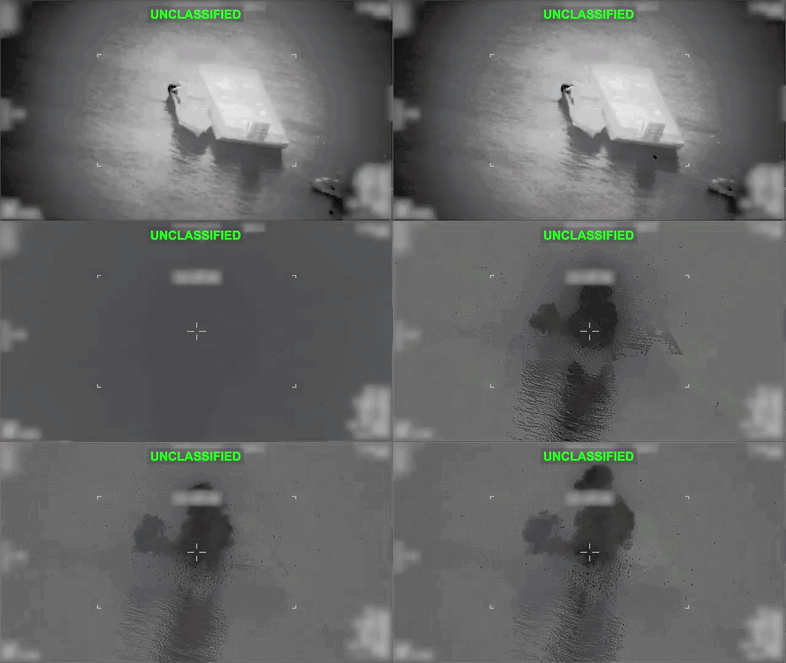
The headlines are screaming about fire on the water. A few minelaying boats caught a Hellfire missile near the Strait of Hormuz, and suddenly every "geopolitical analyst" on your feed is predicting a global energy collapse. They want you to believe we are one skirmish away from $200 barrels and a return to the 1970s.
They are wrong.
This isn't a prelude to World War III. It is theater. High-stakes, expensive, and violent theater, but theater nonetheless. If you are making investment or policy decisions based on the assumption that tactical kinetic strikes in the Persian Gulf dictate the long-term energy reality of the West, you are playing a game that ended a decade ago.
The media focuses on the "chokepoint." I focus on the redundancy. The common consensus—the "lazy consensus"—is that the Strait of Hormuz is the jugular of the global economy. Cut it, and the world bleeds out. This premise is built on outdated logistics and a fundamental misunderstanding of how modern energy markets absorb shocks.
The Myth of the Fragile Chokepoint
Every time a boat blows up in the Gulf, the Brent crude ticker jumps for forty-eight hours. Then it settles. Why? Because the market knows what the pundits ignore: physical disruption is no longer a permanent state of affairs.
We are told that 20% of the world's oil passes through that narrow strip of water. That sounds terrifying until you look at the map of pipelines that bypass the Strait entirely. Saudi Arabia’s East-West Pipeline and the Abu Dhabi Crude Oil Pipeline can move millions of barrels per day directly to the Red Sea or the Gulf of Oman.
The "chokepoint" has a bypass. It’s like panicking about a bridge being out when there is a six-lane tunnel three miles away.
Furthermore, the nature of minelaying has changed. In the 1980s "Tanker War," primitive mines were a legitimate existential threat to shipping. Today, we have autonomous underwater vehicles (AUVs) and high-resolution sonar that can clear a shipping lane in a fraction of the time it took forty years ago. When the US "blows up" minelaying boats, they aren't just neutralizing a physical threat; they are performing a calibration exercise for their sensor nets.
Kinetic Energy is a Lagging Indicator
I have sat in rooms with energy traders who don't even look up from their lunch when a "breaking news" alert about a Gulf skirmish hits the wire. They know the math.
The math says that global inventories are high, US shale is a monster that cannot be easily tamed, and demand in China is no longer the bottomless pit it once was. You can sink ten minelayers tomorrow, and the global supply-demand balance won't shift by a single percentage point.
The real conflict isn't happening in the water; it's happening in the credit markets and the insurance premiums. When a boat explodes, the winner isn't the guy with the missile. The winner is the insurance underwriter who gets to hike rates on "war risk" for the next six months.
If you want to understand the tension in the Middle East, stop looking at the Navy. Look at the Lloyd’s of London rate sheets. That is where the actual damage is done.
The Capability Gap Nobody Mentions
There is a polite fiction in international relations that these regional "asymmetric" threats are a peer-level challenge to Western naval power. Let’s dismantle that.
A minelaying boat is a low-tech solution to a high-tech problem. It is the maritime equivalent of an IED. While it can cause a localized tragedy, it cannot sustain a blockade. To actually close the Strait of Hormuz, an adversary would need to maintain total air and sea superiority against a carrier strike group.
They can't. Not for an hour, let alone a month.
Imagine a scenario where a regional power successfully seeds the entire channel with "smart" mines. Within 72 hours, the US Fifth Fleet and its allies would have established a "safe corridor" using mine-countermeasure (MCM) drones that operate with an efficiency that makes 20th-century sweepers look like rowboats.
The "threat" is marketed to the public to justify massive defense outlays and to the local populace to project strength. It is a ghost. We are fighting ghosts and paying for it in tax dollars and elevated pump prices that are driven more by fear-based speculation than actual scarcity.
The Problem with Your "People Also Ask" Queries
You might be asking: "Will oil prices double if the Strait of Hormuz closes?"
The answer is a brutal no.
Even in a worst-case, total-closure scenario, the Strategic Petroleum Reserve (SPR) and international equivalents exist specifically for this 1-in-100-year event. Moreover, the massive shift toward electrification and the diversification of energy sources (LNG, nuclear, renewables) has decoupled the "oil shock" from total economic collapse.
In 1973, an oil embargo was a heart attack. In 2026, a Strait closure is a severe migraine. It hurts, it slows you down, but it doesn’t kill you.
Another common question: "Is the US military presence in the Gulf still necessary?"
This is the wrong question. The presence isn't about protecting oil. It’s about protecting the petrodollar system. The US doesn't care if the oil flows to New Jersey; it cares that the oil is traded in Dollars. The moment that oil is traded in Yuan or Rubles, the naval presence becomes an expensive relic. The minelayers aren't a threat to the oil; they are a threat to the perception of American hegemony.
Why the "Conflicting Claims" Don't Matter
The competitor article spent 800 words agonizing over whether the boats were "actually" laying mines or just "patrolling."
Who cares?
In the logic of regional brinkmanship, the intent is the action. If you put a gun on the table during a negotiation, it doesn't matter if you intended to clean it or fire it. The gun is the message.
The US blowing up these boats is a response in the same dialect. It’s a "reply-all" email sent with high-explosives. When you see "conflicting claims," understand that both sides are lying to satisfy their domestic audiences.
- The US claims it "prevented an imminent threat" to justify the expenditure of million-dollar munitions.
- The regional power claims "unprovoked aggression" to rally nationalist fervor.
Both sides get what they want. The only loser is the observer who thinks this represents a shift in the global order.
Stop Watching the Horizon
If you want to know when the Middle East will actually explode, don't look at the Strait of Hormuz. Look at the internal stability of the petro-states.
The real danger isn't a mine hitting a tanker. It’s a fiscal crisis hitting a monarchy. When these countries can no longer afford to subsidize their populations because the "green transition" has permanently depressed the long-term value of their only asset, then you will see real chaos.
A boat blowing up is a tactical blip. A sovereign wealth fund running dry is a geopolitical earthquake.
Actionable Reality
Stop reacting to "Strait of Hormuz" headlines. They are the clickbait of the geopolitical world.
If you are a business leader, ignore the short-term volatility. Build your supply chains with the assumption that the Persian Gulf is a permanent theater of low-level, controlled conflict. It is a feature, not a bug, of the current system.
If you are an investor, look for the companies that provide the subsea tech and the autonomous clearing systems. They are the ones profiting from this cycle of "threat and response."
The boats will keep burning. The claims will keep conflicting. And the world will keep turning, fueled by oil that finds a way around the fire, every single time.
Stop falling for the theater. The "chokepoint" is a state of mind, not a geographical reality.