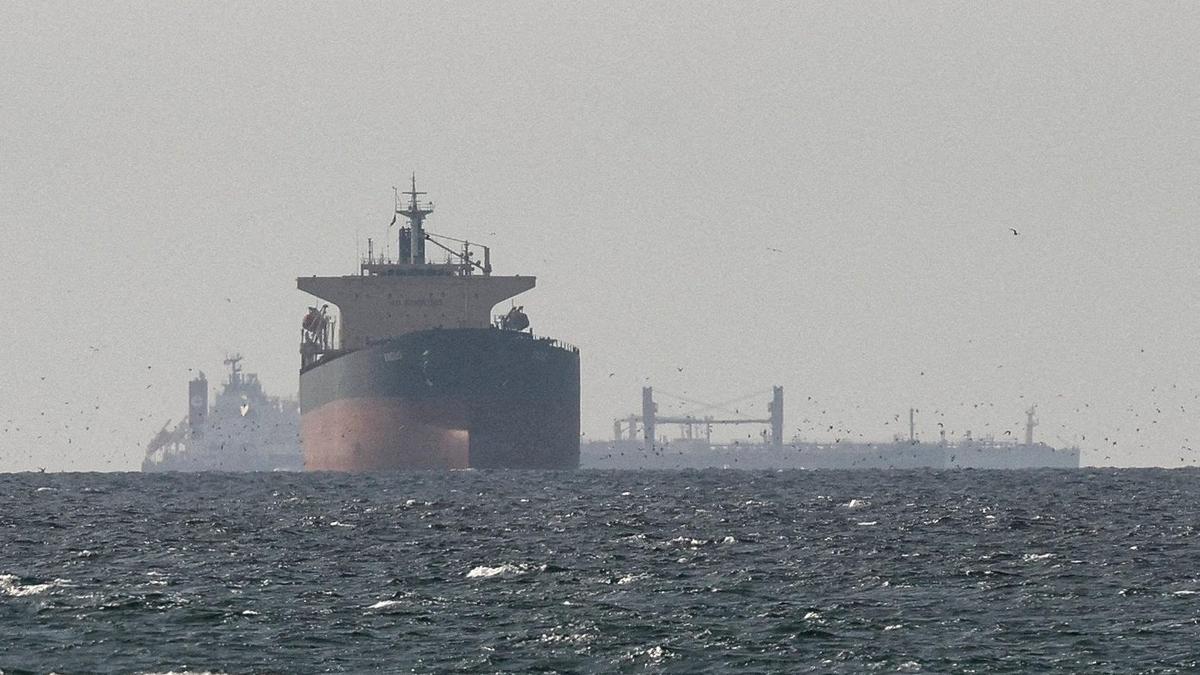
The steel hull of a modern container ship is a marvel of engineering, a floating city that carries the weight of a thousand shopping malls across the spine of the world. But when a Houthi ballistic missile tears through the salt air toward one of these giants, that steel feels as thin as parchment.
For decades, the Bab al-Mandab Strait was just another waypoint on a map. It was a chore for navigators, a narrow neck of water where the Red Sea meets the Gulf of Aden. Now, it is the site of a high-stakes poker game where the chips are global oil prices and the players are firing live ammunition. This isn't just another regional skirmish. It is the moment the shadow war between Iran and the West stepped into the light.
The Ghost in the Machine
Consider a sailor named Elias. He isn't a soldier. He’s a merchant mariner from the Philippines, sending money home to put his daughter through school. When the alarm bells scream in the middle of the night, Elias doesn't see a "geopolitical escalation." He sees a streak of light against a black sky.
The Houthis, a rebel group from the rugged mountains of Yemen, are using technology that was once the exclusive playground of superpowers. They aren't just firing "dumb" rockets. They are launching anti-ship ballistic missiles—weapons designed to hit a moving target in the middle of the ocean from hundreds of miles away. This level of sophistication doesn't happen in a vacuum. It requires satellite data, sophisticated radar, and high-level training.
The fingerprints on these weapons are distinct. While the Houthis pull the trigger, the technical DNA points directly back to Tehran. For years, Iran has operated through proxies, keeping its hands clean while influencing the region’s pulse. By providing the means for these attacks, Iran has effectively extended its borders to the very edge of the world's most vital shipping lanes.
The Invisible Thread
Most people living in London, New York, or Tokyo will never see the Red Sea. Yet, their lives are tethered to it by an invisible thread of logistics. When a missile forces a Maersk or Hapag-Lloyd vessel to turn around and sail thousands of miles around the Cape of Good Hope, the math changes instantly.
Fuel costs spike. Insurance premiums for "war risk" zones vanish into the stratosphere. Delivery dates for everything from semiconductors to seasonal avocados slip by weeks. It is a slow-motion heart attack for the global economy.
The real danger isn't just the explosion on the deck of a ship. It is the realization that the "Long Peace"—the era where the seas were guaranteed to be safe by a single dominant naval power—is over. We are entering a fractured age. In this new reality, a well-placed $50,000 drone or a $500,000 missile can hold a trillion-dollar economy hostage.
The Anatomy of an Escalation
To understand why this feels different, we have to look at the geometry of the conflict. In previous years, Houthi attacks were largely confined to the Saudi border. They were local. They were contained.
Now, the target is everyone.
By striking international shipping, the Houthis—and by extension, their Iranian benefactors—have internationalized the Yemen war. They have forced the United States and its allies into a defensive crouch. Operation Prosperity Guardian, the multinational naval coalition, is a massive undertaking. But there is an inherent asymmetry at play.
The U.S. Navy is firing million-dollar interceptor missiles to shoot down drones that cost as much as a used Honda Civic. You don't have to be a math genius to see that this is a losing game of attrition. The Houthis aren't trying to sink the entire U.S. fleet. They are trying to make the cost of staying in the Red Sea too high for the West to stomach.
The Human Cost of High Policy
Let's look at the hypothetical scenario of a port city in Europe. Let’s call it Rotterdam. If the Red Sea becomes a "no-go" zone permanently, the ripple effect isn't just a delay in Amazon packages. It is the shuttering of factories that rely on "just-in-time" parts. It is the rise in home heating oil costs during a bitter winter.
This is the psychological warfare of the missile. It creates a "serious" escalation because it proves that the geography of the modern world is fragile. We thought we had conquered distance. We thought the internet and fast ships had made the world a small, manageable place.
The Houthis have reminded us that the world is still vast, dangerous, and dependent on narrow chokepoints.
The Shadow of the Dragon
Behind the immediate fire and smoke lies the broader question of Iran's ultimate goal. This isn't just about Yemen, and it isn't just about the conflict in Gaza. It is about leverage.
By showing the world they can close the Red Sea, Iran is sending a message to the negotiating tables in Geneva and Washington. They are demonstrating that they have the "off switch" for a significant portion of the world's trade.
The technology being used—the Shahid drones, the repurposed ballistic missiles—acts as a force multiplier. It allows a relatively small group to project power far beyond their weight class. It’s a democratization of destruction.
The Sound of the Sea
If you stand on the deck of a ship in the middle of the night, the ocean is a place of profound silence. It is a space where the rules of the land are supposed to fade away.
But that silence is being replaced by the hum of surveillance drones and the distant thunder of interceptions. We are watching the birth of a new kind of warfare. It is a war of bits and bytes, of cheap sensors and expensive consequences.
The escalation isn't just about more missiles. It's about the collapse of certainty. When the captain of a vessel has to choose between a three-week detour and the risk of a fireball in the engine room, the system has already broken.
The world watches the screens, counting the missiles and tracking the tankers. We wait for a "de-escalation" that never seems to arrive. We hope for a return to the quiet, invisible logistics that keep our world running.
But the horizon tells a different story. The smoke rising from a burning hull in the Red Sea isn't just a signal of a regional war. It is a flare sent up to mark the end of the world as we knew it, a warning that the sea, once the highway of empires, has become a frontline once again.
Somewhere, a sailor like Elias is looking at a radar screen, watching a small green blip that shouldn't be there, wondering if the next sound he hears will be the wind or the end of the world.