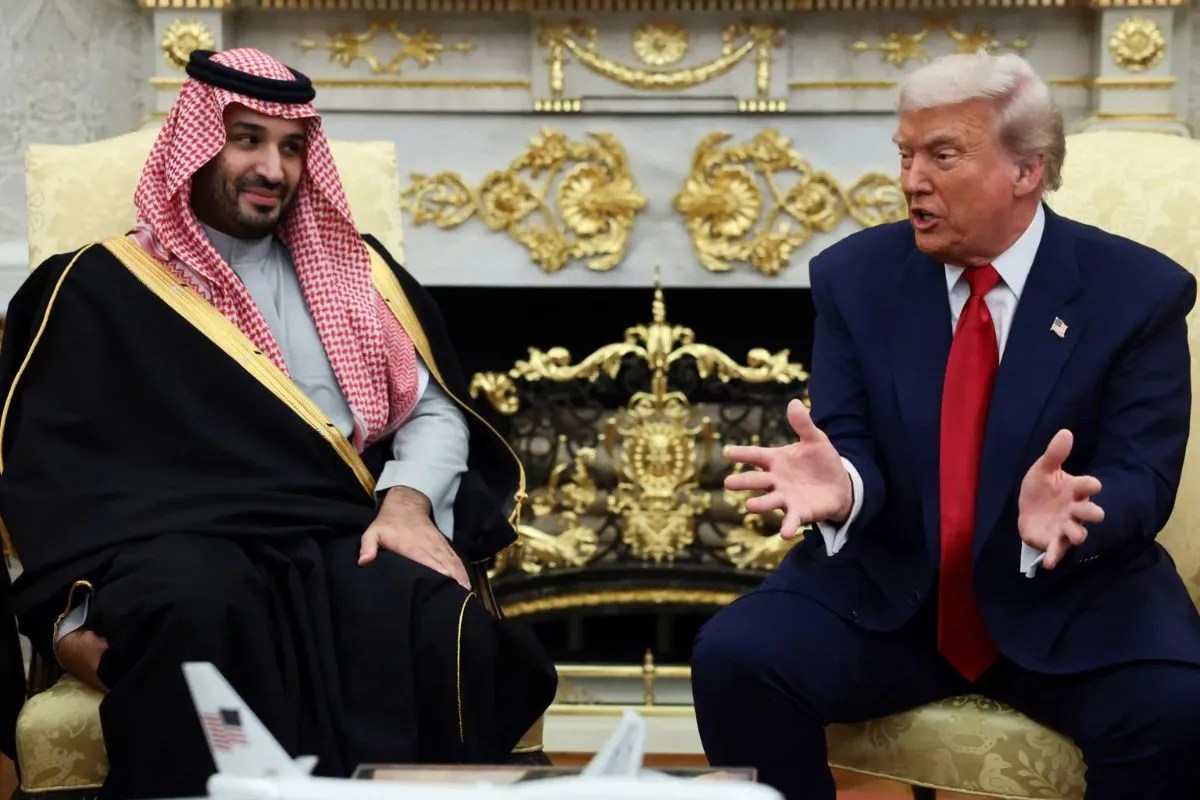
The geopolitical chessboard of the Middle East is shifting under the weight of a renewed and aggressive pact between Washington and Riyadh. While surface-level headlines suggest a simple brotherhood of arms against Iran, the reality is a high-stakes gamble involving global oil stability, billions in private defense contracts, and a fundamental restructuring of regional power. Donald Trump’s public praise for Saudi Arabia’s "warrior" spirit is not merely a diplomatic pleasantry. It is a calculated signal that the United States is willing to outsource significant portions of its regional enforcement to the House of Saud, provided the Kingdom maintains its role as a bulwark against Tehran’s expansionism. This alliance rests on a mutual necessity that ignores historical friction in favor of a singular, shared enemy.
The Architecture of a Managed Conflict
Washington has long sought a way to contain Iran without committing to another "forever war" in the sand. The solution has emerged in the form of a heavily subsidized Saudi military machine. By supplying advanced telemetry, intelligence sharing, and the latest in missile defense technology, the U.S. effectively turns the Kingdom into a forward operating base that requires minimal American boots on the ground. For Riyadh, this is the ultimate insurance policy. They are no longer just a customer of the American defense industry; they are the primary executioners of a strategy designed to cripple Iran’s "Shiite Crescent" influence.
However, this partnership is not without its internal contradictions. The Saudi military, despite its massive budget, has historically struggled with operational efficiency. Relying on Riyadh to lead a campaign against a battle-hardened and asymmetrical Iranian force is a risk that many in the Pentagon view with quiet skepticism. Iran does not fight traditional wars. They operate through proxies like Hezbollah and the Houthis, groups that have already proven they can bleed the Saudi treasury and military through low-cost, high-impact drone and missile strikes.
Oil as the Ultimate Deterrent
The heartbeat of this entire conflict remains the Strait of Hormuz. Roughly one-fifth of the world’s oil consumption passes through this narrow waterway. Iran knows this is their "nuclear option" without actually needing a nuclear tip on a missile. If a full-scale hot war erupts, the first casualty will be the global energy market. A Saudi-U.S. alliance must account for the fact that Tehran can effectively shut down the global economy by sinking a few tankers or mining the strait.
Riyadh’s willingness to step up as a "warrior" nation is tied directly to their Vision 2030 goals. They need a stable, high oil price to fund their massive domestic infrastructure projects, but they cannot afford a war that destroys their own production facilities. The 2019 attacks on Abqaiq and Khurais served as a brutal reminder of how vulnerable the Kingdom’s "crown jewels" are to Iranian technology. This new alignment with Trump suggests a belief that American "maximum pressure" will now include a more direct military umbrella, emboldening the Saudis to take risks they previously avoided.
The Proxy Battlefield and the Yemeni Complication
You cannot discuss the U.S.-Saudi stance on Iran without looking at Yemen. It has become the testing ground for this "warrior" ethos. For years, the Saudi-led coalition has attempted to dislodge Iranian-backed Houthi rebels with mixed success and significant international condemnation. The shift in rhetoric from Washington indicates a move away from humanitarian concerns and a return to cold, hard realism. In this framework, Yemen is simply the southern front of the Iranian war.
The strategic logic is simple: if the Saudis can break the Houthi movement, they sever Iran’s most potent arm on the Arabian Peninsula. Yet, the Houthis have shown a remarkable ability to adapt. They have transitioned from a ragtag militia to a force capable of launching precision strikes on Riyadh and Jeddah. This raises the question of whether the U.S. is backing a "warrior" or a stalemate. The infusion of American logistical support is intended to break this deadlock, but it also ties American prestige to a conflict that has no clear exit strategy.
Defense Contracts and the Economic Engine
Follow the money and you find the true glue of the U.S.-Saudi relationship. The Kingdom remains the largest foreign buyer of American arms. This isn't just about regional security; it's about jobs in Ohio, Pennsylvania, and Arizona. When the American administration praises Saudi Arabia, they are also validating a multi-billion dollar revenue stream for companies like Raytheon, Boeing, and Lockheed Martin.
- Integrated Air Defense: The primary focus is now on countering "suicide drones" and short-range ballistic missiles.
- Intelligence Integration: Saudi command centers are increasingly being linked with U.S. satellite data to provide real-time tracking of Iranian movements.
- Maritime Security: Joint patrols in the Red Sea are becoming the norm to protect trade routes from asymmetric threats.
This economic entanglement makes it nearly impossible for any future U.S. administration to pivot away from Riyadh without facing massive domestic pressure from the industrial base. It is a "lock-in" strategy that ensures the U.S. stays involved in the Middle East, even as leaders claim they want to focus on the Pacific.
Tehran's Counter-Move
Iran is not a passive observer in this developing alliance. Their strategy has always been one of "strategic patience" mixed with "calculated escalation." By strengthening ties with Russia and China, Tehran is building its own counter-bloc. The recent diplomatic thaws between Riyadh and Tehran—often brokered by Beijing—suggest that the Saudis are playing a double game. They want the American military guarantee, but they also want the Chinese economic partnership.
This creates a volatile three-way tension. If the U.S. pushes the Saudis too hard to escalate against Iran, Riyadh might pull back to protect its burgeoning relationship with China. Conversely, if Iran feels too squeezed by the U.S.-Saudi pincer, they may decide that a limited regional war is preferable to a slow economic death by sanctions. They have already demonstrated that they can strike with plausible deniability, a tactic that leaves the U.S. and Saudi Arabia grasping for a proportionate response that doesn't trigger a global depression.
The Intelligence Gap
One of the most overlooked factors in this "warrior" narrative is the quality of human intelligence on the ground. The U.S. has historically struggled to understand the internal dynamics of the Iranian Revolutionary Guard Corps (IRGC). Relying on Saudi intelligence carries its own set of biases. Riyadh often views Iranian moves through a sectarian lens, which can lead to miscalculating Tehran’s nationalist motivations.
A war based on flawed intelligence or over-eager reporting from a regional ally is a recipe for disaster. We saw this in Iraq, and the stakes in Iran are significantly higher. Iran’s geography alone—a mountainous fortress nearly four times the size of Iraq—makes any thought of conventional invasion a fantasy. The "war" being discussed is one of surgical strikes, cyber warfare, and economic strangulation. But as history teaches, surgical strikes rarely stay surgical. They bleed. They escalate.
The Role of the "Warrior" in Modern Conflict
What does it mean to be a "warrior" in 2026? It is no longer about cavalry charges or even traditional dogfights. It is about who controls the electromagnetic spectrum and who can sustain a campaign of attrition. Saudi Arabia has the hardware, but they lack the indigenous technical expertise to maintain these systems without Western contractors. This makes the "warrior" label more of a marketing term for a junior partner in a global security franchise.
The American administration’s embrace of this term is designed to build Saudi confidence and signal to Tehran that the "policeman of the Gulf" has returned. It is a psychological operation as much as a military one. By elevating Riyadh's status, the U.S. hopes to create a credible deterrent that prevents Iran from taking further aggressive steps in Lebanon, Syria, or Iraq.
The danger lies in the "warrior" taking the rhetoric too literally. If Riyadh believes they have a blank check from Washington, they may engage in provocations that the U.S. is not actually prepared to back with its own blood and treasure. The alliance is strong on paper and in the balance sheets of defense firms, but it remains untested in the face of a true, sustained Iranian offensive.
The next phase of this conflict will likely play out in the digital and maritime domains. Expect to see an uptick in "mysterious" explosions at Iranian industrial sites and an increase in intercepted shipments in the Arabian Sea. This is the new face of the war—a shadow conflict where the participants are praised in public but deny everything in private. The U.S. and Saudi Arabia have signaled their intent. Now, the world waits for Tehran’s response, knowing that in this game, a single miscalculation at the Strait of Hormuz could set the entire global economy on fire.
Audit the logistics, watch the carrier strike group movements, and monitor the price of Brent Crude. Those are the only metrics that matter in a region where words are cheap and oil is life.