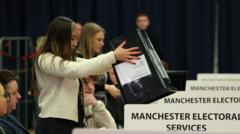
Investigations into recent by-election conduct have failed to produce credible evidence of "family voting," a term often used to describe a specific type of electoral fraud where one household member coerced or cast ballots for others. While the accusations often spark intense media cycles and localized panic, the data from polling stations and the oversight from independent observers tell a different story. The reality is that modern polling safeguards, ranging from individual identity verification to the physical layout of the voting booth, have made the coordinated hijacking of a household’s collective suffrage nearly impossible to execute without immediate detection.
The Mechanics of the Accusation
To understand why these claims persist, one must look at the cultural and political friction that usually precedes them. The "family voting" narrative typically surfaces in tight races where demographic shifts are visible. Critics often point to groups of voters arriving together—large families or neighbors—and equate communal transit with communal decision-making. This is a leap in logic that ignores the basic logistical reality of working-class or immigrant communities where shared transportation is a necessity rather than a conspiracy.
The legal definition of family voting is strict. It requires proof of coercion or the physical act of one person marking multiple ballots. Mere presence does not equal a violation. During the most recent by-election, observers noted several instances where elderly voters were assisted by younger relatives. In every audited case, this assistance was found to be within the bounds of the law, which allows for aid to those with disabilities or language barriers, provided the choice remains with the voter.
The Paper Trail and the Silent Witness
Electoral integrity rests on a foundation of paper and procedure. Every ballot issued is tracked against a specific name on the register. For a "family vote" to occur at scale, a single individual would need to bypass the clerk, the observer, and the presiding officer—not once, but several times.
The physical environment of the polling station is designed to be an antiseptic against influence. The voting booth is a solitary space. If a husband follows a wife into a booth, or a father attempts to shadow a daughter, the presiding officer is trained to intervene immediately. In the by-elections under scrutiny, the logs of these presiding officers show a remarkably low number of such interventions. When they did occur, they were recorded as "clerical corrections" rather than "fraudulent attempts."
The disconnect between public perception and the formal record usually stems from a misunderstanding of "undue influence." Influence happens at the kitchen table, weeks before the election. It happens through television screens and social media feeds. By the time a citizen enters the polling station, the law can only protect the physical act of the vote, not the psychological path taken to get there.
Why the Evidence Dissipates Under Scrutiny
When investigative bodies move in to verify claims of voting irregularities, they look for statistical anomalies. They look for "clumping"—patterns where specific households or blocks show 100% turnout with identical voting patterns in a way that defies probability. In the recent by-election, the turnout data followed a standard bell curve. There were no "ghost" precincts where every resident of a high-density apartment complex magically voted for the same underdog candidate.
The lack of evidence isn't a sign of a cover-up; it is a sign that the system is functioning. The "family voting" trope often functions as a dog whistle, used by losing campaigns to delegitimize the results without having to provide a shred of forensic proof. It relies on the assumption that certain voters lack the agency to think for themselves.
The Real Threats to the Ballot
While the public remains distracted by the specter of family coercion, more pressing vulnerabilities are often ignored. The focus on the physical polling station overlooks the rise of postal vote harvesting. This is a much harder area to police. When a ballot enters a private home, the "solitary booth" protection disappears.
- Voter Identification Laws: These are often framed as a solution to personation, yet they do nothing to address the issues within a private residence.
- Postal Ballot Security: The chain of custody for a mailed ballot is significantly more fragile than a ballot cast in person.
- Intimidation Outside the Perimeter: Groups hovering near the entrance of a polling station can create a "gauntlet" effect that influences a voter’s state of mind before they even reach the clerk.
These are the areas where election law actually struggles. The fixation on "family voting" at the booth is a hunt for a ghost that has already left the building.
The Cost of Unsubstantiated Claims
Every time a political operative or a media outlet pushes a narrative of fraud without evidence, the collateral damage is the public’s trust in the democratic process. This is not a harmless tactical maneuver. When voters believe the system is rigged by "blocks" of coerced individuals, they are less likely to participate themselves. This creates a self-fulfilling prophecy of disenfranchisement.
Data from the Electoral Commission and independent monitoring groups like Democracy Volunteers consistently show that the rate of proven voter personation is infinitesimally low. In the context of the recent by-election, the number of referred cases to the police was zero. Not a single person was charged. Not a single ballot was discarded for being cast under duress.
Strengthening the Infrastructure
If the goal is truly to ensure every vote is free and fair, the energy spent chasing family voting myths should be redirected toward voter education and polling staff training. Ensuring that every presiding officer has the confidence to enforce the "one person, one booth" rule is more effective than any inflammatory headline.
We also need to look at the transparency of the count. Allowing more citizen observers to witness the reconciliation of ballots ensures that the numbers leaving the station match the numbers entering the counting hall. This is where the real integrity lies—in the boring, technical details of logistics, not in the sensationalist claims of household conspiracies.
The by-election results stand because they were earned through the standard, messy, and ultimately secure process of modern democracy. The absence of evidence regarding family voting is not a failure of the investigation; it is a confirmation that the voter, however they arrived at the station, made their mark alone.
If you suspect an irregularity in a future contest, document the specific time, location, and individuals involved, and report it directly to the presiding officer on-site rather than venting on social platforms.