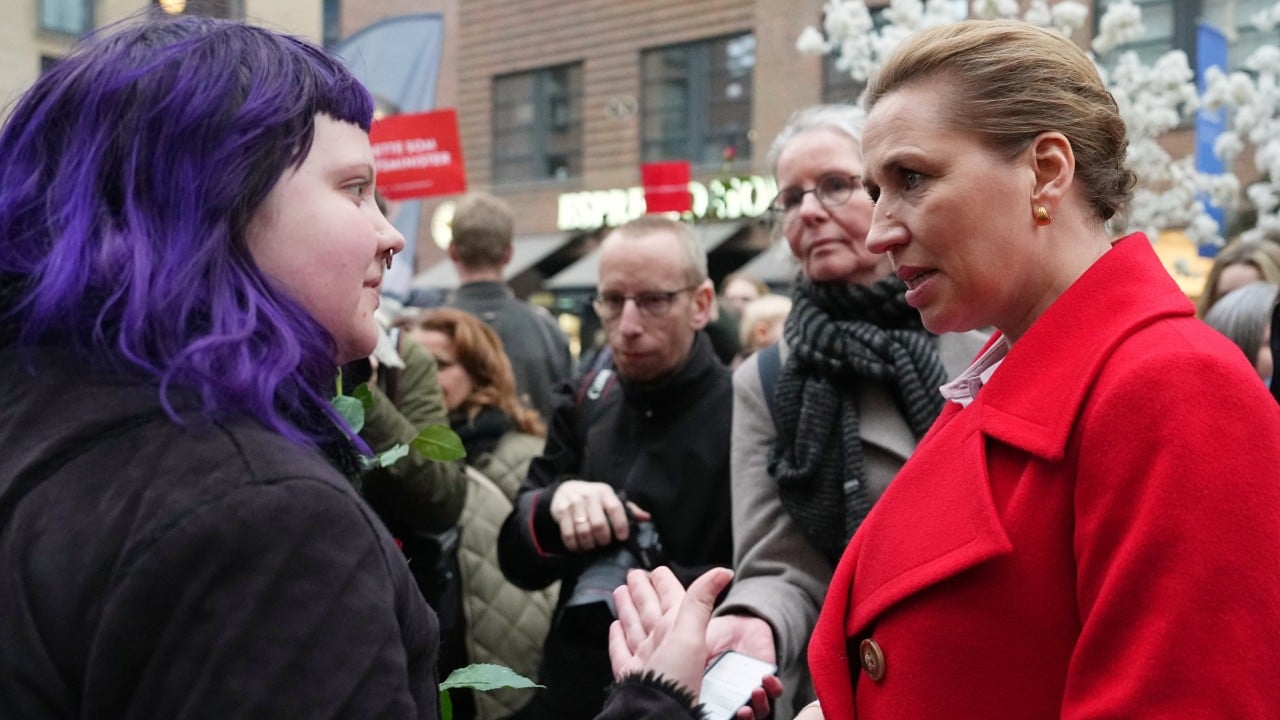
The Danish general election results represent a rare case study in political survival where a centrist-leaning incumbent successfully cannibalized the support of her ideological allies to maintain a precarious grip on power. While Mette Frederiksen’s "Red Bloc" achieved a razor-thin majority of 90 seats in the 179-seat Folketing, the internal composition of this victory reveals a structural decay in the traditional left-wing coalition. The Social Democrats achieved their strongest result in two decades, yet this growth came primarily at the expense of their own partners, creating a coalition that is numerically viable but ideologically fractured.
The Cannibalization of the Left
The Social Democratic strategy utilized a mechanism known as "triangulation," where a center-left party adopts the restrictive immigration and fiscal policies typically reserved for the right. This shifted the Overton window of Danish politics, effectively neutralizing the primary attack vectors of the Blue Bloc (the right-wing opposition).
The outcome created three distinct pressures on the Danish legislative architecture:
- Intra-Bloc Volatility: The Socialist People’s Party and the Red-Green Alliance saw their leverage diminish as the Social Democrats moved toward the center. This creates a "Support Party Paradox" where the smaller parties must choose between supporting a government that ignores their core environmental and welfare demands or triggering an election that could hand power to the right.
- The Rise of the Moderates: Lars Løkke Rasmussen’s newly formed Moderate party emerged as the ultimate kingmaker, holding 16 seats. Their position in the "dead center" of the spectrum allows them to extract maximum concessions from either side, effectively turning a Red Bloc majority into a Centrist-led policy environment.
- Right-Wing Fragmentation: The traditional Venstre party collapsed under the weight of internal defections to the Moderates and the Denmark Democrats, leading to a fragmented opposition that lacks a unified fiscal or social counter-narrative.
The Architecture of Danish Parliamentary Logic
To understand why a 90-seat majority is not a mandate for radical change, one must analyze the "Negative Parliamentarism" model used in Denmark. A government does not need a majority to support it; it simply needs a majority to not oppose it. This nuance allows the Social Democrats to govern from the center, forming "variable majorities" depending on the issue.
The Fiscal Constraint Variable
Denmark’s economy is currently restricted by a labor shortage and inflationary pressures. Any expansionary welfare policy proposed by the Red-Green Alliance faces an immediate veto from the Moderates and the Social Democrats themselves, who are prioritizing fiscal stability to prevent an inflationary spiral. The "Cost Function" of maintaining the coalition involves:
- Green Inflation: The demand for aggressive carbon taxes from the Social Liberals versus the industrial protections sought by the Social Democrats.
- Healthcare Solvency: A massive backlog in the Danish healthcare system requires capital injection, yet the labor pool of nurses and doctors is functionally exhausted.
- Defense Spending: The commitment to reach 2% of GDP for NATO requirements limits the "Welfare Surplus" traditionally used to grease the wheels of coalition negotiations.
The Sovereignty of the Center
Lars Løkke Rasmussen’s Moderates have successfully decoupled themselves from the binary choice of Left or Right. By refusing to commit to either bloc during the campaign, they forced Frederiksen to consider a "broad government" across the center. This structural shift moves Denmark away from the "Block Politics" that has defined the nation since the 1970s and toward a technocratic, consensus-based model.
The Strategic Failure of the Blue Bloc
The right-wing opposition failed to capitalize on the "Minkgate" scandal—the illegal order to cull the country's entire mink population during the pandemic—for two structural reasons. First, the Denmark Democrats, led by Inger Støjberg, successfully drained the populist vote from the traditional Liberal (Venstre) and Conservative parties. Second, the policy gap between the Social Democrats and the Right on immigration has narrowed to the point of invisibility.
When the incumbent adopts the opposition's most popular platform, the opposition is forced into "Policy Extremism" to differentiate itself, which alienates the suburban centrist voter. The Blue Bloc's inability to provide a distinct economic alternative beyond "tax cuts" proved insufficient in a high-inflation environment where voters prioritize the stability of the universal welfare state.
Operational Limitations of the 90-Seat Majority
The narrowest possible majority is inherently unstable. If a single Member of Parliament from the North Atlantic (Greenland or the Faroe Islands) or a fringe element of the Red-Green Alliance dissents, the government collapses. This creates a "Veto Player" environment where every legislative package must be negotiated with surgical precision.
The North Atlantic Influence
The four seats allocated to Greenland and the Faroe Islands were the deciding factor in reaching the 90-seat threshold. This gives these territories unprecedented leverage over Danish domestic policy. The Social Democrats must now balance:
- Greenlandic Sovereignty: Increasing demands for independence or greater control over natural resources and foreign policy in the Arctic.
- Faroese Trade: Specific fishing rights and trade agreements that may conflict with broader EU directives or Danish environmental goals.
The Pivot to a Broad Coalition
Frederiksen’s stated preference for a government across the center—including parties from the Blue Bloc—is a calculated move to insulate her administration from the demands of her far-left allies. By forming a coalition with the Moderates and potentially Venstre, she achieves a "Supermajority" that can pass structural reforms in healthcare and energy without being held hostage by the Red-Green Alliance.
This strategy carries a high risk of "Base Erosion." If the Social Democrats govern too far to the right, they risk a future exodus of voters to the Socialist People's Party. However, in the immediate term, the "Centrist Pivot" is the only path to legislative efficiency.
Tactical Requirements for the Social Democrats
To maintain this equilibrium, the government must execute three specific maneuvers:
- De-escalate the Minkgate Fallout: Utilize the new majority to formalize the closure of the legal inquiries, framing the issue as a "crisis management error" rather than a constitutional crisis.
- Labor Force Expansion: Implement unpopular reforms to increase the retirement age or incentivize foreign skilled labor, using the "Broad Government" as a shield against union backlash.
- Arctic Securitization: Align closer with US and NATO interests in the Arctic to offset the rising influence of Russian and Chinese interests, satisfying the Conservative elements of a broad coalition.
The current political landscape in Denmark is not a victory for the Left; it is a victory for Pragmatic Centrism. The Red Bloc exists on paper, but the reality of the 91st Folketing will be defined by a series of shifting alliances where the Social Democrats act as the anchor for a right-leaning economic agenda disguised in the rhetoric of the welfare state.
The most effective strategic play for the Social Democrats now is to formally invite the Moderates and a weakened Venstre into a grand coalition. This move would permanently dismantle the "Block Politics" era, isolate the ideological extremes of both the Left and Right, and provide the three-year runway necessary to implement the structural healthcare and defense reforms required by the current geopolitical climate. Failure to do so will result in a "Zombie Government" that is technically in power but functionally incapable of passing a budget without debilitating concessions to minor fringe parties.