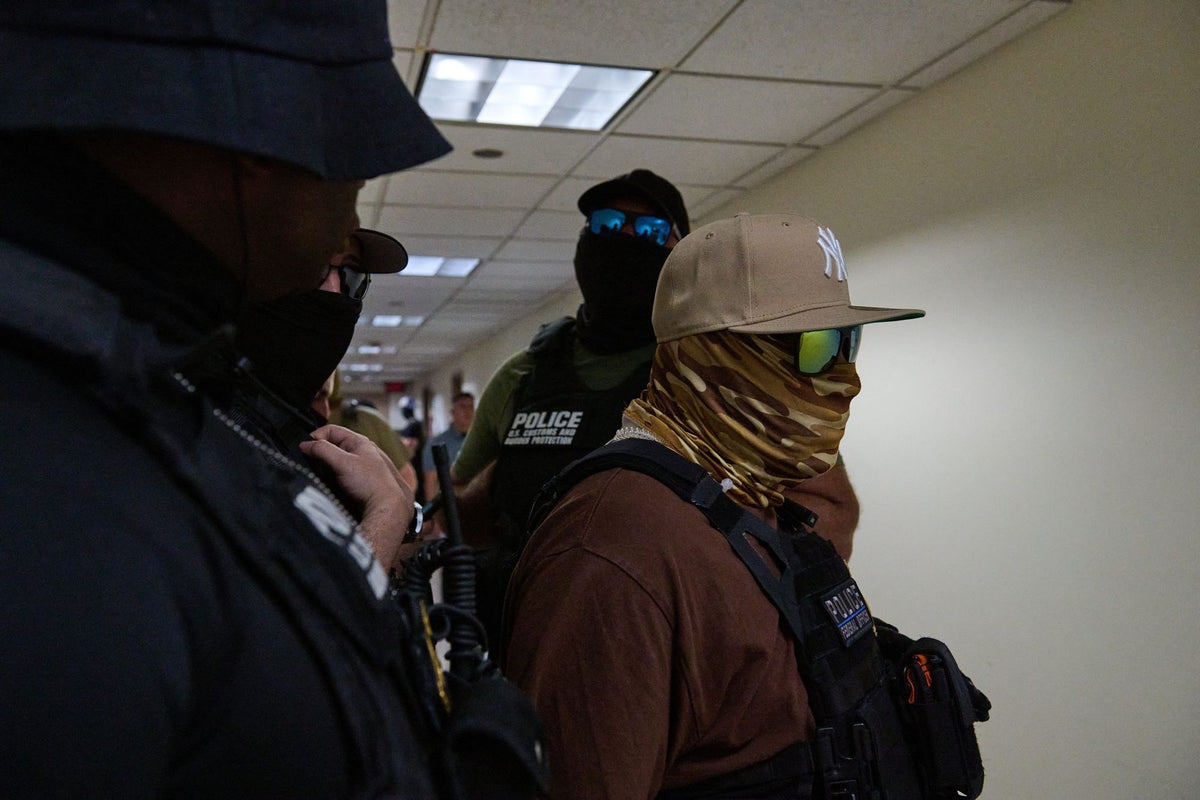
The standoff over facial coverings in federal immigration enforcement has officially moved beyond a health debate and into the territory of high-stakes psychological warfare. Tom Homan, the recently appointed Border Czar, has made his position clear by flatly rejecting demands from Democratic lawmakers to prohibit ICE agents from wearing masks during enforcement operations. To the critics, these masks are tools of intimidation that shroud government actors in a layer of unaccountability. To Homan and the rank-and-file, they are a basic necessity for personal safety in a digital age where "doxxing" has become a preferred weapon of political activists. This is not a dispute about lingering pandemic protocols. It is a fundamental disagreement over whether a civil servant’s right to privacy survives the moment they step onto a front porch to execute a warrant.
The Evolution of the Enforcement Aesthetic
For decades, the standard uniform for an Immigration and Customs Enforcement (ICE) agent was a clear, identifiable vest or windbreaker. The face was visible. This visibility served as a social contract of sorts, a sign that the individual was an authorized representative of the state. However, the political temperature surrounding immigration shifted violently over the last ten years. As protests at the homes of federal officials became more common, the calculus for agents changed.
Masking during raids started as a pragmatic response to COVID-19, but it quickly became a permanent fixture for tactical teams. Even as the rest of the federal workforce returned to pre-pandemic appearances, ICE’s Enforcement and Removal Operations (ERO) kept the gaiters and balaclavas. The shift reflects a hardening of the divide between the agency and the communities it patrols. When an agent covers their face, they cease to be a neighbor or a fellow citizen in the eyes of the public. They become an anonymous extension of state power.
Safety Concerns versus Public Accountability
The primary argument from Homan’s office centers on the "doxxing" phenomenon. In our hyper-connected world, a single high-resolution photo of an agent’s face can be run through facial recognition software by private citizens. Within minutes, that agent’s home address, their spouse’s place of employment, and the school their children attend can be broadcast to thousands of angry strangers.
Homan argues that expecting agents to expose their identities during high-risk arrests is an unreasonable demand. He views the mask as a piece of safety equipment, no different than a ballistic vest or a duty belt. From his perspective, the "intimidation" felt by those being arrested is secondary to the physical and digital safety of the men and women under his command.
On the other side of the aisle, Democrats led by figures like Representative Alexandria Ocasio-Cortez argue that anonymity invites abuse. The history of policing suggests that when individuals feel they cannot be identified, the threshold for misconduct drops. If a resident believes an agent used excessive force or violated their rights, they have no way to identify the specific individual if everyone on the scene is wearing a black mask. This lack of transparency erodes what little trust remains in the system. They argue that if an agent is performing a legal, ethical duty, they should be able to do so with their face showing, just like any other local police officer or federal marshal.
The Tactical Reality of Home Arrivals
When ICE agents arrive at a residence, the goal is total control of the environment. This is achieved through speed, volume, and a commanding presence. Critics point out that the use of masks, especially when combined with tactical gear and long guns, makes these civil administrative actions look like military combat operations.
Consider the psychological impact. A family wakes up to four men in tactical gear with their faces covered. In many of the countries these individuals fled, masked men in uniforms are not the police; they are death squads or paramilitary kidnappers. The presence of the mask triggers a level of terror that may actually make the situation more dangerous. A person in a state of blind panic is more likely to resist or flee, potentially escalating a routine pickup into a violent confrontation.
Homan disagrees with this assessment. He maintains that the threat level is dictated by the environment, not the agent's wardrobe. His focus remains on the "vicious" gangs and criminal elements that his teams are tasked with removing. To Homan, the idea that a gang member's comfort should be prioritized over an officer's anonymity is a non-starter.
A Legal Gray Area
The legality of masked enforcement is surprisingly settled, though controversial. There is no federal law that explicitly prohibits law enforcement officers from wearing masks during the execution of their duties. Most police departments have internal policies regarding "public-facing" roles, but tactical units (like SWAT) have worn masks for years to protect their identities during drug raids or hostage situations.
The conflict here is that ICE ERO agents are often performing functions that are not strictly "tactical" in the traditional sense. They are often conducting interviews or taking people into custody for civil violations. The expansion of tactical-style anonymity into civilian neighborhoods represents a significant shift in how federal power is projected.
The Technological Fix that Isn't Happening
If the goal is accountability without doxxing, there are middle-ground solutions. Some have suggested that agents wear large, unique identification numbers on their chests and helmets. This would allow a citizen to report a specific agent for misconduct without knowing their name or seeing their face. Yet, this proposal has gained little traction. The agency seems to prefer the "all-or-nothing" approach to identity protection, while critics seem to prefer the "all-or-nothing" approach to visibility.
Furthermore, the data on the effectiveness of masks in preventing doxxing is thin. Most doxxing incidents occur through leaked payroll databases, social media slips by family members, or license plate tracking, rather than facial recognition from a grainy doorbell camera. The mask may be more of a symbolic shield than a functional one, providing a sense of psychological distance for the agent more than actual security.
The Cost of a Faceless Agency
There is a long-term cost to this policy that Homan may be underestimating. When an agency becomes faceless, it becomes easier for the public to dehumanize its members. Conversely, it becomes easier for the agents to view the public as "targets" rather than people. The mask creates a barrier that prevents the small, human interactions that can de-escalate a tense situation. A smirk, a look of concern, or a calm expression can do more to settle a crowd than a dozen shouted commands.
By doubling down on the use of masks, the administration is signaling that they are prepared for a period of intense, friction-filled enforcement. They are prioritizing the internal morale and perceived safety of the force over the optics of public accountability. This choice will likely embolden agents who feel they are finally being given the "tools" to do their jobs without interference, but it will also fuel the fire of those seeking to defund or dismantle the agency entirely.
The border czar's refusal to budge suggests that the era of "community-style" immigration enforcement is over. In its place is a more rigid, militarized approach that views the public eye as a threat to be managed rather than a stakeholder to be respected. As operations ramp up across the country, the black gaiter will remain the most visible symbol of this new, uncompromising direction. If you find yourself on a doorstep facing a team of masked men, the message is clear: the person behind the mask is not there to talk, and they are certainly not there to be known.
The administration’s stance effectively creates two different classes of federal employees: those who must stand behind their actions with their faces visible, and those who are permitted to operate in the shadows of a polyester blend. This distinction will be tested in the courts, but for now, the masks stay on.
.png?width=1200&auto=webp&trim=0%2C0%2C0%2C0)