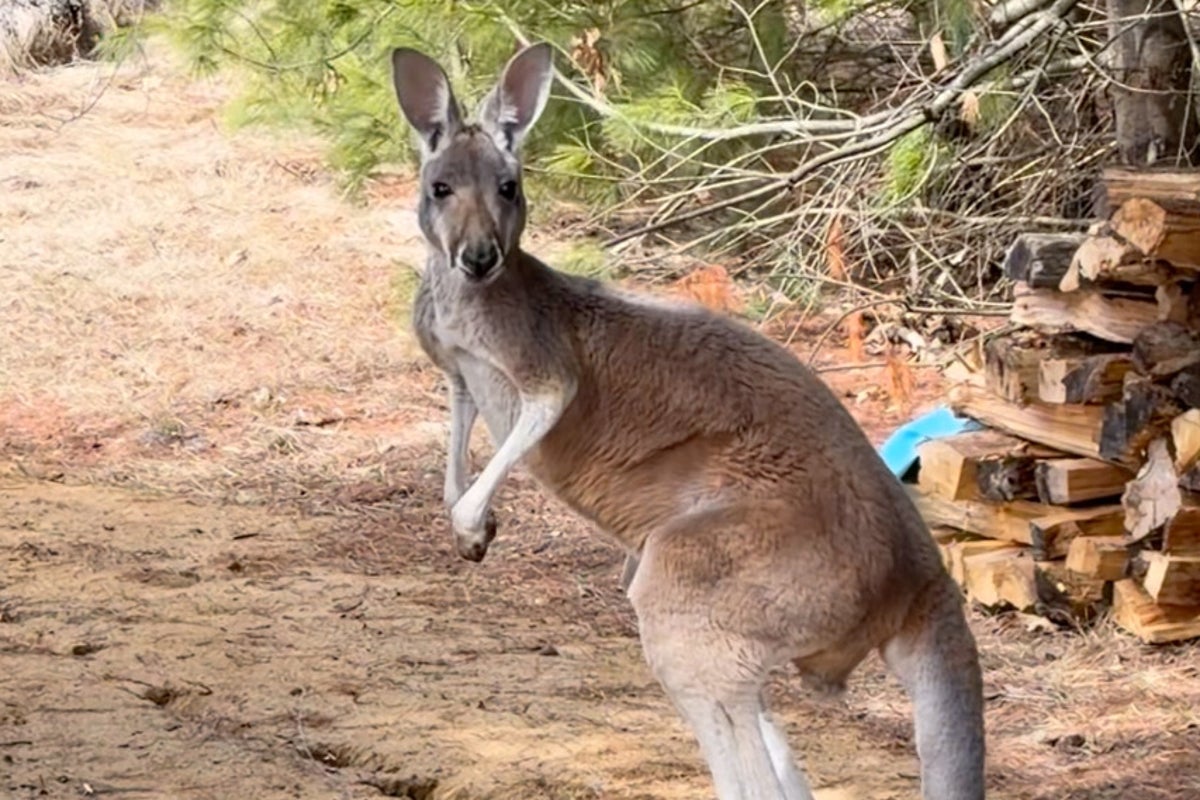
The recovery of an escaped macropod in a temperate, non-native environment is not a matter of chance but a function of thermal constraints, containment physics, and search-grid optimization. When a kangaroo escaped from a petting zoo in Clinton, Wisconsin, the subsequent three-day recovery window exposed a significant gap between standard agricultural containment and the high-mobility evasion tactics of Australian megafauna. Traditional search and rescue models often fail in these scenarios because they underestimate the animal’s metabolic response to stress and the specific sensory advantages it holds over human search parties.
To understand how the animal was eventually located and secured, one must analyze the interaction between the animal's biological imperatives and the environmental variables of the Wisconsin landscape.
The Kinematics of Macro-Evasion
A kangaroo’s primary defensive mechanism is high-velocity displacement. Unlike domestic livestock, which tend to circle a known grazing territory or seek human-associated food sources, a kangaroo in a state of high cortisol—triggered by the escape event—utilizes a "flight" response that can cover several miles in an hour. This creates an expanding search radius that grows exponentially rather than linearly.
The physics of their movement further complicates detection. Kangaroos are capable of vertical leaps exceeding six feet and horizontal bounds that bypass traditional fencing designed for bovine or equine containment. The Clinton incident demonstrated that once the initial perimeter is breached, the search area transitions from a "controlled zone" to a "low-probability intercept zone" within minutes.
The Thermal Signature Bottleneck
Wisconsin’s climate, even in milder months, presents a thermal challenge for a species evolved for arid and semi-arid regions. The animal's survival during the 72-hour window depended on its ability to find micro-climates—densely wooded areas or agricultural outbuildings—that mimicked the shelter of its native scrubland.
From a detection standpoint, this creates a thermal bottleneck. Traditional visual search is ineffective in high-vegetation areas. The successful recovery relied heavily on Forward-Looking Infrared (FLIR) technology mounted on unmanned aerial vehicles (UAVs). The heat differential between the kangaroo’s body and the cooler Wisconsin ground provided the only high-contrast data point available to the search teams.
The Three Pillars of Search-Grid Optimization
The recovery effort was categorized by three distinct phases of operational logic. Failures in the first two phases are common in these incidents, but the third phase is where the resolution typically occurs.
1. The Proximity Bias Phase
Initial efforts almost always center on the point of origin. Searchers assume the animal will remain near its food source or social group. However, the "stress-induced dispersal" phase of an escape often pushes the animal well beyond the 1.5-mile radius within the first four hours. Relying on proximity-based search patterns leads to a 48-hour delay as the animal settles into a new, hidden "safe zone" outside the initial sweep.
2. The Community Intelligence Loop
Once the animal has moved beyond the immediate vicinity, the search shifts to a crowdsourced data model. This introduces "signal noise." Public sightings are often delayed or inaccurate regarding exact GPS coordinates. In the Wisconsin case, the turning point was the transition from passive monitoring of public tips to the deployment of a localized "sight-on-target" protocol, where specific sightings were used to anchor a new, smaller search radius for the tech teams.
3. The Tech-Integrated Intercept
The final phase involves the synchronization of aerial surveillance and ground-based containment. Once the drone identified the heat signature, the ground team had to approach from downwind to avoid triggering another high-velocity flight response. The use of a "soft-containment" strategy—using nets and tranquilizers rather than physical pursuit—is the only way to prevent "capture myopathy," a fatal condition where extreme exertion and stress cause muscle breakdown and heart failure in macropods.
The Cost Function of Rural Containment
There is an inherent financial and operational trade-off in rural petting zoo management. The "Cost of Failure" (CoF) for an escape includes not only the loss of the asset but the massive mobilization of local law enforcement, volunteer hours, and specialized drone equipment.
$$CoF = (L_a + O_c + R_p) \times T$$
Where:
- $L_a$ is the value of the animal asset.
- $O_c$ is the operational cost per hour of the search.
- $R_p$ is the reputational and regulatory penalty.
- $T$ is the time elapsed until recovery or loss.
The Wisconsin incident highlights that many facilities operate with an $O_c$ that they cannot sustain. The reliance on local police—who are not trained in exotic animal behavior—shifts the cost burden to the taxpayer. A more efficient model involves the pre-emptive integration of GPS-collar technology for high-mobility species. The cost of a $300 cellular GPS tag is negligible compared to the thousands of dollars spent on a three-day multi-agency search.
Behavioral Constraints and Capture Mechanics
The eventual capture of the kangaroo occurred when it was cornered in a fenced area that limited its vector of escape. This is a critical tactical lesson: search teams should not attempt to "catch" the animal in open terrain. Instead, the objective is "guided displacement." By moving the animal toward natural or man-made funnels, the searchers can force the kangaroo into a high-friction environment where its speed is neutralized.
Ground teams in Wisconsin correctly identified that the animal was in a state of exhaustion by day three. The metabolic cost of three days of high-cortisol evasion in a non-native environment creates a "capture window" where the animal’s reaction time is significantly degraded.
Regulatory Bottlenecks and Future Mitigation
The escape in Clinton was not just a failure of a physical latch or fence; it was a failure of the risk-assessment framework governing "Class III" wildlife in residential or semi-rural areas. Current Wisconsin statutes provide significant leeway for petting zoos, but they lack mandates for "Recovery SOPs" (Standard Operating Procedures).
A transition to a "Hardened Perimeter" standard is required for species capable of high-velocity evasion. This includes:
- Secondary Containment Layers: Double-gating systems that prevent single-point-of-failure escapes.
- Bio-Acoustic Deterrents: High-frequency sound barriers that discourage animals from approaching the outer perimeter.
- Mandatory Telemetry: Any animal with a flight-radius potential exceeding 5 miles per hour must be fitted with active or passive tracking.
The reliance on luck and thermal drones is a reactive strategy. To elevate the safety and success rate of these facilities, the shift must be toward predictive containment and automated recovery protocols.
The strategic priority for facilities housing high-mobility exotics must move away from visual monitoring toward automated alert systems that trigger the moment a perimeter is breached. This reduces the "Initial Dispersal Radius" by over 70%, ensuring that the animal is recovered before it enters the high-risk, high-cost territory of the public landscape.
Would you like me to develop a comprehensive Risk Mitigation Protocol for exotic animal facilities that integrates GPS telemetry and automated containment alerts?