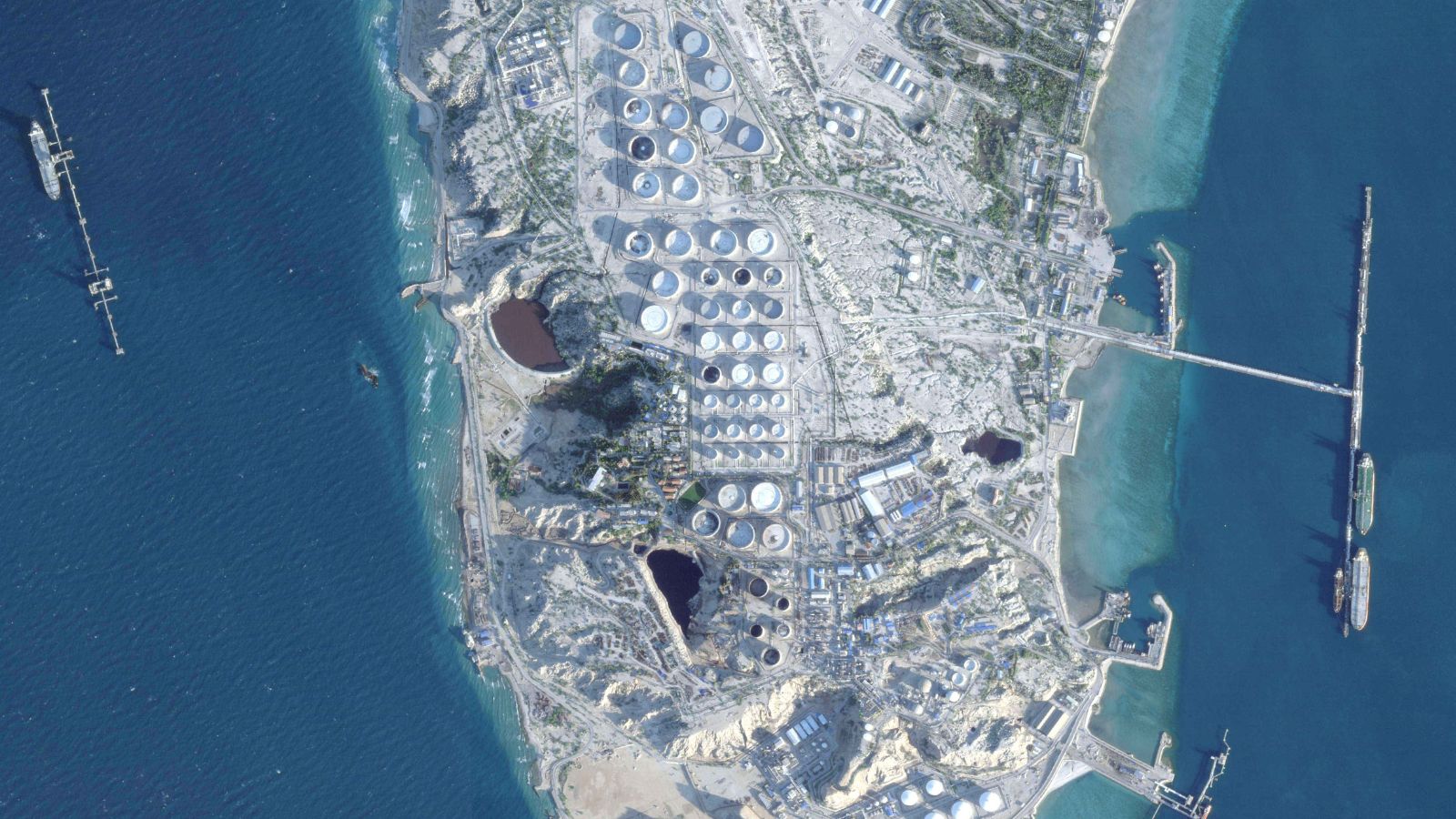
The standoff in the Persian Gulf has reached a threshold where the mechanics of war are shifting from airborne strikes to the gritty reality of boots on the ground. Kharg Island, a coral-fringed rock barely one-third the size of Manhattan, has become the focal point of a high-stakes gamble by the Trump administration to break the Iranian regime's economic spine. By moving thousands of Marines and paratroopers from bases in Japan and the United States toward the Gulf, Washington is signaled that it is no longer content with simply "degrading" targets from the air. The goal is now leverage, and Kharg Island—which handles roughly 90% of Iran’s crude oil exports—is the ultimate bargaining chip.
Military planners are currently weighing an amphibious seizure of the island to force Tehran into reopening the Strait of Hormuz. Iran has responded by turning the island into a fortress, layering the coastline with anti-personnel mines and saturating the airspace with man-portable air-defense systems (MANPADS). This is not just a regional skirmish; it is a direct confrontation between American power projection and Iran’s "Chokepoint Doctrine," with the global energy market hanging in the balance. If you enjoyed this article, you should check out: this related article.
The logic of the island grab
For decades, Kharg Island was the "untouchable" asset. During the Iran-Iraq War in the 1980s, it was hit hundreds of times but never occupied. The current administration views history differently. In the eyes of the White House, Kharg is the financial oxygen for the Islamic Revolutionary Guard Corps (IRGC). If the U.S. controls the loading terminals, it controls the flow of cash to every Iranian proxy from Lebanon to Yemen.
On March 13, U.S. strikes carefully dismantled military bunkers and mine storage facilities on the island while leaving the oil piers intact. The message was surgical. By sparing the infrastructure, the U.S. kept the asset functional for a potential "management" phase. The deployment of the 31st Marine Expeditionary Unit (MEU) from Okinawa, Japan, alongside the arrival of the USS Tripoli, suggests that the "bombing-only" phase of Operation Epic Fury is transitioning into a seizure-and-hold scenario. For another angle on this story, see the recent coverage from TIME.
Fortifying the coral fortress
Tehran is not waiting for the ramp to drop. Satellite imagery and intelligence reports indicate a frantic effort to make any landing cost the U.S. dearly in blood. The Iranian strategy relies on "asymmetric lethality." They aren't trying to outgun a Carrier Strike Group; they are trying to make the political cost of American casualties too high for a president who promised to avoid "endless wars."
- Coastal Denial: Iran has laid hundreds of Maham-class mines along the shallow approach zones. These are designed to tear the hulls of landing craft and amphibious vehicles.
- Layered Air Defense: The island is now bristling with shoulder-fired missiles. These MANPADS are difficult to detect from the air and represent a constant threat to the helicopters and V-22 Ospreys that would be required for a vertical assault.
- Human Shields and Hardened Nodes: The IRGC has reportedly moved personnel into the sprawling underground tunnel networks beneath the oil storage tanks, effectively using the world’s energy supply as a shield against further heavy bombardment.
If the U.S. moves in, the initial 18 hours will be a gauntlet. The 82nd Airborne Division, capable of dropping in with less than a day's notice, would likely face a landscape where every loading crane is a sniper nest and every pipeline is potentially rigged with explosives.
The Japan shift and the NATO void
The decision to pull the 31st MEU and the USS Tripoli from the Indo-Pacific theater is a calculated risk. It leaves a temporary vacuum in the East China Sea, but it highlights the administration's frustration with European allies. President Trump has been vocal on social media, accusing NATO nations of doing "absolutely nothing" to assist in securing the Strait of Hormuz.
This lack of coalition support has forced a reliance on "surge" forces from the Pacific. It is a logistical flex that shows the U.S. can still pivot its weight, but it also exposes the thinness of the current security architecture. While Germany and France call for a total stop to hostilities, the U.S. is doubling down on a unilateral solution. The arrival of 1,000 paratroopers from the 82nd Airborne in the coming days will bring the total reinforcement count to a level not seen in the region since the early 2000s.
The oil price paradox
There is a brutal irony in the Kharg Island strategy. The U.S. wants to seize the island to stabilize the market and end the blockade of the Strait. However, the mere threat of a ground invasion has already pushed Brent crude past $100 per barrel.
If the island is seized, the U.S. would technically be in charge of 1.5 million barrels of Iranian oil per day. Who does that oil go to? China is the primary customer. An American occupation of Kharg would put Washington in the position of either allowing Chinese tankers to fill up—thereby funding the very regime they are fighting—or blocking them and risking a direct confrontation with Beijing. It is a geopolitical trap. Seizing the leverage is one thing; knowing how to trade it without starting a global depression is another.
Retaliation beyond the island
Iran’s Parliament Speaker, Mohammad Bagher Ghalibaf, has already outlined the counter-move. If the U.S. or its regional partners support an "occupation of an Iranian island," Tehran will target "vital infrastructure" across the entire Gulf. This isn't just tough talk. Iran’s drone and missile inventory remains significant despite the 9,000 targets the U.S. claims to have hit since February.
Desalination plants in the UAE, refineries in Saudi Arabia, and even the glass towers of Dubai are on the target list. Iran is essentially saying that if they lose Kharg, the entire region loses its ability to function. This "Sampson Option" is why many of Washington’s Gulf allies are privately pleading for restraint. They know that an American victory on Kharg Island could be a pyrrhic one for the neighbors.
The negotiation ghost
While the military prepares for a landing, there are whispers of a 15-point peace plan. The White House claims progress; Tehran claims the terms are "excessive." This is the classic "Art of the Deal" playbook: create maximum pressure on the ground to force a lopsided deal at the table.
But the Iranian regime is in a state of transition. With reports of injuries to high-level leadership and the rise of Mojtaba Khamenei, the domestic pressure to show "revolutionary strength" is immense. A retreat now could lead to internal collapse. For the U.S., a failure to act after such a public buildup would be seen as a bluff called. Both sides have painted themselves into a corner where the only way out is through a small, rocky island in the middle of the Gulf.
Check the arrival times of the USS Tripoli at the mouth of the Strait to see if this moves from a standoff to a shore-fall.