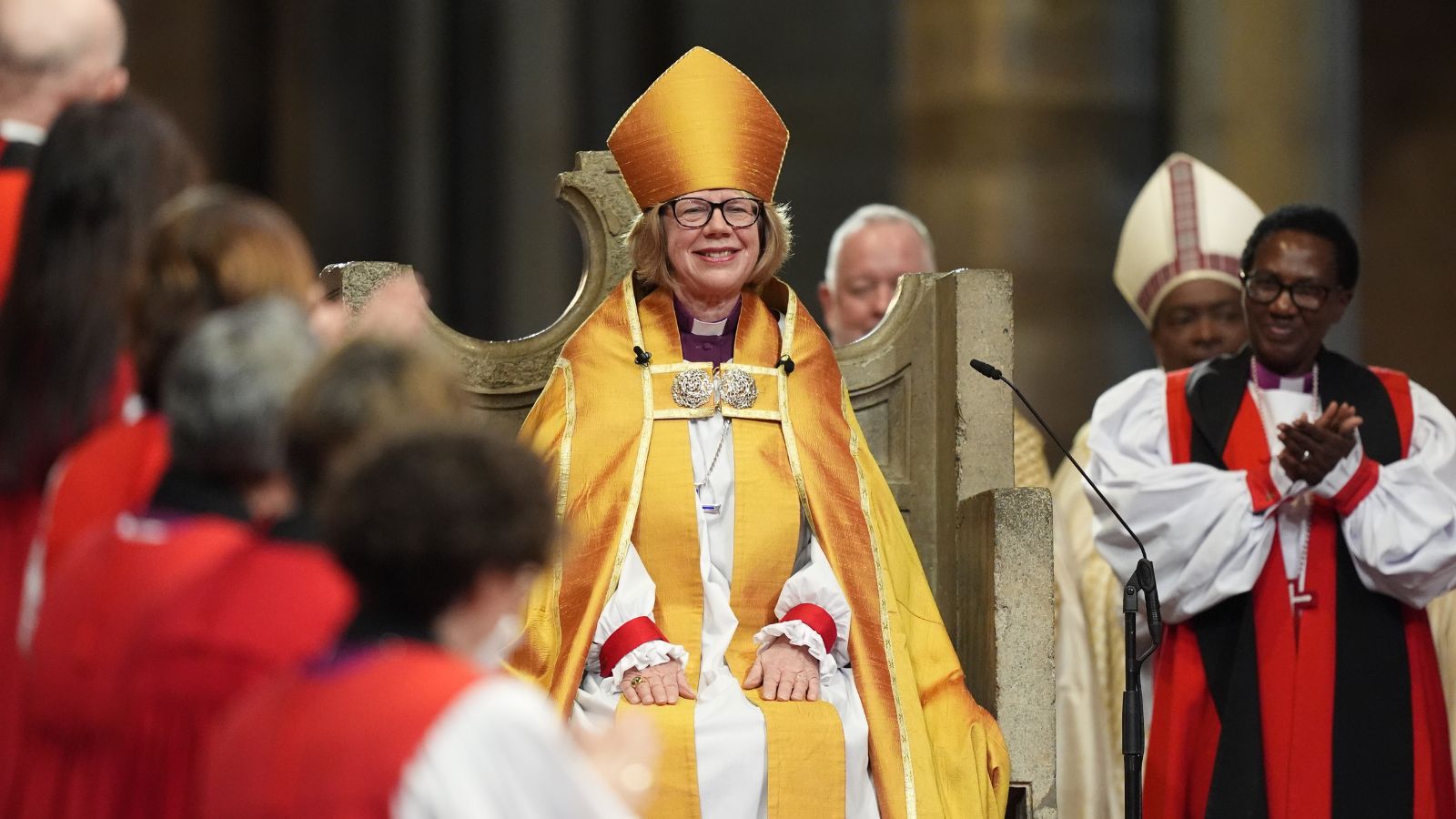
The coronation of a female Bishop—or in the hypothetical fever dreams of the press, an Archbishop—is treated by the media like a corporate merger that finally puts a woman in the C-suite. It is framed as a "historic milestone," a "shattering of the glass ceiling," and a "new era for the Church."
It is none of those things.
When Sarah Mullally was installed as the Bishop of London, the headlines acted as if the gender of the person wearing the mitre would somehow reverse the terminal decline of an institution that has been hemorrhaging members for fifty years. They focused on the optics of the throne while ignoring the fact that the floor underneath it is rotting away.
The obsession with the "first female" narrative is a classic distraction. It allows the Church of England to pretend it is modernizing without actually addressing why its pews are empty. If you are rearranging the deck chairs on the Titanic, it doesn't matter if the person directing the crew is a man or a woman. The ship is still hitting the iceberg.
The Identity Politics Trap
The secular press loves a "first." They love it because it fits a predictable, linear narrative of progress. If a woman reaches a position of power, the institution must be "evolving."
But the Church of England isn't a tech startup in Shoreditch. It’s a 500-year-old state-integrated religious body defined by tradition and theology. By focusing entirely on the identity of the leader, we ignore the efficacy of the leadership.
The "lazy consensus" suggests that representation equals relevance. The logic goes like this: if the leadership looks more like the general population, the general population will return to the fold. This is a provable fallacy. Since the ordination of women as priests in 1994 and bishops in 2014, church attendance has continued its steady, agonizing slide into the abyss.
British Social Attitudes surveys show that "No Religion" is the fastest-growing demographic in the UK. People aren't staying away because the Bishop is a man; they are staying away because the Church has failed to provide a compelling reason for its own existence in a post-Christian society.
Management is Not a Miracle
Sarah Mullally’s background is in nursing and the civil service. She was the Chief Nursing Officer. On paper, she is a brilliant bureaucrat. She knows how to navigate the corridors of Whitehall. She understands systems, KPIs, and organizational structures.
But the Church of England does not need more "management." It is already over-managed and under-inspired.
We have seen this in the corporate world for decades. A company starts to fail because its core product is no longer desired. Instead of innovating the product, the board hires a "transformational" leader who checks all the right diversity boxes to signal to shareholders that "change is happening."
I’ve seen dozens of organizations burn through millions of pounds on "rebranding" and "culture shifts" led by historic firsts, only to realize that the customer still doesn't want what they’re selling. In the Church’s case, the "product" is a spiritual framework for life and death. If that framework feels hollow, no amount of inclusive hiring will fix it.
The Theological Schism Nobody Talks About
While the London media celebrates a female Bishop, the global Anglican Communion is tearing itself apart. This is the nuance the "milestone" articles miss.
The Church of England is the mother church of a global body of 85 million people. In the Global South—specifically in Africa and Southeast Asia—the Church is growing at an explosive rate. And guess what? They aren't interested in the Western liberal consensus.
By pushing for "historic firsts" that align with modern secular values, the leadership in London is effectively excommunicating its own growth engines in Nigeria, Uganda, and Kenya. We are witnessing the managed decline of a national church that is choosing to be "relevant" to a secular British public that doesn't go to church, at the expense of its relationship with the millions of Christians who actually do.
It’s a high-stakes gamble. The Church is betting that by mimicking the values of 21st-century liberalism, it can win back the West. But you cannot out-liberal the liberals. If people want secular progressivism, they go to a political rally or a non-profit gala. They don't go to a drafty cathedral to hear a watered-down version of it whispered from a pulpit.
The Professionalization of the Priesthood
We have turned the clergy into a career track. When we talk about "the first female Archbishop," we are using the language of careerism.
The priesthood was never supposed to be a career. It was a vocation—a "calling" that often demanded the sacrifice of status, not the pursuit of it. By focusing on the "ceiling," we have transformed the office of Bishop into a prize to be won in the name of equality.
This professionalization has a cost. The more the Church acts like a civil service department, the more it loses its "otherness."
People don't go to church for a "seamless" administrative experience. They go for the transcendent. They go for the "weirdness" of ancient liturgy and the conviction of absolute truth. When the leadership starts sounding like they’re delivering a TED talk on "inclusive management," that "otherness" evaporates.
The "People Also Ask" Truths (Dismantled)
"Will having a female Archbishop save the Church of England?"
No. It’s a category error. Attendance doesn't drop because of the person at the top; it drops because the message is no longer resonant at the bottom. The Bishop of London's sex is irrelevant to the secular parent who would rather take their kids to football on a Sunday morning.
"Is the Church finally modernizing?"
It’s modernizing its optics. It is not modernizing its impact. Modernizing usually means updating the core proposition. If the core proposition remains "come and listen to us talk about things you can already find on Twitter," then it isn't modernization; it's a costume change.
"What is the next step for equality in the Church?"
The wrong question. The right question is: what is the next step for survival in the Church? If you reach 100% perfect representation and 0% attendance, have you won or lost?
The Inconvenient Reality of Growth
Growth in the Church isn't coming from the "progressives" in London. It's coming from the hardline, traditionalist wings.
I've watched as the liberal, "modernizing" wing of the Church celebrates its social victories while its churches continue to close. At the same time, the conservative, evangelical, and Anglo-Catholic wings—the ones who often disagree with female Bishops—are the ones with full pews and vibrant youth programs.
This is the paradox the secular press cannot stomach. The parts of the Church that are "backward" in their eyes are the only parts that are actually growing. People don't want a Church that is a mirror of their own secular lives; they want a Church that is an alternative to it.
Sarah Mullally is a symptom of a Church that wants to be liked by a public that will never return. She is a historic first, and she is also a tragic footnote in the history of an institution that is trading its spiritual authority for a pat on the head from the Guardian editorial board.
The glass ceiling is broken. Now, look at the floor.