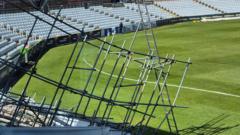
The wind didn't just blow; it screamed. It tore across the Wear Valley with a predatory intent, the kind of gale that makes the iron-grey skies of County Durham feel like they are collapsing inward. In the early hours, while the city slept and the cathedral stood its ancient watch on the hill, the Riverside Ground in Chester-le-Street was fighting a losing battle.
Metal groaned. Siding buckled. By the time the sun limped over the horizon, the home of Durham Cricket was no longer a sanctuary for sport. It was a hazard zone.
Imagine a groundsman standing at the gates, the same gates where thousands of fans usually pour through with the smell of cut grass and the hope of a century in their hearts. Instead of the rhythmic "clack" of bat on ball, there is only the eerie, metallic rattle of loose debris. The structural damage inflicted by the storm wasn't just a matter of broken windows or a few missing tiles. It was a fundamental compromise of the space.
Durham Cricket released the news with the clinical brevity required of official statements, but the reality for the supporters is far heavier. The message was clear: stay away. The doors are locked. The seats must remain empty. For a club that lives and breathes through its community, this isn't just a scheduling conflict. It is a temporary exile.
The Anatomy of a Gale
Cricket is a game defined by its fragility. It requires a specific temperature, a precise moisture level in the soil, and a sky that isn't actively trying to dismantle the grandstands. When a storm of this magnitude hits, the "invisible stakes" become visible very quickly. We take the architecture of our leisure for granted until the very roof over our heads becomes a potential projectile.
The decision to bar fans from the ground wasn't made by a bureaucrat behind a desk. It was made by the physics of wind load and the terrifying reality of flying debris. When the wind catches a stadium's canopy or a temporary stand, the structure acts like a sail. But these sails aren't meant to move. If the bolts strain or the joints crack, the "home of cricket" becomes a gallery of falling glass and twisted steel.
Safety is a quiet, thankless priority. You only notice it when it's gone.
The club’s technical assessment highlighted "significant" damage to the hospitality areas and the seating sections. This isn't a quick fix with a hammer and nails. It involves structural engineers, safety inspectors, and a meticulous inventory of every nut and bolt that keeps the fans safe from the elements. Until that audit is complete, the gates remain chained.
The Ghost in the Machine
Cricket fans are a hardy breed. They sit through drizzle that would send a footballer running for the tunnel. They endure the biting North Sea wind with nothing but a thermos of tea and a woollen blanket. To tell these people to stay home is to ask them to ignore a heartbeat.
Consider a hypothetical supporter named Arthur. Arthur hasn't missed a home opener in thirty years. For him, the Riverside isn't just a venue; it’s a living record of his life. He remembers where he sat when Ben Stokes played those early, explosive innings. He knows which corner of the stand catches the sun at exactly four o'clock. When the news hit his phone—Stay away from the ground—it wasn't just a news alert. It was a Sunday morning rendered hollow.
This is the human cost of a "weather event." It’s the disruption of ritual. The local pub that relies on the pre-match rush sits quiet. The steward who knows every regular by name is told to stay home. The silence at Chester-le-Street right now is heavy, filled with the absence of the very people who give the concrete meaning.
Behind the Warning Signs
The club’s insistence on keeping people away is a legal necessity, yes, but it’s also a moral one. The Riverside sits in a bit of a wind tunnel, exposed to the raw power of the weather as it barrels through the valley. When the structural integrity of a public building is questioned, the risk is never "low." It is binary. Either the building is safe, or it is a weapon.
Engineers are currently navigating the debris, assessing the rafters, and checking the tension of the cables. They are looking for the "hidden" damage—the stress fractures that the untrained eye would miss but the next gust of wind would exploit.
The timeline for a return is frustratingly vague. "Until further notice" is the phrase that haunts sports fans. It’s a vacuum of information that breeds anxiety. Will the next fixture be moved? Will the repairs take weeks or months? The uncertainty is the second storm that follows the first.
Why This Matters Beyond the Boundary
We often talk about sports teams as businesses, but they are more accurately described as social anchors. When a storm shuts down a stadium, it severs a line of communication between a town and its identity. Durham is a proud, gritty county. Its cricket team reflects that. To see the Riverside battered and empty is a visual metaphor for the vulnerability we all feel when the climate decides to remind us who is actually in charge.
The "dry facts" tell us that the roof is damaged and the public is at risk. The narrative truth tells us that a community is currently waiting for a signal that their home is once again a place of safety.
There is a specific kind of melancholy in a sports ground without people. It’s the sight of a discarded program fluttering against a chain-link fence. It’s the empty car park where there should be the roar of engines and the chatter of families. The storm took the tiles, but the silence took the soul of the weekend.
The repair crews are working. The cranes will eventually arrive. The shards of glass will be swept up, and the metal will be welded back into place. But for now, the instruction remains absolute. Don't go to the Riverside. Don't try to peek through the gates. The wind has left its mark, and the ground needs time to heal.
The next time the sun rises over the Wear and the gates finally swing open, the sound of the first ball hitting the bat won't just be the start of a match. It will be the sound of a community reclaiming its ground from the wreckage of the sky.
The grass is still there, green and resilient under the mud, waiting for the feet of those who were told to stay away.