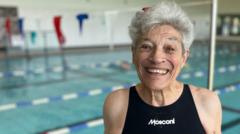
While the rest of the world debates the declining efficacy of the human frame past the age of eighty, Maurine Kornfeld is busy shattering the data. At 95, Kornfeld recently secured five additional world records in masters swimming, a feat that pushes beyond mere "feel-good" local news and into the territory of significant physiological anomaly. She isn't just participating. She is performing at a level that forces us to reconsider the velocity of cellular decay.
Most coverage of senior athletics treats these milestones as heartwarming anomalies. This is a mistake. When a nonagenarian maintains the cardiovascular capacity to sprint through high-resistance water and turn sharp laps, it provides a rare look at the upper ceiling of human durability. Kornfeld’s recent performance at the regional and national levels isn't an accident of luck; it is a case study in the preservation of mitochondrial function and the power of consistent mechanical stress. For another view, see: this related article.
The Myth of Necessary Decline
We have been conditioned to accept a steep, inevitable drop-off in physical capability once we hit the seventh decade of life. The medical term is sarcopenia—the involuntary loss of skeletal muscle mass and strength. By the time a person reaches 90, the standard expectation is a body that has surrendered its fast-twitch fibers and lost the majority of its aerobic power.
Kornfeld defies the standard curve. Her ability to set world records in multiple disciplines, from the freestyle to the backstroke, suggests that the "inevitable" decline is more elastic than previously thought. Similar analysis on this matter has been published by NBC Sports.
The mechanism at play here is high-frequency, low-impact resistance. Swimming offers a unique environment where the heart can be pushed to near-maximum output without the joint-crushing impact of road running or heavy lifting. For a 95-year-old, the water acts as both a support system and a relentless opponent. By moving through a medium that is roughly 800 times denser than air, Kornfeld is engaging in a full-body resistance workout that maintains bone density and muscle attachment points that would otherwise wither in a sedentary lifestyle.
Behind the Numbers at 95
When we look at the specific world records broken, the data reveals a startling consistency. It is not just about finishing the race. It is about the sustainable power output. In masters swimming, the age brackets are designed to keep competition fair, but Kornfeld is often competing against the clock and the ghosts of previous record-holders who were considered the gold standard of senior health.
The Physiology of the Senior Sprint
- V02 Max Maintenance: While the average 90-year-old sees a massive drop in oxygen utilization, competitive swimmers in this bracket maintain a higher stroke volume, allowing more oxygenated blood to reach the muscles.
- Neuromuscular Coordination: Executing a proper flip-turn or a clean backstroke start requires a level of proprioception—the body's ability to sense its position in space—that usually degrades with age.
- Thermal Regulation: Cold water immersion during training forces the vascular system to remain reactive, improving overall circulatory health.
This isn't about "staying active." This is about athletic intent. There is a psychological gulf between a casual morning walk and a structured training block aimed at a world record. The latter requires a neurological "buy-in" that keeps the brain-to-muscle connection firing at a higher frequency.
The Overlooked Factor of Late Start Longevity
One of the most fascinating aspects of Kornfeld’s trajectory is that she did not spend her entire life as an elite athlete. She began competitive swimming in her 60s. This is a crucial detail for those analyzing the "why" behind her success.
In many cases, lifetime elite athletes carry a heavy burden of "wear and tear" injuries—scar tissue, degraded cartilage, and mental burnout. By entering the pool later in life, Kornfeld bypassed the decades of repetitive stress that often sideline younger veterans. Her joints are, in a literal sense, younger than her chronological age.
This suggests a provocative theory for the future of senior health: The Secondary Peak. If the body is shielded from extreme impact in its middle years, it may retain a hidden reservoir of athletic potential that can be tapped into during the final decades. It challenges the "use it or lose it" mantra by suggesting that "using it at the right time" might be just as vital.
The Infrastructure of a World Record
No one breaks five world records in a vacuum. Behind the 95-year-old in the lane is a specialized ecosystem of masters coaching and sports science. The Rose Bowl Aquatics Center, where she trains, represents a shift in how we view senior facilities. It isn't a "senior center" with bingo and light stretching; it is a high-performance environment.
The training involves high-intensity interval training (HIIT), which was once thought dangerous for the elderly. We now know that brief bursts of high-intensity effort are more effective at maintaining heart health than long, slow sessions of low-effort movement. Kornfeld’s regimen proves that the aging heart is more resilient than clinical caution often allows.
Why This Matters for Public Health
The economic and social implications of Kornfeld’s performance are massive. We are currently facing a global "silver tsunami," where the cost of caring for an aging population threatens to overwhelm healthcare systems. Most of that cost is driven by frailty-related injuries—falls, broken hips, and the loss of independence.
A body that can break a swimming world record at 95 is a body that does not fall. It is a body that maintains its own balance, its own bone structure, and its own cognitive clarity.
If we can distill the "Kornfeld Method"—a combination of late-life athletic adoption, high-resistance/low-impact training, and competitive psychological framing—we could theoretically push the "frailty window" back by a decade or more. We are looking at the difference between ten years of assisted living and ten years of active, independent contribution to society.
The Psychological Resistance
The final barrier to this level of performance isn't physical; it is cultural. We expect 95-year-olds to be fragile. When an individual rejects that expectation, they face a unique kind of social friction. Kornfeld’s "tired" or "sore" days are likely viewed by observers as a sign to stop, whereas in a 20-year-old, they would be viewed as a sign to push through.
Maintaining the discipline to train through the logistical and physical hurdles of being nearly a century old requires a specific type of mental grit. It is a refusal to let the calendar dictate the capability of the muscle.
Redefining the Human Finish Line
We often treat aging as a slow fade to black. Maurine Kornfeld is treating it as a final, high-stakes heat. Her five new world records are more than just medals; they are data points in a new map of human potential.
The takeaway for the observer is not simply to "go for a swim." The takeaway is that the physiological "cliff" we have been taught to fear is actually a slope, and with the right mechanical and psychological interventions, that slope can be leveled out significantly.
Stop looking at the age and start looking at the output. The body is an adaptive machine, even when it has been running for 95 years. The records are not the story. The survival of the athlete's will to compete against their own cellular clock is the story.
Invest in the resistance. Accept the stress. Refuse the chair.