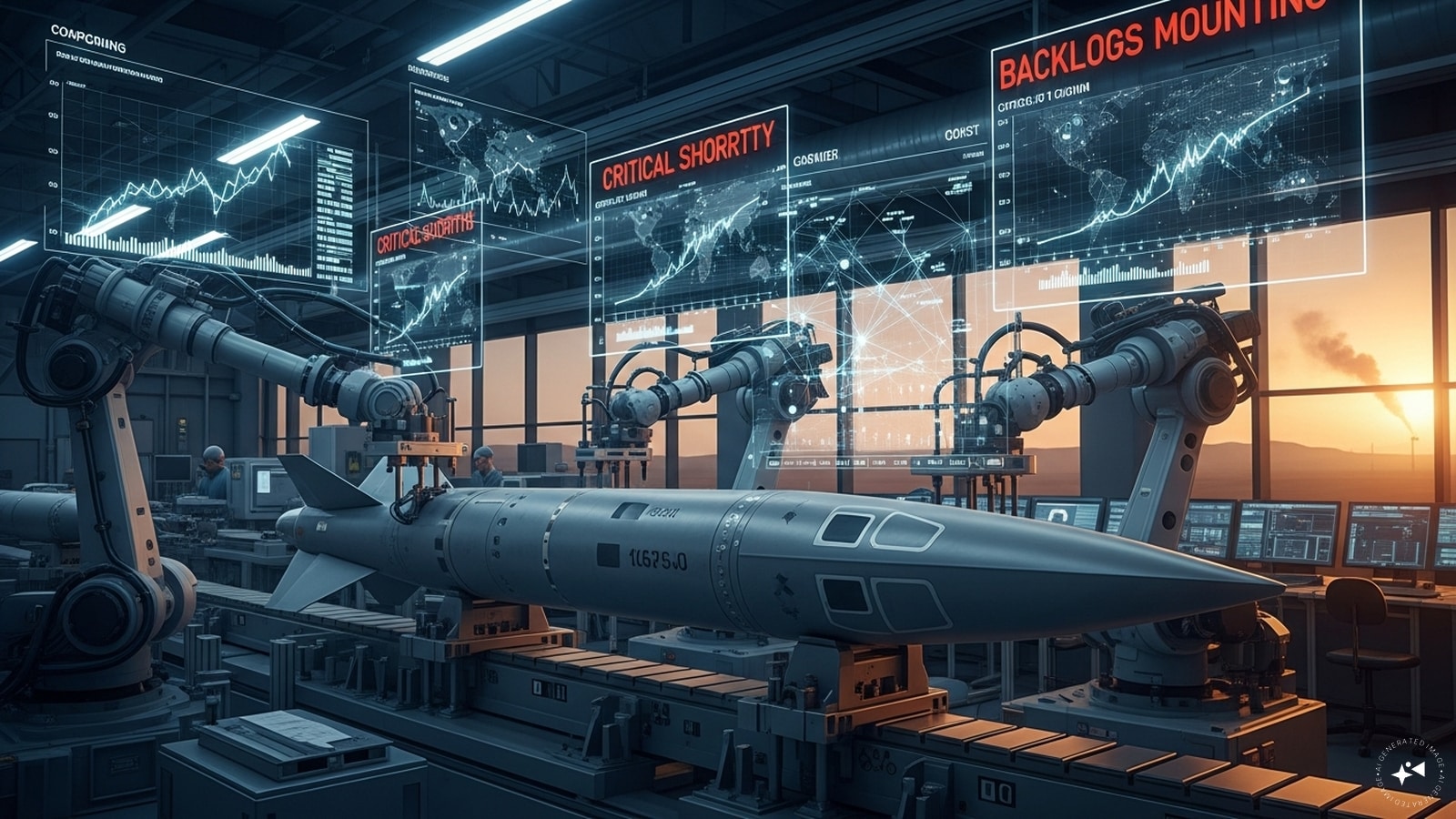
The floor of a modern munitions factory does not sound like war. It sounds like a high-end dental clinic. There is the persistent, clinical hum of climate control and the rhythmic, surgical click of robotic arms pivoting on grease-slicked axels. In a facility tucked away in the American Southwest or the industrial heartlands of Europe, workers in white lab coats—not grease-stained overalls—oversee the birth of a Patriot interceptor or a Storm Shadow missile.
These are not bullets. They are flying supercomputers.
But there is a terrifying silence growing beneath that rhythmic clicking. It is the sound of a math problem that no longer adds up. For thirty years, the global defense industry operated on the "just-in-time" philosophy of a boutique silicon chip manufacturer. We built exquisite, terrifyingly expensive machines in tiny batches, convinced that the days of muddy, industrial-scale slugfests were relics of a black-and-white past.
The recent conflicts in the Gulf and Eastern Europe have shattered that illusion. We are rediscovering a brutal, ancient truth: high-tech brilliance means nothing if you run out of it in the first three weeks of a fight.
The Accountant’s War
Consider a hypothetical logistics officer named Elias. Elias doesn't fire missiles; he tracks them on a spreadsheet. In the old doctrine, Elias was told that precision would replace volume. Why need a thousand dumb bombs when one "smart" missile can fly through a specific window from fifty miles away?
It was a beautiful theory. It saved billions of dollars. It allowed governments to downsize factories and sell off stockpiles.
Then the reality of sustained regional conflict arrived. Elias watches the screen as interceptors—each costing upwards of $4 million—are launched to knock down "suicide drones" that cost less than a used Honda Civic. The math is a slow-motion car crash. You can win every single engagement and still go bankrupt by Tuesday. Or worse, you can simply run out of the "exquisite" tools because the factory that makes the specific sensors for those missiles only produces twenty units a month.
This is the "manufacturing limit" that is currently sending shockwaves through every ministry of defense from London to Riyadh. We traded the raw, muscular capacity of the mid-20th century for a brittle, sophisticated efficiency.
The Ghost in the Machine
The problem isn't just money. You can’t simply "print" a missile, even if you have an infinite budget.
Modern defense systems rely on a sprawling, fragile web of sub-suppliers. One specific missile might require specialized casting for its engine, a very particular grade of microchip from a foundry in Taiwan, and rare-earth magnets processed in a single facility halfway across the globe.
When the demand spikes, the web snaps.
During the height of the Cold War, the defense industrial base was a sprawling, redundant giant. If one factory blew a fuse, ten others could take the load. Today, the industry has undergone what economists call "radical consolidation." There are only a handful of "Primes"—the massive conglomerates—left. Beneath them, the "Tier 3" and "Tier 4" suppliers have vanished. These were the small, family-owned machine shops that knew how to turn a specific type of hardened steel. When they went out of business in the 90s because there weren't enough orders, that institutional knowledge evaporated.
You cannot conjure a master machinist out of thin air. You cannot rebuild a shuttered solid-rocket motor facility in a weekend.
We are finding that the "invisible stakes" of the modern defense landscape aren't about who has the fastest jet. They are about who has the most boring, reliable supply chain for ball bearings and thermal batteries.
The Gulf’s New Gravity
The Middle East has long been the world’s showroom for advanced weaponry. But the latest escalations have changed the Gulf from a customer to a laboratory—and a catalyst.
For decades, the Gulf states were content to buy security off the shelf. They wrote the checks; the West sent the crates. But the realization that Western production lines are choked has triggered a frantic, quiet pivot. They are no longer just buying the missile; they are trying to buy the factory.
This isn't just about sovereignty. It’s about survival. If a regional power realizes that their primary ally’s stockpiles are depleted by a conflict on the other side of the world, they are suddenly, terrifyingly alone.
This anxiety is fueling a massive shift in how money flows. We are seeing a move toward "localization"—forcing defense giants to build assembly lines on foreign soil. It is a desperate attempt to bypass the bottlenecks of the traditional Western industrial base. But even this faces the same ghost: the lack of a skilled workforce and the scarcity of raw components.
The Arrogance of Precision
There is a psychological weight to this shift. For a generation, military planners lived in the "End of History." They believed that war would remain a series of short, sharp "surgical strikes."
That arrogance led to the dismantling of the "Industrial Base of Democracy." We assumed we would always have time to spool up production if things got hairy. We were wrong.
In a world where a $500 drone can disable a $10 million tank, the "price of admission" for modern defense has inverted. We are over-engineered for a type of war that isn't happening, and under-equipped for the one that is.
The emotional core of this crisis is a sense of vulnerability that hasn't been felt in the West for eighty years. It is the realization that our "technological edge" is a glass sword. It is sharp, yes. It is beautiful. But once it shatters, we have no way to forge a new one quickly.
The Grind of the New Era
So, what happens when the money is there but the missiles aren't?
Governments are now forced to play a high-stakes game of "prioritization." Every missile sent to one theater is a missile taken away from another potential flashpoint. It is a zero-sum game played with the lives of millions.
We are entering an era of "The Long Grind." Defense companies are being asked to do something they haven't done since the 1940s: prioritize volume over vanity. They are being told to make systems simpler, cheaper, and more "attritable."
But the transition is agonizing. It requires changing the very DNA of how we design technology. It means moving away from the "all-in-one" wonder-weapons that take a decade to develop and toward modular, "good enough" systems that can be pumped out by the thousands.
The struggle is visible in the eyes of the engineers who have spent their careers chasing the 1% improvement in accuracy, only to be told that what we actually need is 1,000% more of the old stuff. It is a blow to the ego of a high-tech civilization.
The Weight of the Unbuilt
Walk back onto that quiet, clinical factory floor.
The robotic arm clicks. The climate control hums. The workers in their white coats check their monitors. On the screen, a single interceptor is marked as "Complete."
In a warehouse five miles away, a logistics officer looks at a shelf that should hold a hundred of those interceptors. There are only five.
The gap between those two numbers is where the future of global security lives. It is a gap filled with the ghosts of closed factories and the hubris of a world that thought it could outsmart the necessity of mass production.
The machines are faster than ever. The software is more brilliant than we dreamed. The money is flowing like a river. Yet, the silos remain half-empty, waiting for a manufacturing miracle that hasn't arrived.
The next war won't be won by the side with the best computer code. It will be won by the side that can keep the factory lights on when the sensors run out.
We are finally realizing that in the end, iron still beats silicon if you have enough of it.
The silence in the silo is the loudest warning we’ve ever had.