Northern Ireland stands on the precipice of a forty-year exile from the world stage, a drought that has transformed from a temporary slump into a structural crisis. While the romanticism of 1982 and 1986 still lingers in the rain-soaked terraces of Windsor Park, the reality of 2026 is far bleaker. The national team is currently navigating a high-stakes play-off path that requires them to overcome Italy in Bergamo before facing either Wales or Bosnia-Herzegovina. Even with a tactical mastermind like Michael O’Neill at the helm, the path to North America is blocked by decades of underinvestment and a widening gulf in European football’s middle class.
The "why" behind this prolonged absence is not found in a lack of passion, but in a systematic failure to modernize. For years, the Irish FA relied on a golden generation that overperformed under O'Neill during the Euro 2016 cycle. That success acted as a mask, hiding the fact that the pipeline of talent was drying up. When the old guard—the McAuleys, the Davis's, the Evans's—began to fade, there was no equivalent tier of battle-hardened professionals ready to take their place.
The Michael O’Neill Paradox
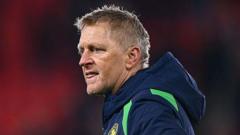
In a move that raised eyebrows across the Irish Sea, Michael O’Neill recently took on a dual role, managing Blackburn Rovers in the EFL Championship while preparing for the World Cup play-offs. This is not the behavior of a federation in a position of strength. While the official line suggests this keeps O'Neill "sharp" and gives him "proximity" to his players in the English second tier, it highlights a desperate need for the national team to remain relevant in a domestic market that increasingly views international breaks as a nuisance.
O’Neill’s second spell has been defined by a brutal transition. He has been forced to blood teenagers and League One stalwarts against elite European opposition. Isaac Price and Shea Charles represent the future, but expecting them to carry the tactical burden against a wounded Italian side is a monumental ask. The manager is effectively trying to build a house while the storm is already overhead.
Infrastructure of Neglect
The stadium situation in Belfast is a physical manifestation of the country’s footballing stagnation. While the Clearer Twist National Stadium at Windsor Park remains a fortress of sorts, the surrounding infrastructure is crumbling. The saga of Casement Park is a national embarrassment that has cost Northern Ireland its seat at the table for Euro 2028.
The stadium was removed from the hosting roster because the redevelopment couldn't meet UEFA’s deadlines. Now, in early 2026, we see only "enabling works" and site clearances. Costs have ballooned from an initial £78.5 million to an eye-watering £260 million. While the GAA and various governments argue over the funding gap, the footballing community watches as a once-in-a-generation opportunity to revitalize the city’s sporting heart slips away.
The Grassroots Funding Illusion
Politicians love a photo opportunity at a local club, and the recent announcement of a £9 million pilot scheme for grassroots facilities is being touted as a victory. In reality, it is a drop in the ocean. The Department for Communities admits that the sector needs "significantly more investment," but the delivery of these funds is paced over years, not months.
Consider the "Performance Programme" versus the reality of a kid playing on a waterlogged pitch in Fermanagh. The Irish FA has launched the Youth Football Framework, a five-year plan aimed at a "child-centered approach." While the sentiment is noble, the implementation is slow. A framework cannot replace a lack of all-weather pitches or the disappearance of full-time scouts in rural areas.
- The Funding Gap: Current government pledges sit around £170 million, leaving a massive shortfall for major projects.
- The Talent Drain: Young players are still leaving for English academies at 16, often disappearing into the "loan carrousel" and losing the regular first-team football necessary for international progression.
- The Competition: Nations like Luxembourg and Iceland, once considered "easy points," have overtaken Northern Ireland in terms of technical coaching and facility development.
The Slovakia Scar
The psychological toll of recent failures cannot be ignored. The stoppage-time defeat to Slovakia in late 2025, which ended automatic qualification hopes, was a microcosm of the last decade. A defensive lapse, a controversial refereeing decision, and a lack of clinical finishing. O'Neill fumed at the goal that "should clearly have been disallowed," but the harsh truth is that top-tier nations don't leave their fate to the whims of a VAR official in Kosice.
Northern Ireland is currently the third most underperforming nation in UEFA when factoring in population and participation rates. This isn't a temporary dip in form; it is a statistical red alert. The strategy for 2026–2029 speaks of "inspiring the nation," but inspiration is a poor substitute for a functioning National Football Centre. The proposed facility at Galgorm is still in the planning stages, with construction not expected to start until 2027.
The Survival Strategy
If Northern Ireland is to ever return to the World Cup, the focus must shift from "qualifying by miracle" to "qualifying by design." This requires a ruthless assessment of the Irish League’s role. The domestic game is improving, but it remains a semi-professional environment that struggles to prepare players for the intensity of the international stage.
We are seeing a reliance on the "ancestry" rule to find players in English academies who have a tenuous link to Ulster. While this has provided short-term fixes, it is not a sustainable model for a proud footballing nation. True success will only come when a kid from Derry or Lisburn can access the same level of coaching and facilities as a teenager in Reykjavik or Brussels.
The play-off in Bergamo is more than just a game. It is a referendum on the state of the sport in Northern Ireland. A win would be one of the greatest upsets in the country's history, a "Gerry Armstrong moment" for the TikTok generation. A loss, however, would confirm what many fear: that the Green and White Army is becoming a nostalgic act, forever singing about the past because the present is too painful to confront.
The Irish FA generates roughly £23 million a year, which it reinvests. In the world of modern football, that is change found down the back of the sofa. Without a massive, state-led injection of capital into the very foundations of the game, the wait for a World Cup will not just continue; it will become permanent.
The time for "careful consideration" and "progressive moves" has passed. The bulldozer needs to be in the ground at Galgorm and Casement, and the money needs to be on the pitch at the grassroots level. Anything less is just managing a slow, dignified decline.
If you want to see the future of Northern Irish football, don't look at the flashy graphics of the 2026 draw. Look at the empty, derelict stands of Casement Park. That is the monument to the current era.
Would you like me to analyze the financial feasibility of the Irish FA's 2027 National Football Centre project?