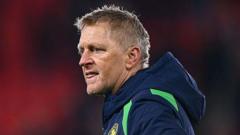
The final whistle against the Czech Republic did more than just extinguish Ireland’s mathematical chances of qualification. It exposed a systemic vacuum. Heimir Hallgrimsson stood on the touchline, a figure of visible dejection, but the "pain" he described in the post-match press conference is merely a symptom of a much deeper, structural rot within the Irish senior setup. For a manager hired to bring "Icelandic grit" and tournament-hardened pragmatism to a squad that had grown soft under the idealistic but ultimately fruitless tenure of Stephen Kenny, the regression has been startling.
Ireland did not just lose a football match in Prague. They lost their identity.
The Illusion of Progress
When the Football Association of Ireland (FAI) eventually landed Hallgrimsson after a protracted and frankly embarrassing search process, the brief was clear. Shore up the defense. Stop the bleeding. Turn the Aviva Stadium back into a fortress where superior technical sides dread to play. Instead, the team has regressed into a state of tactical paralysis. They are neither a progressive passing side nor a disciplined low-block unit. They exist in a grey area of mediocrity, caught between two philosophies and mastering neither.
The numbers tell a story that the emotional rhetoric seeks to hide. Against the Czechs, Ireland’s expected goals (xG) sat at a dismal 0.42. You cannot win international matches with such a complete lack of creative output. While Hallgrimsson lamented the "small details" and "cruel bounces" that led to the Czech goals, the reality is that Ireland was outplayed in the middle of the park for seventy minutes. The midfield duo looked like strangers. They lacked the spatial awareness to track runners from deep, and when they did win the ball, the transition was agonizingly slow.
The Captaincy and the Leadership Gap
Leadership is not just about wearing an armband and shouting at referees. It is about organizational management under pressure. Currently, the Irish squad suffers from a leadership deficit that begins in the dugout and trickles down to the pitch. Hallgrimsson’s public admissions of "pain" and "disappointment" are becoming a repetitive soundtrack to failure. There is a fine line between honesty and the projection of helplessness.
In elite international sport, the manager must be the lightning rod for pressure. By constantly highlighting the psychological fragility of his players, Hallgrimsson is inadvertently reinforcing it. The players look like they are playing with a weight on their shoulders, terrified of making the mistake that will inevitably lead to another post-match autopsy about "learning processes." At this level, the learning process should be over. These are professional athletes playing in the top tiers of English and European football. They don't need a mentor; they need a tactician who can give them a roadmap to a clean sheet.
Tactical Rigidity in a Fluid Game
The most damning indictment of the current regime is the lack of a Plan B. Hallgrimsson has wedded himself to a rigid structure that relies heavily on individual moments of brilliance from wide areas. When those moments don't arrive—as they didn't in Prague—the team has no internal mechanism to change the tempo of the game.
The Czech Republic identified the weakness in Ireland’s defensive transition within fifteen minutes. They targeted the space behind the wing-backs with ruthless efficiency. Rather than adjusting the shape or dropping a midfielder deeper to cover the vacated space, the Irish bench remained static. This isn't just a lack of quality on the pitch; it's a failure of bench management.
The FAI and the Cost of Indecision
We must look at the architects of this era. The FAI’s hunt for a manager lasted nearly eight months. During that time, the momentum of the national team stalled completely. By the time Hallgrimsson was appointed, he was already behind the curve. He inherited a squad that had been told for three years that "the process" was more important than the result. Breaking that habit requires a radical shift in culture, yet the FAI chose a manager whose primary strength is defensive organization, then failed to provide him with a coaching staff that understands the nuances of the modern Irish player.
The commercial reality of this failure is looming. Empty seats at the Aviva Stadium are no longer a threat; they are a reality. Fans are voting with their feet. The "Green Army" has always been loyal, but loyalty requires at least a glimmer of hope. When the overriding emotion from the manager is pain rather than defiance, the fans take their cues from him.
The Technical Deficiency
There is a hard truth that Irish football fans struggle to accept. The technical ceiling of the current squad is lower than we care to admit. For decades, Ireland relied on a spine of Premier League regulars playing for top-six clubs. That era is gone. Today’s squad is largely comprised of Championship stalwarts and bottom-half Premier League squad players.
However, this does not excuse the lack of a coherent system. Nations with similar or even lesser resources—Albania, Slovenia, and indeed Hallgrimsson’s own Iceland in 2016—have shown that a well-drilled, tactically astute collective can punch well above its weight. Ireland is currently punching well below it.
The focus on "heart" and "passion" is a convenient distraction from the fact that the team cannot keep the ball for more than three passes under high-intensity pressure. In Prague, the Czechs didn't need to be extraordinary. They simply needed to be organized. They waited for the inevitable Irish error, exploited it, and then managed the game with a professional ease that made the Irish efforts look amateurish.
The Youth Development Paradox
We are told that the future is bright because of the talent coming through the underage ranks. But the bridge between the Under-21s and the senior team is currently a broken one. Promising talents are being thrown into a dysfunctional senior system and seeing their confidence shattered. We are witnessing the "scarring" of a generation.
Evan Ferguson, once touted as the savior of Irish football, looks isolated and starved of service. A striker of his caliber needs a supply line. In the current setup, he is expected to be a target man, a playmaker, and a finisher all at once. It is an impossible task. If the manager cannot find a way to integrate the youth talent into a winning structure, their potential will be wasted in a cycle of international failure.
Broken Defensive Principles
The hallmark of a Hallgrimsson team should be its solidity. Yet, Ireland is conceding goals from set-pieces and basic defensive lapses that would be unacceptable at Sunday league level. Why? Because the defensive organization is not a byproduct of coaching, it's a byproduct of a lack of tactical clarity.
When a defender doesn't know where his teammate is, he loses his own position. That's what happened in the build-up to the Czech opener. A simple overlap, a missed rotation, and suddenly the center-backs were exposed. The manager’s "pain" is an admission that he has lost control of his primary objective.
Ireland’s recovery will not come from more of the same. It requires a fundamental shift in the FAI’s approach to the senior team. If Hallgrimsson cannot deliver on his core promise of defensive stability and a winning culture, then his tenure is already a failed experiment. The Irish football public is exhausted by the cycle of disappointment, and they are tired of being told to trust a process that has yielded only mediocrity.
If the FAI and Hallgrimsson cannot find a way to stop the bleeding, the national team will continue its slide into irrelevance. The pain being felt in the dressing room is nothing compared to the apathy growing in the stands.
Get the defensive shape right or get out of the way.