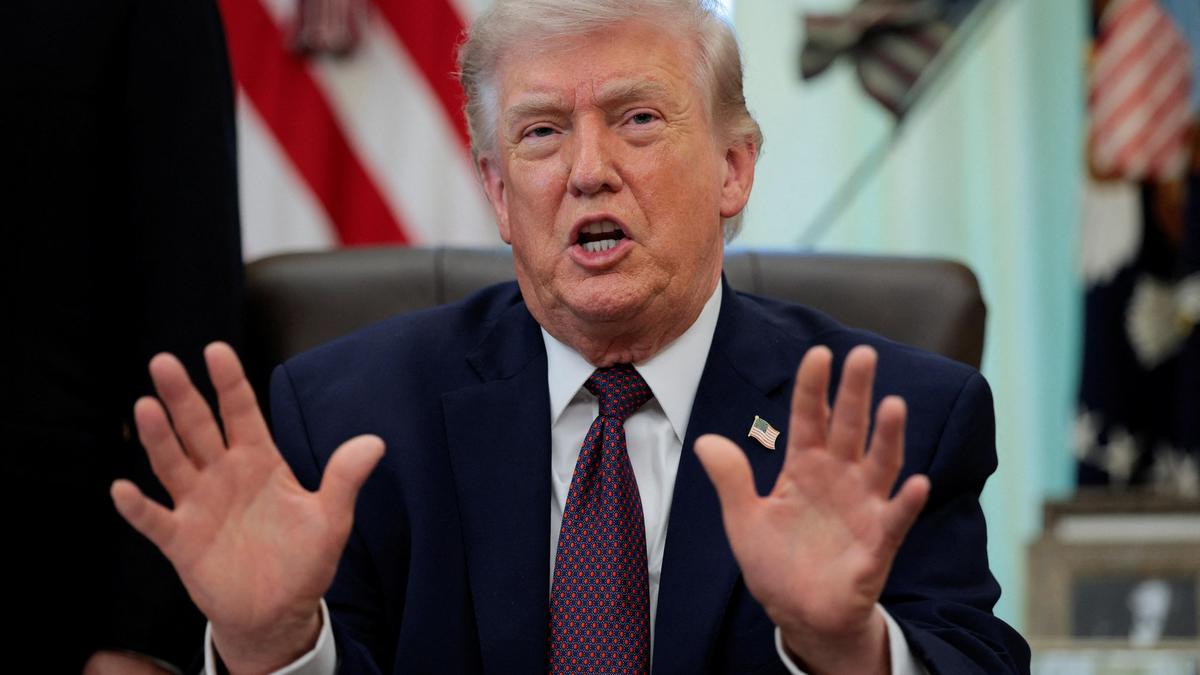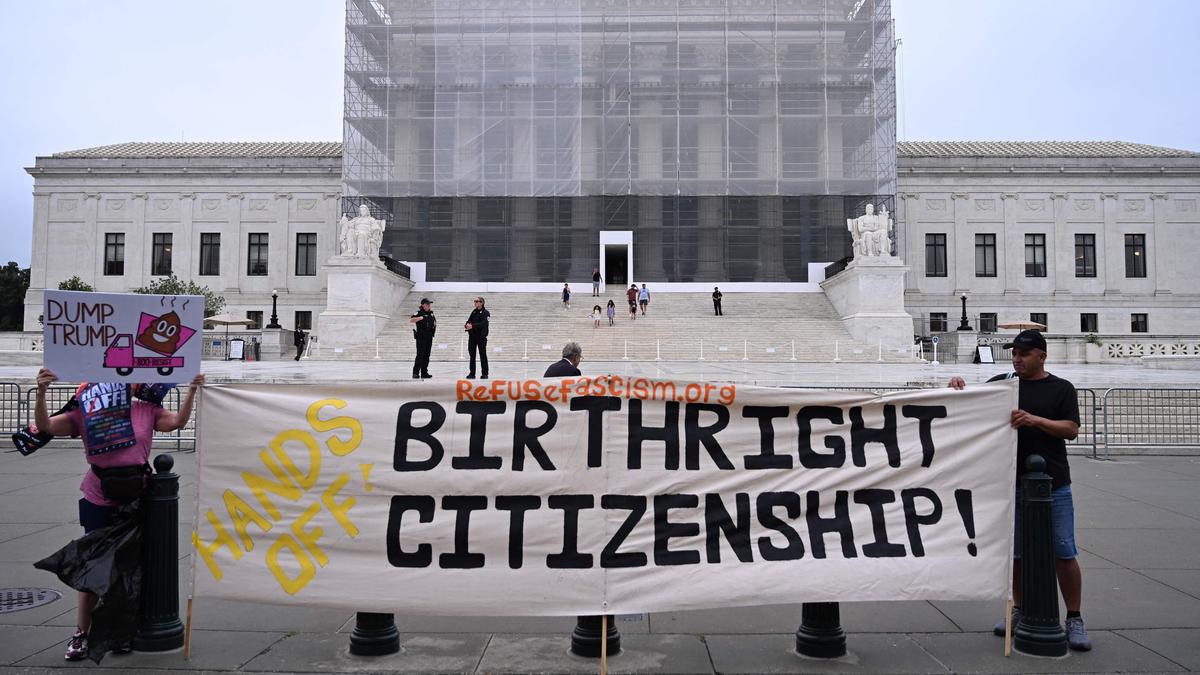
The heavy brass doors of the Supreme Court carry a weight that has nothing to do with physics. They are the gates to the American identity. On April 1, 2026, those doors will swing open for a man who has spent a decade trying to redefine who, exactly, is allowed to walk through them. Donald Trump isn’t just sending lawyers this time. He is showing up in person.
He wants to talk about the 14th Amendment. He wants to talk about a concept that has been the bedrock of the American experiment since the dust of the Civil War settled: birthright citizenship.
To understand why a hearing in a marble hall in D.C. matters, you have to look away from the podiums and the television cameras. Look instead at a girl named Elena. She doesn't exist in the legal briefs, but she is the ghost in the machine of this entire debate. Elena was born in a fluorescent-lit hospital in El Paso. Her first breath was American air. Her first cry was heard on American soil. Because of a sentence written in 1868, she is as much a citizen as any descendant of the Mayflower.
But if the arguments heard this April prevail, that certainty evaporates. The "accident of birth" becomes a legal liability.
The Architect of the Argument
Trump’s arrival at the Supreme Court is a theatrical masterstroke, but the legal foundation he’s leaning on is cold and transactional. For years, the prevailing wisdom held that the 14th Amendment was settled law. It states, with deceptive simplicity, "All persons born or naturalized in the United States, and subject to the jurisdiction thereof, are citizens of the United States."
The debate hinges on those four words: subject to the jurisdiction.
For over a century, the Supreme Court has interpreted this to mean practically everyone born here, excluding only the children of foreign diplomats or invading armies. It was the great equalizer. It meant that your citizenship was not a gift from the government, but a right granted by the land itself.
Trump’s legal team is preparing to argue that "jurisdiction" requires more than just being physically present and following the law. They are proposing a "consensual" theory of citizenship. In their view, the United States must consent to your citizenship. If your parents were here without legal status, the argument goes, the country never entered into a contract with you.
It turns a right into an invitation. Invitations can be rescinded.
A History Written in Scars
We have been here before. The 14th Amendment wasn't written to be a welcoming mat for modern immigrants; it was written to bury the ghost of the Dred Scott decision. It was a promise to formerly enslaved people that their children would never again be considered "property" or "aliens" in the only home they had ever known.
When you tinker with the mechanism of birthright citizenship, you aren't just changing a policy for the future. You are pulling at a thread that runs through the very heart of the post-Civil War reconstruction. You are suggesting that the government has the power to look at a newborn baby and say, "Not ours."
Consider the logistical nightmare of a "non-consensual" birth. If the Supreme Court sides with the former president, the United States could instantly create a permanent underclass of "stateless" people. These are children who belong to no country, born in a legal vacuum, protected by no constitution, and owed nothing by the state.
Fear is a powerful motivator. For the Trump campaign, this hearing is the ultimate realization of a "border-first" philosophy. It is the final wall—not one made of steel and concrete in the desert, but one made of ink and precedent in the law books.
The Human Ledger
There is a specific kind of silence that falls over a room when a family realizes their foundation is built on sand.
Imagine a father who has paid taxes for twenty years, whose daughter is the valedictorian of her high school class, who wears a jersey with "USA" across the chest. Under the proposed shift, that daughter’s passport is no longer a shield. It becomes a question mark.
Critics of birthright citizenship often point to "birth tourism" or "anchor babies," terms designed to make the process sound like a strategic heist. They use statistics to show a strain on public resources. They talk about the "magnet effect," claiming that the promise of a blue passport pulls people across dangerous rivers and through scorching deserts.
But statistics don't have faces. They don't have the terrified eyes of a teenager who suddenly learns that the only country she has ever loved considers her an intruder.
The legal theory being tested on April 1 suggests that citizenship should be inherited through blood, not location. In the legal world, this is the difference between jus soli (right of the soil) and jus sanguinis (right of the blood). Most of the world operates on the right of the blood. America, uniquely, built its greatness on the right of the soil.
If we switch to the right of the blood, we become something else. We become a nation defined by our ancestors rather than our aspirations.
The Court as a Crucible
The justices sitting on those high-backed chairs are well aware of the stakes. They aren't just deciding a case; they are deciding the definition of a "person" under the law.
If the court moves to limit the 14th Amendment, the ripple effects will be felt in every DMV, every polling station, and every hospital in the country. The burden of proof shifts. Currently, if you are born here, you are a citizen until proven otherwise. In a post-birthright world, you might have to prove you belong.
How do you prove the "consent" of a nation? Do you show a visa? Do you show a lineage chart? The paperwork of belonging would become the most valuable—and most gate-kept—commodity in America.
Trump’s presence at the hearing signals that this is not a peripheral campaign issue. It is the core. It is the fulfillment of a promise to a base that feels the American identity has been diluted. To them, he is the protector of the gates. To the millions living in the shadow of this decision, he is the one trying to lock them out of their own homes.
The Invisible Line
The hearing will likely be technical. There will be long discussions about the intentions of Senator Jacob Howard in 1866. There will be debates about the 1898 case of United States v. Wong Kim Ark, which affirmed that the son of Chinese immigrants born in San Francisco was indeed a citizen.
But the technicality is a mask for a much deeper, more visceral struggle.
The struggle is over the soul of the map. Is a map a set of lines that defines who we exclude, or is it a vessel for anyone who stands upon it?
When the sun sets over the Supreme Court on April 1, the lawyers will pack their briefcases and the protesters will fold their signs. The former president will board his plane, and the news cycle will churn toward the next controversy.
But for the girl in El Paso, and for millions like her, the air will feel slightly thinner. They will be waiting to hear if the soil they walk on still recognizes their footsteps, or if they have become ghosts in the land of their birth.
The law can be rewritten. The blood can be questioned. But the memory of belonging is much harder to erase.