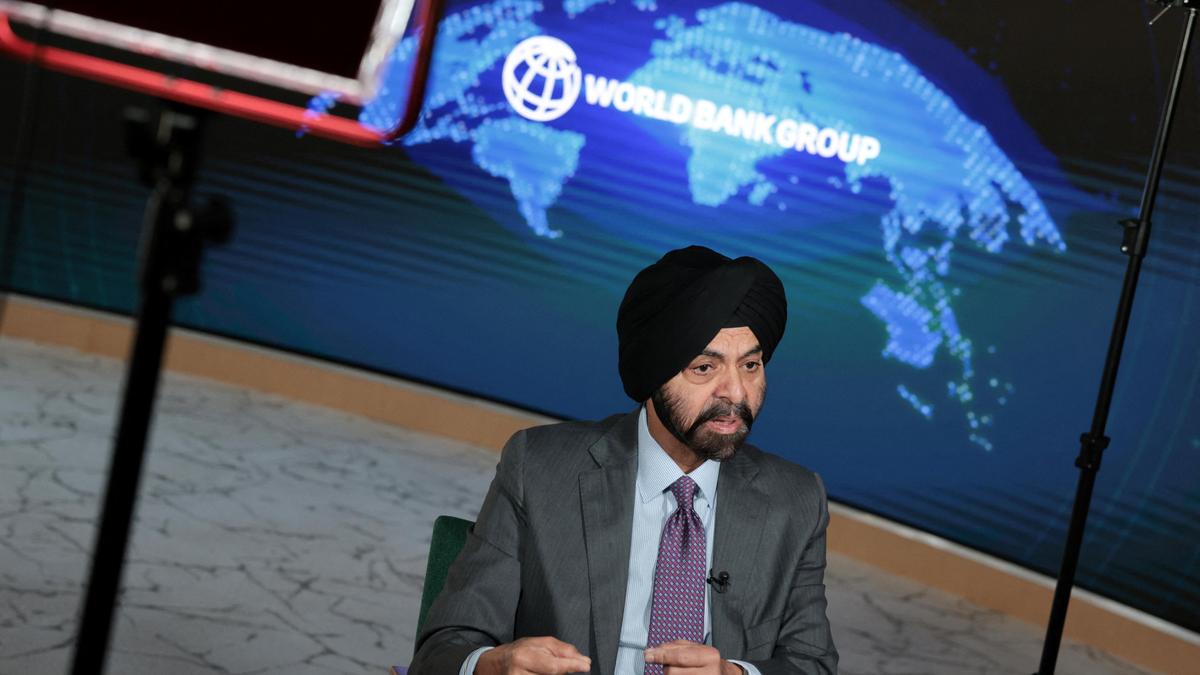
War doesn't just leave behind ruins and grief. It leaves behind a generation of people with nowhere to work and no way to feed their families. World Bank President Ajay Banga isn't just worried about the immediate violence. He's looking at a massive, structural failure in the global economy that hits the moment the guns go silent. We’re talking about a global jobs crisis that threatens to swallow the progress of developing nations.
The math is brutal. Over the next decade, roughly 1.1 billion young people in the Global South will reach working age. That’s a staggering number. Now, look at the job creation projections. Based on current trends, these same countries are only expected to create about 325 million jobs. You don't need a PhD in economics to see the gap. We’re missing nearly 800 million jobs. That isn't just a "challenge." It’s a recipe for permanent instability.
I've seen how this plays out in post-conflict zones. When the rebuilding starts, everyone talks about "infrastructure." They want to talk about bridges, roads, and power grids. But if you build a bridge and the people crossing it don't have a paycheck waiting on the other side, that bridge leads to a dead end. Banga is shouting into the wind because he knows that without jobs, "peace" is just a temporary pause before the next round of desperation-driven unrest.
The Post War Employment Trap
Post-war recovery usually follows a predictable, flawed pattern. International aid floods in. Construction booms for a few years. Then, the money dries up, the contractors leave, and the local population is left with shiny new buildings but no sustainable industry.
Think about Ukraine or Gaza. When those conflicts eventually end, the focus will be on clearing rubble. But what happens in year five? Or year ten? If the private sector doesn't have a reason to invest, those economies will flatline. Banga’s alarm isn't just about the quantity of jobs, but the quality and the timing. We're seeing a trend where the window to integrate youth into the workforce is shrinking.
If a young person spends their first five years of adulthood in a post-war vacuum without a job, their lifetime earnings potential drops off a cliff. It's a "scarring effect." They lose skills. They lose hope. Eventually, they become easy targets for recruitment by the very groups that started the wars in the first place. This is the cycle the World Bank is desperate to break.
Why Private Capital is Staying Under the Bed
You can’t solve an 800-million-job deficit with government grants. It’s impossible. The money simply isn't there. To fix this, you need private investment. But right now, private capital is terrified of emerging markets.
Investors look at political instability, fluctuating currencies, and weak legal systems and they run the other way. Banga has been vocal about the need for "de-risking." Basically, he wants the World Bank and other multilateral banks to take the first loss on projects to make them palatable for big pension funds and private equity.
It’s a tough sell. Honestly, it’s a bit of a gamble. If the World Bank uses its limited capital to guarantee private profits, it risks its own credit rating. But if it doesn't, the jobs won't appear. We're stuck in this weird limbo where everyone knows what needs to happen, but nobody wants to be the first one to put their neck on the line.
The Missing Middle of Small Business
Most jobs don't come from massive factories or tech giants. They come from small and medium enterprises (SMEs). These are the shops, the local logistics firms, and the small-scale processors. In stable economies, SMEs are the backbone. In a crisis zone, they’re the first to die.
They can't get loans. Interest rates in these areas are often astronomical—sometimes 20% or 30%. How can a small business grow when it's being strangled by debt from day one? The World Bank is trying to pivot toward supporting these smaller players, but the scale of the problem is just so vast.
The Digital Myth and the Reality of Labor
There’s a lot of talk about "digital jobs" or "leapfrogging" traditional industrialization. People love to imagine a kid in a rural village coding for a firm in London. It's a nice story. It's also mostly a fantasy for the scale we're talking about.
You can't code without a stable power grid. You can't run a digital business without high-speed internet that doesn't cut out every time there's a storm. While digital opportunities matter, the bulk of that 1.1 billion youth population needs physical jobs. They need manufacturing, modernized agriculture, and services.
Ignoring the "old school" sectors in favor of tech buzzwords is a mistake. We need to stop pretending that an app is going to replace a factory floor for a country trying to lift itself out of poverty. It’s about basic dignity. It’s about having a place to show up to every morning where your labor is traded for a fair wage.
Education is Failing the Market
Another huge issue Banga highlighted is the "skills mismatch." We have millions of graduates who have degrees that don't match what the market actually needs. It’s a global problem, sure, but in a developing nation, it’s a catastrophe.
Governments spend a fortune on education systems that are stuck in the 1980s. They're churning out clerks and administrators when the economy needs mechanics, solar technicians, and specialized farmers. We need to stop measuring success by how many kids are in school and start measuring it by how many of them can actually do something useful when they leave.
This requires a radical shift in how we think about vocational training. It shouldn't be the "backup plan" for kids who aren't academic. It should be the primary engine of the economy. If you want to fix the jobs crisis, you have to fix the pipeline.
Changing the Global Playbook
The old way of doing development is dead. Sending a check and wishing a country "good luck" doesn't work in 2026. The world is too interconnected, and the stakes are too high.
If the World Bank can't find a way to bridge that 800-million-job gap, the consequences won't stay in the Global South. We'll see unprecedented migration surges. We'll see more radicalization. We'll see global supply chains shatter every time a new "jobless" generation decides they’ve had enough of the status quo.
Banga is right to be loud. He’s right to be worried. The "alarm" he’s sounding is the sound of a clock ticking down. We have less than a decade to figure out how to create work for a billion people.
Start by looking at where your own investments go. Demand that development banks prioritize job-multiplier projects over vanity infrastructure. Support initiatives that de-risk investment in emerging markets. This isn't charity. It’s global survival. If we don't create jobs, the "post-war" era will just be the preamble to the next conflict. Stop waiting for a miracle and start building the markets that make work possible. It's the only way out.