The air changes first. It becomes heavy, recycled, and carries a faint metallic tang that suggests a thousand engines have breathed here before you. Then comes the light—or the lack of it. High-pressure sodium lamps cast a rhythmic, amber strobe against the windows as you descend. Above you sits two kilometers of solid, unyielding granite. If the mountain decided to shrug, you would be a microscopic smear in a geological heartbeat.
We don't think about the pressure. We think about the GPS signal cutting out. We think about how many minutes remain until we see the sky again. But for the engineers who spent thirty years chewing through the roots of the Alps and the fjords of Norway, every meter was a negotiation with the earth itself.
They aren't just roads. They are scars of human defiance.
The Ghost of the Saint Gotthard
In 1980, the world changed for anyone trying to traverse the spine of Europe. Before the Gotthard Road Tunnel opened, the Swiss Alps were a wall. You climbed the pass, white-knuckled and praying for your brakes, or you waited for the train. Then, 16.9 kilometers of hollowed darkness offered a shortcut.
Imagine being a lead driller in the mid-70s. You are standing in a space where no light has ever touched in four billion years. The temperature rises. The rock "talks"—a series of sharp cracks and groans that sound like a ship’s hull under stress. This isn't a metaphor. It is the sound of tectonic stress searching for a weakness.
The Gotthard wasn't just built; it was wrestled into existence. It took ten years and the lives of nineteen workers to connect Göschenen with Airolo. When you drive it today, the journey takes fifteen minutes. To the men who bled there, those fifteen minutes represent 3,650 days of inhaling stone dust and damp heat. It remained the gold standard of subterranean transit for two decades, a concrete artery through the heart of the continent.
The Loneliness of the Lærdal
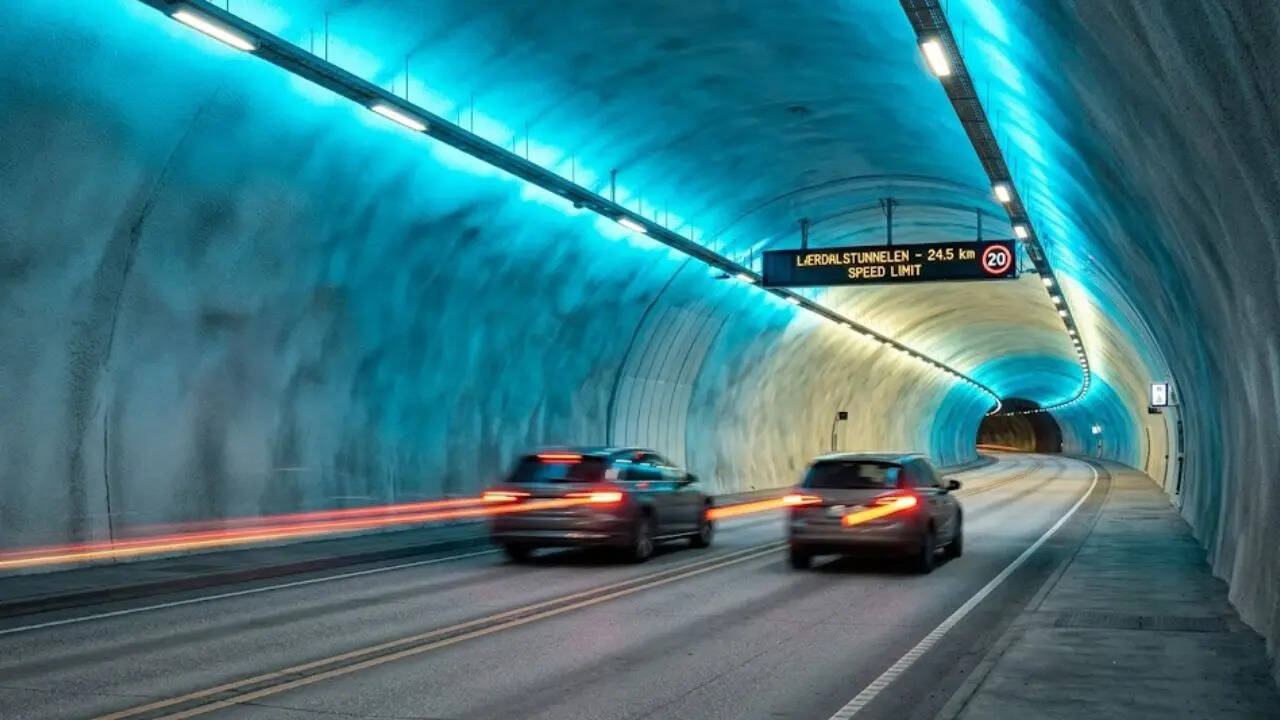
If the Swiss built for efficiency, the Norwegians built for the soul. To drive the Lærdal Tunnel is to experience a specific kind of sensory deprivation. It is 24.5 kilometers long. That is fifteen miles of gray concrete.
Scientists worried about "highway hypnosis." They feared that drivers, trapped in a repetitive visual loop for twenty minutes, would simply drift off into a trance and veer into the walls. The solution wasn't more signs or louder rumble strips. It was art.
Every six kilometers, the tunnel expands into a massive cavern bathed in blue and yellow light. It mimics a sunrise. It tricks the brain into thinking it has reached the end, providing a psychological "breath" before the darkness resumes. Norway didn't just solve a geographic problem; they solved a neurological one. They recognized that the human mind isn't designed to be buried alive at sixty miles per hour.
The Titan Beneath the Sea
The Tokyo Bay Aqua-Line feels like something out of a mid-century fever dream. Most long tunnels go through mountains because mountains are in the way. Japan decided to go under the ocean because the city was too full.
It is a hybrid—a bridge that suddenly gives up and dives into the waves. The Kisarazu artificial island, known as the Umi-hotaru or "sea firefly," marks the transition. From there, you descend into a 9.6-kilometer shield-driven tunnel.
Think about the stakes here. Japan is a land of tremors. To build a tunnel in a high-seismic zone, under a massive body of water, requires more than just concrete. It requires massive rubber gaskets and flexible joints that allow the entire structure to wiggle like a snake when the earth shakes. It is a masterpiece of precariousness. You are driving through a tube held together by math and a collective hope that the Pacific stays on its side of the wall.
The Longest Reach: Zhongnanshan
China’s pace of construction is difficult to grasp without seeing it. The Qinling Zhongnanshan Tunnel is a 18.02-kilometer double-tube beast that slashed travel time through the Qinling Mountains from three hours to forty minutes.
But the Chinese engineers added a flourish that feels almost surreal. Inside the tunnel, they planted artificial forests. Plastic palms and fake grass are illuminated by specialized LEDs to keep drivers alert. It is a kitschy, strange, and deeply human attempt to mask the reality of being encased in stone. We are biological creatures. We need green. We need the illusion of the surface, even when we are miles away from a blade of real grass.
The Price of Progress
We often overlook the Arlberg in Austria or the Xueshan in Taiwan, but each one tells the same story: the refusal to be diverted. The Xueshan Tunnel, specifically, was a nightmare. Workers hit massive underground aquifers. The tunnel flooded. Machines were buried in mud. It took fifteen years to finish a thirteen-kilometer stretch.
There is a specific kind of courage required to go back into a hole that tried to drown you the day before.
When we look at the list of the world's longest tunnels—the Yamate in Japan at 18.2 kilometers, or the New Guanjiao in China—we see numbers. We see "decades to build." But the "decades" aren't a statistic. They are a generation of people who spent their entire working lives in the dark so that we could save two hours on a road trip.
The Invisible Weight
The next time you enter a tunnel, don't look at your dashboard. Look at the ceiling.
Feel the pressure of the earth above you. Think about the "daylight" or "holing through" ceremonies, where two teams of workers, digging from opposite sides of a mountain, finally smash through the last few inches of rock to see each other's faces. They usually exchange flags. They usually weep.
They weep because the mountain is finally conquered. They have created a void where there was once only density. They have turned a barrier into a gateway.
We drive through these places at high speeds, complaining about the radio static or the speed limits. We treat these tunnels as voids—empty spaces between point A and point B. But they are not empty. They are filled with the ghosts of the machines that broke there, the echoes of the blasts that cleared the way, and the sheer, staggering will of a species that refuses to let a mountain stand in its way.
The light at the end of the tunnel isn't just a physical reality. It is a relief that reaches into the lizard brain, a silent signal that the weight of the world has finally been lifted from your shoulders. You emerge into the wind and the sun, and for a fleeting second, the world feels impossibly wide.
Would you like me to look into the specific engineering failures that led to the modern safety standards in these tunnels?