The departure of Carol Kirkwood from the BBC represents more than just a vacancy on a breakfast sofa. It marks the structural collapse of a specific era of public service broadcasting. For decades, Kirkwood functioned as the primary human interface between the British public and the increasingly chaotic unpredictability of the northern hemisphere's jet stream. Her exit follows a pattern of high-profile departures that suggests the corporation is struggling to reconcile its legacy of "personality-led" expertise with a modern, data-driven mandate that prioritizes algorithms over charisma.
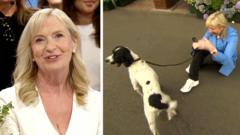
While the public consumes the highlights of her funniest moments—the accidental slips of the tongue, the stray dogs on set, and the genuine warmth that made her a staple of the morning routine—the industry reality is far colder. The BBC is currently navigating a brutal pivot in how it delivers meteorological data. The move away from the traditional "weather presenter" toward a multi-platform, automated delivery system is stripping away the very humanity that Kirkwood spent thirty years cultivating.
The Professionalization of the Morning Smile
Kirkwood was never just a face on a screen. She was a trained professional who joined the Met Office before moving into the broadcast sphere. This distinction matters because it represents a bridge between raw scientific data and national sentiment. When the weather is the primary topic of British conversation, the person delivering that news carries a heavy burden of public trust.
The "emotional goodbye" seen on screen is the surface tension of a much deeper shift. Broadcast newsrooms are under intense pressure to cut costs while competing with the precision of smartphone apps. In this environment, the veteran presenter becomes an expensive luxury. However, the data suggests that viewers don't tune in for the numbers alone. They tune in for the interpretation. Kirkwood’s ability to translate complex pressure systems into a narrative about whether a viewer should hang out their laundry was a masterclass in communication.
The Met Office Fracture and the Contract War
To understand why figures like Kirkwood are becoming a rarity, one must look at the 2018 decision by the BBC to drop the Met Office as its primary weather provider in favor of MeteoGroup. This wasn't just a change in data source; it was a fundamental shift in the corporation’s identity. The Met Office had been the BBC’s partner since the first radio weather forecast in 1922.
This commercial divorce created a vacuum. Presenters who were once part of a unified national institution suddenly found themselves caught between commercial interests and public duty. Kirkwood survived that transition, but the landscape changed around her. The focus shifted to "visualizations"—high-definition graphics and augmented reality setups that often felt like they were competing with the presenter for the viewer’s attention.
The irony is that as the technology became more sophisticated, the connection with the audience became more clinical. Kirkwood’s "funniest moments" were often the result of technology failing or the unpredictability of live, outdoor broadcasts. These moments served as a reminder that the weather is a physical, messy reality, not just a digital render on a green screen.
Why Personalities Outperform Data Points
The BBC’s current strategy appears to favor a rotating cast of meteorologists who can work across radio, television, and digital platforms with interchangeable efficiency. On paper, this is a "robust" way to manage a 24-hour news cycle. In practice, it ignores the psychology of the morning viewer.
Morning television is built on the illusion of companionship. Viewers develop a parasocial relationship with presenters like Kirkwood because they are the first "outsiders" allowed into the home every day. When a veteran of three decades leaves, that bond is severed. It is not easily replaced by a younger presenter with a better grasp of TikTok trends but less weight in the eyes of a skeptical public.
The "emotional" nature of her exit isn't just about her own feelings; it’s about the audience’s sense of loss. We are witnessing the end of the "National Weather Identity." In an era of climate anxiety, the public seeks a steady hand and a familiar voice. By moving toward a more fragmented, data-heavy approach, the BBC risks losing the trust that Kirkwood worked so hard to maintain.
The Hidden Mechanics of the BBC Exit
High-profile departures at the BBC are rarely as simple as a retirement or a desire for new challenges. There is an ongoing tension regarding the "over-60s" demographic in broadcasting, particularly for women. While male anchors are often allowed to age into the role of "elder statesmen," women in the industry frequently face a different set of pressures.
Kirkwood’s departure leaves a massive void in the BBC’s diversity of age and experience. The industry has a habit of "refreshing" its lineups in a way that often feels like a purge of institutional memory. By losing Kirkwood, the BBC loses a direct link to the standards and practices of a different era of broadcasting—one where the goal was to inform and calm, rather than to shock and viralize.
The Cost of the Digital Pivot
The BBC Weather app is one of the most used pieces of software in the UK. This success has a downside for the television wing of the business. Management sees the millions of users checking their phones and wonders if a live television presenter is still a necessary expense.
But an app cannot contextualize a flood warning with the same nuance as a human who understands the geography of the affected area. An app doesn't have a "funny moment" that humanizes a disaster or lightens the mood during a dark winter morning. The drive for efficiency is creating a hollowed-out version of public service.
The Survival of the Specialist
Those who remain in the wake of this departure face a steep climb. They must prove that they are more than just readers of a script generated by a meteorological computer. They have to find a way to be indispensable in an age where every viewer has a radar map in their pocket.
The path forward isn't more technology; it’s more humanity. The "emotional goodbye" should be a warning to the BBC. If they continue to prioritize the platform over the person, they will find themselves with a very efficient, very accurate system that nobody bothers to watch.
The viewer's loyalty isn't to the BBC logo or the MeteoGroup data. It's to the person standing in front of the map, telling them, with a hint of a smile, that it’s probably going to rain.
Stop looking at the data and start looking at the face.