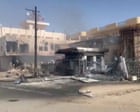
The plastic bottle is empty, and the air is thick with the smell of scorched rubber and unwashed skin.
Amina is nine years old. She doesn't know the World Health Organization has issued a warning about a "health crisis unfolding in real time." She doesn't know that global health officials are tracing the collapse of sanitation systems across the Middle East. What she knows is that her throat feels like it has been rubbed with sandpaper, and the only water source left is a greenish puddle near a ruptured pipe.
She watches her mother, Fatimah, stare at that puddle. Fatimah knows the math of survival. She knows that drinking this water might lead to a fever that consumes her daughter within forty-eight hours. She also knows that without it, Amina won't last the afternoon in the 104-degree heat.
This is the microscopic reality of a regional collapse. While headlines focus on the thunder of falling buildings and the geometry of border lines, a silent, biological war is being fought in the gut of every child caught in the crossfire.
The Middle East is currently a laboratory for how quickly modern civilization can revert to the Middle Ages. When the power grids fail, the water pumps stop. When the pumps stop, the waste stays where it falls. When the waste stays, the ancient killers—cholera, polio, and typhoid—return with a vengeance that modern medicine thought it had buried decades ago.
The Ghost of an Extinguished Disease
For years, polio was a ghost story told by grandfathers. It was a relic of a harder time, nearly eradicated by a global effort that felt like a rare victory for humanity.
Then came the first case in Gaza.
It wasn't just a medical statistic. It was a signal fire. Polio is a virus of proximity and poverty. It thrives where children are packed into tents, where soap is a luxury, and where the sewage system is nothing more than a shallow trench in the sand. When the WHO confirmed that the virus was circulating, they weren't just reporting a localized outbreak. They were announcing the failure of a collective promise.
Imagine the logistical nightmare of a vaccination campaign in a war zone. It requires a "cold chain"—a constant, unbroken line of refrigeration from the factory to the syringe. If the temperature rises for even an hour, the vaccine becomes little more than expensive water. In a region where the electricity flickers out for days at a time, keeping those vials cold is an act of defiance.
Health workers are moving through ruins, carrying coolers packed with ice that is rapidly melting. They aren't looking for patients in clinics; they are looking for them in the rubble of schools and the back of overstuffed trucks. Every child who receives those two drops of protection is a small, fragile barrier against a wave of paralysis that threatens to define an entire generation.
The Invisible Architecture of Survival
We often think of healthcare as a doctor with a stethoscope. But the most vital healthcare is actually the invisible architecture beneath our feet.
It is the pressure in the pipes. It is the chemical balance in the treatment plant. It is the garbage truck that comes on Tuesday morning. When these things vanish, the hospital becomes a graveyard.
Consider a surgeon in Lebanon or Yemen. They are skilled, trained, and desperate to help. But what is a surgeon without sterile water? What is a doctor without the ability to wash their hands between patients?
The WHO reports that the health crisis is "unfolding," but for those on the ground, it has already arrived. The clinics that remain open are often overwhelmed by "silent" ailments. These aren't the dramatic injuries of shrapnel or debris. They are the slow, grinding illnesses of displacement. Scabies that turns skin into a weeping mess because there is no water to bathe. Respiratory infections that bloom in the dust of pulverized concrete.
The statistics are staggering, yet they fail to capture the sensory horror. They don't mention the sound of a hundred coughing infants in a single basement. They don't mention the way the air tastes when the sewage treatment plants are bombed or run out of fuel.
The Math of the Unattainable
In a stable society, we spend about 1% of our day thinking about our health. In the midst of this crisis, it consumes 100%.
Fatimah spends four hours a day searching for fuel to boil the water she took from the puddle. She spends another three hours waiting in a line for a bag of flour that may or may not arrive. Her "health" is no longer a state of being; it is a full-time job.
When we talk about the Middle East, we often talk about the "stakes." Usually, we mean the political stakes or the economic stakes. But the real stakes are the biological limits of the human body. The body can go three minutes without air, three days without water, and three weeks without food.
The "unfolding crisis" is the sound of millions of people hitting those limits simultaneously.
It is easy to look at the map and see a series of isolated tragedies. But the pathogens don't see borders. A virus doesn't care about a ceasefire. If a health system collapses in one territory, the shockwaves travel through the groundwater, the air, and the movement of refugees.
We are witnessing the de-development of a region. It is the systematic removal of the things that keep us human. This is not just a lack of medicine; it is a lack of safety, dignity, and the basic certainty that tomorrow will be as healthy as today.
The Weight of the Smallest Things
The most heartbreaking part of this collapse is how cheap the solutions are compared to the cost of the catastrophe.
A packet of oral rehydration salts—a simple mixture of salt and sugar—can save a child from dying of diarrhea. It costs pennies. But in a conflict zone, those pennies might as well be gold bars if the roads are blocked or the warehouses are empty.
The WHO and other agencies are screaming into the wind because they know that once these diseases take root, they are incredibly difficult to pull out. It is easier to prevent a polio outbreak than it is to manage a thousand paralyzed children. It is cheaper to repair a water main than it is to treat a city for cholera.
Yet, the world waits.
We watch the "real-time" updates as if they are a slow-motion film. We see the graphs trend upward—more cases, more deaths, less medicine. We analyze the geopolitical implications while the biological reality remains unchanged.
Amina eventually drinks the water.
Her mother has filtered it through a piece of cloth, a desperate gesture of hope against the invisible. They sit together in the shade of a leaning wall. The girl’s thirst is momentarily quenched, but the countdown has begun. Within her, a battle may soon be fought between her immune system and the bacteria that have thrived in the chaos of men.
The health crisis in the Middle East is not a series of unfortunate events. It is the predictable, mathematical result of destroying the foundations of life. It is what happens when we forget that the most important thing a government or a society can do is ensure that a nine-year-old girl can drink a glass of water without it becoming her death sentence.
The air stays hot. The dust stays thick. The bottles stay empty.
And somewhere, in a basement or a tent, another child begins to cough.