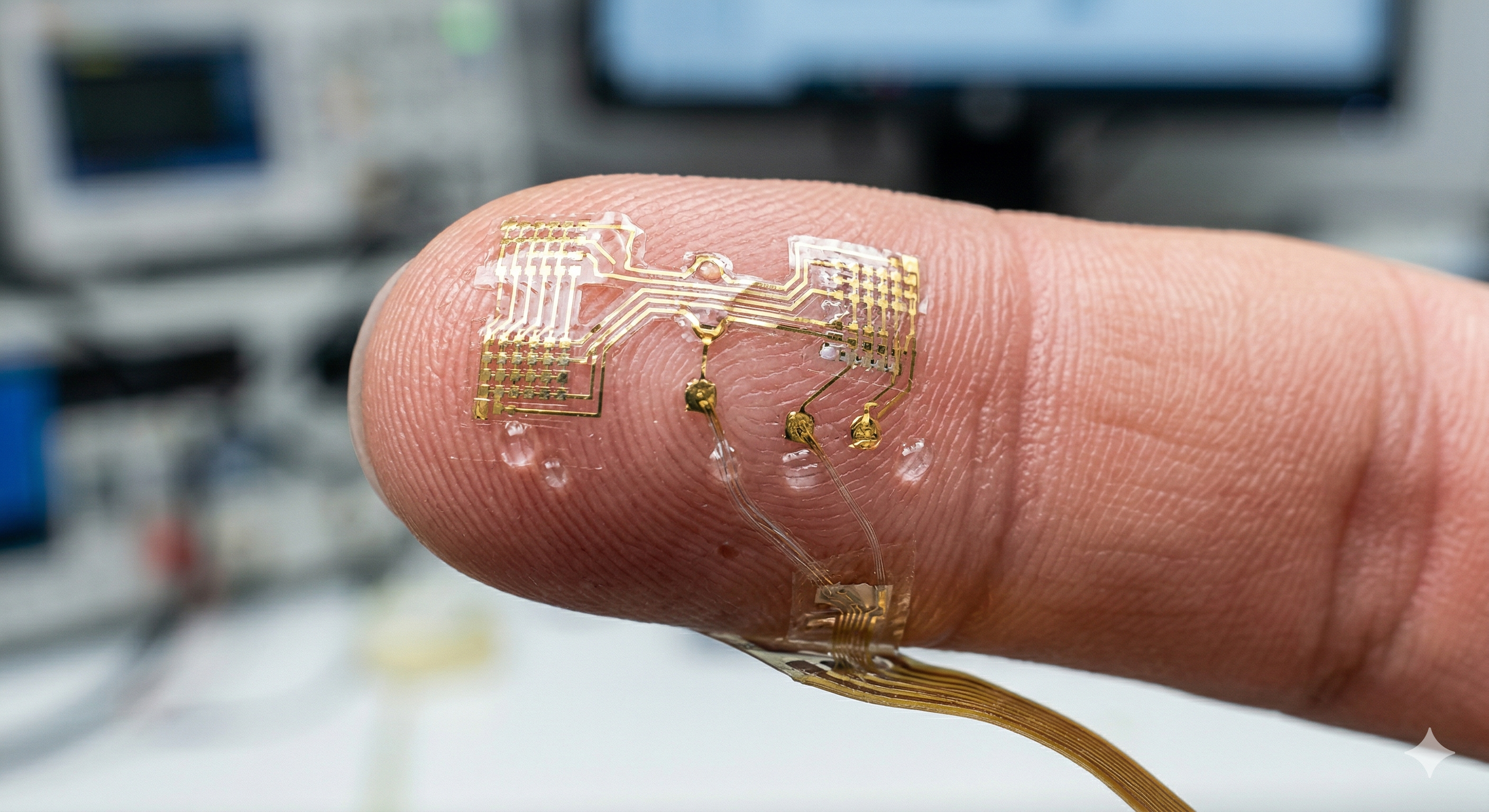
You’re probably used to thinking of sweat as a nuisance. It ruins your favorite gray t-shirt, makes your grip slip on the tennis racket, and generally smells like a bad decision. But for a growing group of engineers at institutions like Caltech and UC San Diego, that salty liquid is pure gold. It’s not just waste. It’s a data-rich biofluid and, believe it or not, a literal battery.
We've spent a decade obsessed with smartwatches that track heart rate and steps. Those are "mechanical" metrics. They tell you how fast your engine is spinning but nothing about the chemistry of the fuel. Sweat sensors change the game by looking at the molecular level in real time. We're talking about monitoring glucose, lactate, and even stress hormones like cortisol without a single needle prick.
The chemistry of a workout
Most people don't realize that sweat contains almost everything your blood does. When you're pushing through a heavy lift or a long run, your skin is leaking biomarkers that tell a story about your metabolic health. Standard wearables guess your exertion. A sweat sensor knows it.
Lactate is the big one here. For years, athletes had to prick their fingers mid-workout to measure lactic acid levels. It's painful and impractical. New wearable patches use enzymes to react with the lactate in your perspiration, creating a small electrical signal. The harder you work, the more lactate you produce, and the stronger the signal becomes. It's direct, chemical feedback.
But there’s a catch that most surface-level articles miss. Sweat rate varies wildly between people. If you're a "salty sweater," your readings might look different than someone who barely glimmers. Researchers are currently tackling this by building microfluidic channels—tiny, lab-on-a-chip pipes—that capture a specific volume of sweat to ensure the concentration readings are actually accurate.
Turning perspiration into power
The most mind-blowing part of this tech isn't just the sensing. It's the power source. Traditional wearables need batteries. Batteries are bulky, rigid, and need charging. They're the literal "heavy lifting" of the tech world.
Scientists have developed biofuel cells that actually run on your sweat. These cells use enzymes to break down lactate, and in that chemical reaction, they release electrons. You are the battery. In a study led by Lu Yin and Joseph Wang at UC San Diego, researchers created a "finger-wrap" sensor. It harvests energy while you sleep or type.
"The goal is to make electronics that are completely self-sustaining," says the research team.
Think about that. You don't plug your watch into the wall. You just exist. Your passive perspiration provides enough microwatts to power a small radio or a sensing chip. It's a closed loop. You produce the fuel, the fuel powers the sensor, and the sensor tells you how the fuel is doing.
Why glucose monitoring is the holy grail
If you ask anyone in the medical tech space what the "big win" is, they’ll say non-invasive glucose monitoring. For people with diabetes, the daily routine of finger pricking is a constant, stinging reminder of their condition. It's exhausting.
Sweat-based glucose sensors have been the "five years away" tech for about twenty years. Why? Because glucose levels in sweat are much lower than in blood. They also lag behind blood sugar changes. If your blood sugar spikes, your sweat might not show it for 10 or 20 minutes.
However, recent breakthroughs in "iontophoresis" are changing this. This process uses a tiny, unfelt electric current to pull interstitial fluid to the surface. It's technically "enhanced" sweating. By combining this with ultra-sensitive graphene electrodes, researchers are finally getting readings that correlate with blood glucose levels closely enough to be useful. It’s not just a dream anymore. We’re seeing prototypes that can actually stick to your arm like a Band-Aid and send data to your phone.
The stress hormone problem
We all say we're "stressed," but that's subjective. Your boss thinks you're fine; you feel like you're vibrating. Sweat sensors offer an objective truth through cortisol.
Cortisol is the body's primary stress hormone. It usually peaks in the morning and drops at night. If those levels stay high, you’re looking at long-term health issues like heart disease or a wrecked immune system. Tracking cortisol usually requires a blood draw or a saliva sample sent to a lab.
New patches are being designed to detect these hormones using molecularly imprinted polymers. Think of it like a lock and key. The sensor has "locks" shaped exactly like a cortisol molecule. When the hormone enters the lock, the sensor’s electrical properties change. It’s a way to quantify mental health. It’s the difference between saying "I feel burnt out" and seeing a chart that proves your endocrine system is redlining.
Dealing with the ick factor
Let’s be real. Wearing a soggy patch sounds gross. This is the biggest hurdle for consumer adoption. No one wants a piece of wet plastic strapped to their forearm all day.
The industry is moving toward "breathable" electronics. Instead of a solid slab of silicone, they're using laser-etched materials that look more like a mesh or a temporary tattoo. These materials allow water vapor to escape while keeping the liquid sweat in contact with the electrodes. They’re thin. They’re flexible. You honestly forget they’re there until you check your app.
There's also the issue of skin irritation. If you leave sweat trapped against your skin for 24 hours, you’re going to get a rash. Designers are now building in "wicking" layers that move old sweat away from the sensor once it’s been read, keeping the skin relatively dry and the data fresh.
What this means for your doctor visits
In a few years, "going to the doctor" might look very different. Instead of a once-a-year checkup where they take a snapshot of your health, your doctor might ask you to wear a sweat patch for a week.
This gives them a movie instead of a photo. They can see how your body reacts to food, sleep, and work stress in your actual life, not in a sterile clinic. It’s the shift from reactive medicine to proactive maintenance. If your potassium levels are dipping into a dangerous zone during your morning jog, the patch tells you before you cramp up or faint.
The privacy elephant in the room
Your sweat contains your DNA. It contains traces of medications you’re taking, substances you’ve consumed, and your unique hormonal signature. This isn't just "step count" data. This is deeply personal biological information.
If insurance companies get their hands on real-time cortisol or glucose data, could they hike your premiums because you had a stressful month? Could an employer track your "performance chemistry" during a presentation? These aren't sci-fi questions. The tech is outpacing the legislation. As we move toward a world where our bodies are constantly "online," we need to be incredibly picky about who owns the server that data sits on.
How to get ahead of the curve
You can't go buy a full-blown cortisol-tracking sweat patch at Best Buy just yet, but the tech is trickling down. If you're interested in this space, look into "sweat rate" patches already available for endurance athletes. Companies like Gatorade have launched single-use patches that give you a basic look at your sodium loss.
Start by tracking your hydration more intentionally. Pay attention to the "white crust" on your workout clothes—that's a sign of a high salt-loss rate. Understanding your basic perspiration patterns now will make you much better at interpreting the complex data these sensors will provide in the very near future. Keep an eye on clinical trials from groups like the Rogers Research Group at Northwestern University. They're the ones currently defining how these devices will actually fit into our lives.
The era of the "dumb" watch is ending. Your skin is about to become the most important interface you own.