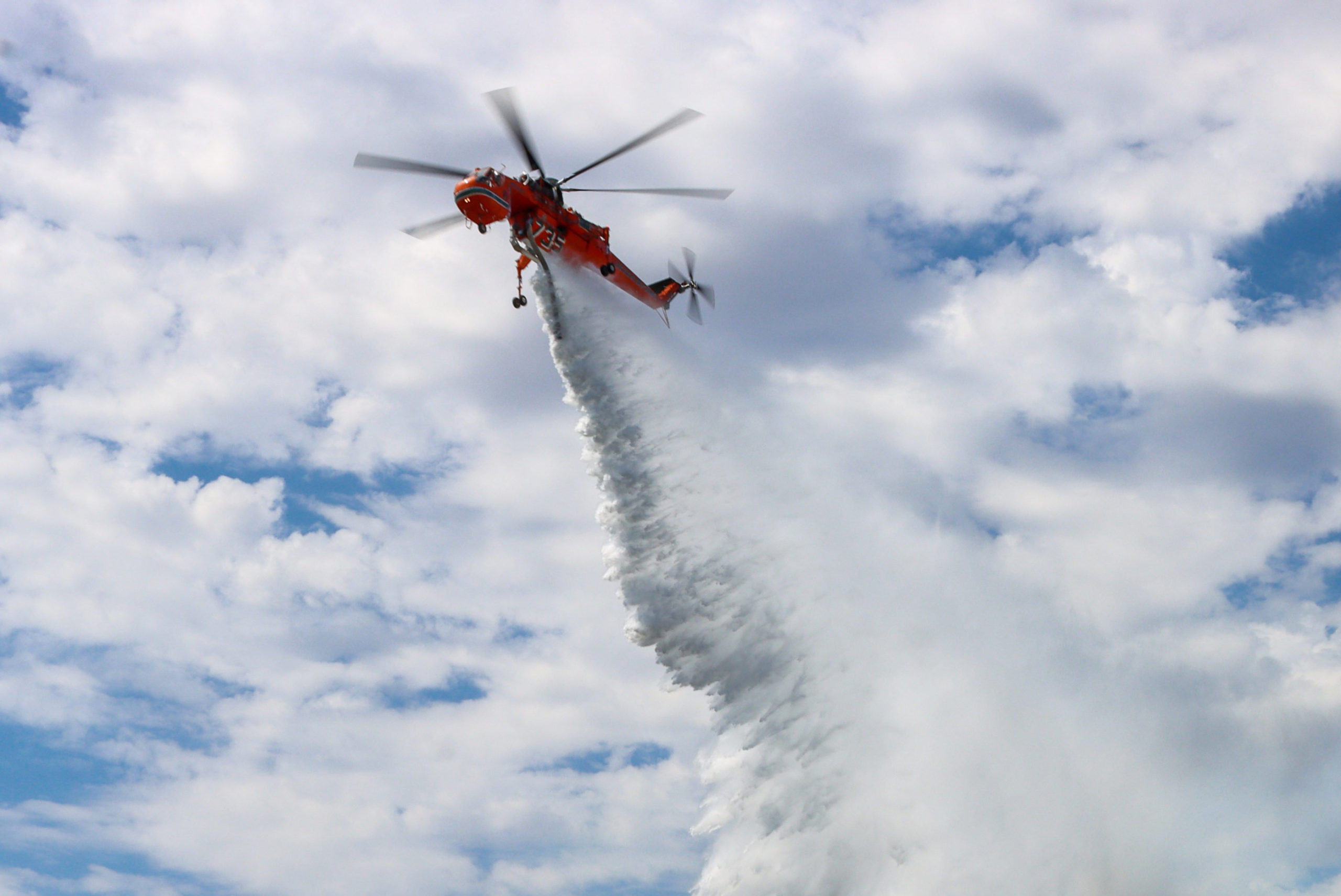
The headlines out of South Africa are predictable. "Pilots Survive Miraculous Crash." "Heroic Crew Escapes Firefighting Helicopter Wreckage." They treat the survival of a flight crew during a water-bombing run as a feel-good story of human resilience.
They are dead wrong.
When a Bell 212 or a Huey II goes down in a dam while dipping a bucket, we shouldn’t be celebrating the "miracle" of their escape. We should be interrogating why we are still putting human beings in the cockpit of a 50-year-old airframe to perform a repeatable, high-risk physics problem that a computer could solve with ten times the precision. The survival of these pilots isn't a success story. It is a lucky break in a systemic failure of how we manage aerial firefighting.
The Myth of the Heroic Aviator
The industry loves the image of the rugged pilot navigating smoke and thermal updrafts. It sells calendars. It builds the "tapestry" of aviation lore—wait, no, it builds a false narrative that human intuition is the gold standard for fire suppression.
In reality, human pilots are the most significant point of failure in the firefighting loop.
Low-level flight in high-density altitudes, combined with the shifting weight of a 300-gallon water bucket, creates a margin for error that is razor-thin. When you add "vortex ring state"—a condition where a helicopter settles into its own downwash—you aren't looking for a hero. You are looking at a pilot fighting a losing battle against aerodynamics.
In the South African incident, the survival of the crew is attributed to training and quick thinking. While true, that "quick thinking" was necessitated by the fact that we still use manual flight controls for a task that is essentially a heavy-lift cargo operation in a disaster zone. We are asking humans to perform like sensors, and then we act shocked when the sensor fails.
The Cost of the "Safety First" Lie
Aviation authorities love to talk about safety culture. They mandate checklists. They enforce rest periods. They audit maintenance logs.
But the most "robust"—no, let's call it what it is—the most effective way to ensure a pilot doesn't die in a firefighting crash is to remove the pilot from the fire.
We have the technology to automate aerial fire suppression. We’ve had it for a decade. Military-grade heavy lift drones and converted autonomous K-MAX helicopters can fly in smoke conditions that would ground a human crew. They can fly at night when the "diurnal cycle" drops the fire's intensity, which is exactly when you should be hitting it hardest.
Why don't we? Because the bureaucracy of civil aviation is terrified of a 5,000-pound unmanned rotorcraft falling on a house. So instead, we continue to let 5,000-pound manned rotorcraft fall into dams, and we call it an "occupational hazard."
I’ve sat in the hangars. I’ve seen the "battle scars" on airframes that have been pushed way past their fatigue life because the contract requires "boots in the air" by 0800. The industry isn't prioritizing safety; it’s prioritizing the status quo of manned contracts because that’s how the insurance premiums are structured.
Why "Engine Failure" is Usually a Cop-Out
Whenever a firefighting helicopter goes down, the initial report almost always mentions "mechanical issues" or "engine flameout." It’s the easiest way to deflect blame from the operational profile.
However, look at the physics of a water-dipping operation:
- The Approach: High power demand to hover out of ground effect over water.
- The Dip: The sudden addition of weight (mass) while the aircraft is in a vulnerable power state.
- The Climb: Maximum power required to clear obstacles while heavy.
If an engine "fails" during this cycle, it’s often because it was being operated at the absolute limit of its thermal capacity in an environment filled with particulate matter (smoke) and high ambient temperatures.
Mathematically, the power required ($P$) for a helicopter to maintain a hover is defined by:
$$P = \sqrt{\frac{T^3}{2\rho A}}$$
Where $T$ is thrust, $\rho$ is air density, and $A$ is the disc area.
In the heat of a South African summer, $\rho$ (density) drops. To keep $T$ (thrust) high enough to lift that water bucket, the engine has to work significantly harder. We are redlining these machines for hours on end and then acting surprised when the metal gives up. Calling it a "mechanical failure" is like redlining your car for 500 miles and blaming the manufacturer when the piston puts a hole through the hood.
The False Economy of Old Iron
The aircraft involved in these "miraculous" escapes are often decades old. The Bell 205s and 212s are the workhorses of the industry, but they are relics.
We keep them in the air because the acquisition cost is low. A used Huey might cost a fraction of a modern, fly-by-wire AW139 or a specialized Firehawk. But the "total cost of ownership" is measured in pilot lives and destroyed airframes.
The industry is stuck in a loop:
- Contractors bid low to win government tenders.
- Low bids necessitate using older, paid-off aircraft.
- Older aircraft have higher maintenance requirements and lower safety margins.
- A crash occurs.
- The crew survives (luckily).
- The media calls it a miracle.
- The cycle repeats.
If we actually valued the lives of these pilots, we would mandate that any aircraft used for aerial firefighting must have been manufactured in the last 15 years and equipped with Terrain Awareness and Warning Systems (TAWS) and automated hover flight-control modes. But that would make the contracts too expensive. We’d rather pay for the "miracle" than the upgrade.
Stop Asking "How Did They Survive?"
The "People Also Ask" section of your search engine is likely filled with queries like:
- "How do pilots survive helicopter crashes in water?"
- "What is the safety record of firefighting helicopters?"
These are the wrong questions. They assume the crash is an inevitable act of God.
The real question should be: "Why are we still using humans for low-level water bombing in 2026?"
If you want to actually solve the problem of forest fires without killing people, you shift to a high-altitude, GPS-guided delivery system or a fully autonomous low-level swarm. You don't send a guy named Dave in a 1974 helicopter to hover 50 feet over a lake while his engine chokes on soot.
The survival of these two pilots in South Africa wasn't a testament to the safety of the industry. It was a stark reminder of how close we are to the edge of a catastrophe every time a bucket hits the water. We are gambling with lives because the "synergy"—no, because the math of the current contract model demands it.
Next time you see a video of a helicopter water-dropping, don't marvel at the skill. Look at the dated cockpit, the vibrating airframe, and the impossible physics. Then ask yourself why we find it acceptable to treat these people as expendable components in a machine that should have been retired when disco was still popular.
The only way to win this game is to stop playing by the 1970s rulebook. Get the pilots out of the cockpit before their luck runs out, because "miracles" aren't a sustainable business model.