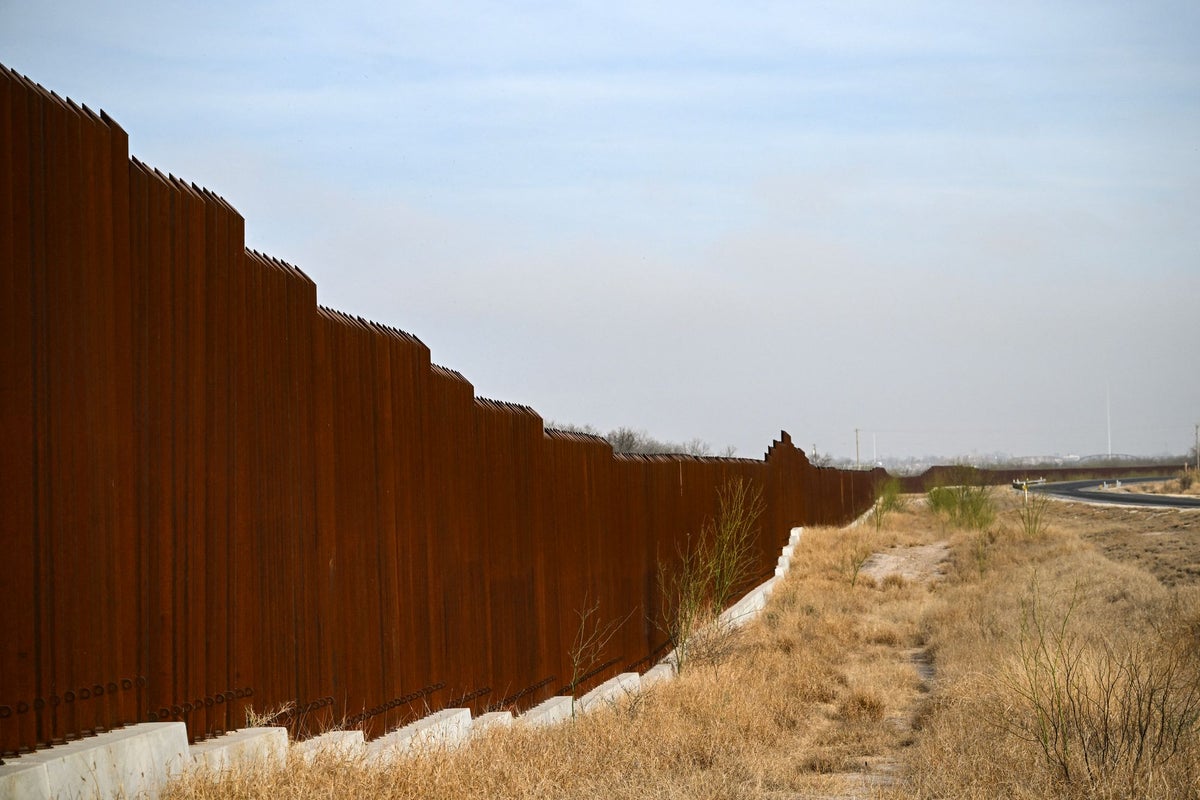
The cancellation of a proposed 400-mile expansion of the U.S. southern border wall represents a fundamental collision between centralized federal directives and the decentralized reality of American property law. While administrative shifts often prioritize speed and visibility, the actualization of large-scale linear infrastructure is governed by three non-negotiable variables: land tenure, topographical viability, and the fiscal efficiency of eminent domain. The decision to abandon the project indicates that the transaction costs—both political and economic—outweighed the projected utility of the physical barrier.
The Triad of Impediments to Linear Border Infrastructure
Large-scale border construction is not merely a task of civil engineering; it is a complex negotiation of space and law. The 400-mile plan failed because it hit a wall of structural reality before a single brick was laid.
1. The Fragmented Ownership Model
Unlike the western portions of the U.S.-Mexico border, which are largely comprised of federal lands, the Texas border is a mosaic of private property. Approximately 95% of land in Texas is privately owned. This creates a high-friction environment for federal projects. When the government seeks to build on private land, it must navigate the Fifth Amendment’s "Just Compensation" clause.
The acquisition process involves:
- Title Research: Identifying every legal stakeholder across hundreds of miles.
- Appraisal Disparity: The gap between federal valuation and owner-perceived value.
- Litigation Lag: Every contested parcel triggers a court case that can stall construction for years.
The administrative burden of managing 400 miles of individual lawsuits creates a logistical bottleneck that renders the project’s timeline indefinite. In this context, the withdrawal is a strategic recognition that the legal throughput was insufficient to meet the administration's goals.
2. Topographical and Hydrological Engineering Costs
The Rio Grande serves as a natural boundary, but its shifting course and floodplain status introduce severe engineering constraints. Building a permanent structure in a floodplain requires compliance with the 1970 treaty between the U.S. and Mexico, which prohibits construction that interferes with river flow or causes cross-border flooding.
Engineers face a "Cost-Complexity Curve" where every mile closer to the river increases the expense of:
- Foundational Integrity: Soil saturation in the Rio Grande Valley requires deeper, more expensive pilings.
- Hydraulic Openings: The wall must include gates or gaps to prevent it from acting as a dam, which paradoxically creates points of vulnerability.
- Maintenance Access: Building further inland to avoid the water creates "no man's land" zones—pockets of U.S. territory trapped on the south side of the wall, which degrades the very security the wall intends to provide.
3. The Political Capital Deficit
The Texas border region is not a monolith, but its local leadership and ranching communities possess significant leverage. When local stakeholders—ranging from municipal leaders to agricultural conglomerates—organize against a federal mandate, the political cost of enforcement rises. The "push back" mentioned in recent reports is actually a measure of "Intergovernmental Friction." If the federal government must fight the state and local entities simultaneously, the project ceases to be a tool of security and becomes a liability for broader legislative agendas.
Quantifying the Opportunity Cost of Eminent Domain
Every mile of wall constructed through eminent domain carries a price tag that extends beyond the materials. We can model the efficiency of this project through a Friction Index.
$FI = \frac{L + A + D}{V}$
Where:
- L is the Legal Cost (per mile)
- A is the Acquisition Premium (market value + litigation fees)
- D is the Delay Cost (inflation and idle labor)
- V is the Security Value (the measurable reduction in illicit flow)
As $FI$ increases, the marginal utility of the wall decreases. In the 400-mile Texas plan, the $FI$ reached a point of diminishing returns. The government realized that the same capital could be deployed toward higher-yield technologies—such as autonomous surveillance towers and fiber-optic ground sensors—which have a significantly lower footprint and bypass the need for massive land seizures.
The Pivot to "Smart" Borders and Virtual Barriers
The abandonment of the physical wall plan signals a shift toward a Disintegrated Security Architecture. Instead of a continuous physical line, the strategy moves toward a network of nodes.
- Aerostat Surveillance: Persistent high-altitude monitoring that covers vast areas without occupying ground space.
- AI-Integrated Sensors: Using seismic and thermal data to identify movement, allowing for targeted tactical responses rather than passive physical deterrence.
- Tiered Response Zones: Utilizing natural geography as the primary barrier and deploying mobile units to intercept at specific "choke points."
This transition allows the federal government to claim border security progress without the optics or the expense of seizing land from its own citizens. It is a pivot from 19th-century physical engineering to 21st-century digital surveillance.
Strategic Realignment of Federal Resources
The immediate tactical move for stakeholders—including contractors, local governments, and policy analysts—is to transition from "Hard Infrastructure" to "System Integration." The capital previously earmarked for the 400-mile wall will likely be reallocated into two primary streams:
- Port of Entry (POE) Modernization: Approximately 90% of illicit narcotics enter through legal ports. Expanding the throughput and technological scanning capabilities at these points offers a higher ROI than rural barriers.
- Mobile Kinetic Response: Increasing the "speed to intercept" through improved road networks and high-mobility vehicle fleets.
Contractors who were previously bidding on steel and concrete should pivot toward data management and multi-sensor fusion. The era of the "Great Wall" is being replaced by the era of the "Deep Network." This is not a retreat from border security; it is a tactical evolution toward a model that is less vulnerable to the legal and geological realities of the Texas landscape. Focus resources on the development of non-persistent barriers and high-fidelity detection systems that do not require permanent land easements. Avoid long-term investments in heavy civil engineering projects tied to private land parcels, as the legal risk remains the primary barrier to execution.


