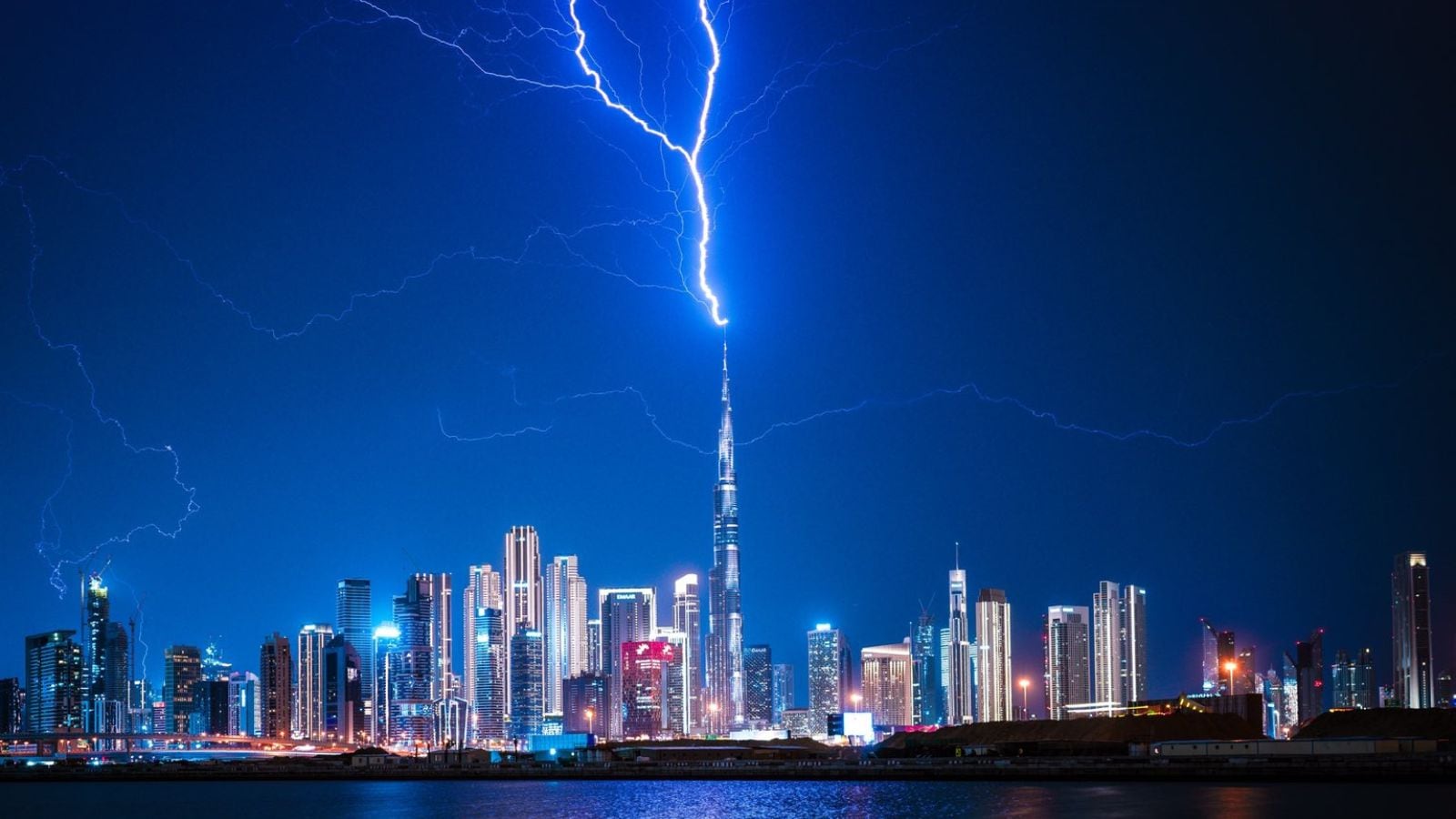
The Burj Khalifa just took a direct hit from a lightning bolt. The headlines are screaming. The authorities are frantic. The "safety alerts" are flooding your phone like the rain flooding the Sheikh Zayed Road.
Everyone is focused on the flash. They are missing the circuit.
The common narrative surrounding UAE storms is built on a foundation of desert-dwellers’ anxiety and a fundamental misunderstanding of structural engineering. We treat a thunderstorm in Dubai like a biblical event because we’ve been conditioned to view this geography as a static, dry sandbox. We see a skyscraper struck by lightning and think "danger."
I’ve spent a decade analyzing urban infrastructure resilience. I’ve seen what happens when "safety first" rhetoric masks a lack of technical literacy. Here is the truth: The Burj Khalifa getting struck by lightning isn’t a news story. It’s a success story. If it wasn't getting hit, you should be terrified.
The Lightning Rod Fallacy
The "lazy consensus" suggests that these storms are "lashing" the city, implying a victimhood of the built environment. This is a category error.
A building like the Burj Khalifa is not a target; it is a giant, vertical lightning conductor. It is designed to be hit. It wants to be hit. The structure employs a sophisticated Lightning Protection System (LPS) that integrates the very steel of its skeleton into a massive Faraday cage. When that purple bolt connects with the spire, the energy isn't "attacking" the building. It is being efficiently, boringly, and safely shunted into the ground through a series of heavy-duty conductors.
When you see that viral photo of the strike, you aren't looking at a disaster. You are looking at a $1.5 billion machine working exactly as intended. The "danger" isn't the 828-meter tower. The danger is the three-story villa in Jumeirah with a DIY satellite dish and a neglected grounding wire.
Stop Asking if the Rain is Natural
Every time a cloud darkens over the Emirates, the same tired debate resurfaces: "Is this cloud seeding?"
It’s the wrong question. It doesn't matter if the rain was nudged by a King Air 350 injecting silver iodide or if it’s a standard Mediterranean depression. The obsession with the source of the water distracts from the failure of the drainage.
The UAE’s infrastructure wasn't built for "heavy rain." It was built for "maximum ROI per square foot." We have some of the most advanced architecture on the planet resting on top of 20th-century drainage logic.
If you want to be a "contrarian insider," stop looking at the sky and start looking at the manhole covers. The real crisis isn't the "thunderstorm lashing the UAE." It’s the fact that our urban "landscape"—a word people love to use to describe nothing—is almost entirely non-porous. Asphalt, concrete, and marble don't absorb water. They move it. And they usually move it toward the lowest point, which happens to be the basement of your luxury apartment building.
The Architecture of Arrogance
We build for the 99% of days when the sun is a physical weight. We optimize for heat. We use materials that reflect UV rays and glass that keeps the AC bills manageable.
But we ignore the 1% of the year that actually tests the system.
The "safety alerts" issued by authorities are a reactive band-aid for a proactive failure. Telling people to "stay indoors" is the ultimate admission that the public space is poorly engineered for its environment. Imagine a scenario where a city’s value isn’t judged by the height of its towers, but by the speed at which it can clear 50mm of rainfall. Dubai would fail that test every single winter.
We see the Burj Khalifa as a symbol of power. In a storm, it’s actually a symbol of isolation. While the tower stands perfectly safe, grounded, and dry, the streets around it turn into canals. This is the "nuance" the headlines skip: the vertical city is invincible, but the horizontal city is fragile.
Why Your "Safety Alerts" are Useless
Authorities love issuing alerts because it shifts the liability from the state to the individual.
- "Don't drive."
- "Avoid valleys."
- "Stay away from windows."
This is common-sense fluff. It provides no actionable value to the person whose warehouse in Al Quoz is currently taking on three inches of water an hour. The real safety alert should be for the developers who continue to build "waterfront" properties without considering that "water" can also come from the sky.
If you are a business owner or a resident, stop relying on the government’s weather app. Start auditing your own environment.
- Check the Sump Pumps: Most residential buildings have them. Most haven't been tested since the last "historic" storm.
- Understand Grounding: If you live in a structure built before 2005, your lightning protection is likely a prayer and a rusted copper rod.
- Analyze the Slope: Look at the gradient of the road outside your office. If it slopes toward your door, no "alert" will save your servers.
The Myth of the "Unprecedented" Storm
The media loves the word "unprecedented." It’s a shield. If a storm is unprecedented, nobody is to blame for the chaos.
Except it’s a lie. The 1988 Sharjah floods. The 2016 Dubai "supercell." The April 2024 deluge. These aren't "once-in-a-century" events. They are the new baseline.
The status quo is to treat every storm like a freak accident. The contrarian reality is that we are living in a tropical-desert hybrid climate. Our buildings are prepared for the lightning, but our society is not prepared for the mud. We have the technology to build a tower that can withstand a billion volts of electricity, yet we can't figure out how to keep a tunnel from flooding.
Data Over Drama
Let’s look at the physics. A single lightning strike can carry up to 1 billion joules of energy. That sounds terrifying. But the Burj Khalifa’s LPS is designed to handle multiple such strikes in a single minute. The thermal expansion of the air during a strike creates the "thunder" clap, which is essentially a sonic boom.
People fear the sound. They should fear the "ponding."
In engineering, "ponding" is when water accumulates on a flat roof faster than it can drain. The weight of that water can exceed the structural load-bearing capacity of the roof. While you're busy filming the lightning on your phone, the roof of your warehouse is literally bowing under the weight of "unprecedented" rain.
The Burj Khalifa is fine. It’s the thousands of flat-roofed, poorly drained industrial and residential units that are the real story.
The "Safety" Industrial Complex
There is a whole industry built on "disaster management" that thrives on the drama of these storms. They sell you insurance you can't claim, and they issue warnings that tell you what you already know: it's raining.
The real "insider" move is to stop being a consumer of the spectacle.
The Burj Khalifa getting hit by lightning is a tourist attraction. It’s a light show. It’s a PR win for Emaar’s engineering team. The chaos on the ground is the reality. We are obsessed with the tip of the spear—the glittering spire—and we ignore the shaft and the handle.
Stop looking at the Burj. Look at your feet.
If the water is rising, it’s because the people who designed the ground you're standing on assumed it would never rain again. They were wrong. They are wrong every year. And until we stop treating rain like a surprise and start treating it like a requirement for urban planning, you'll keep getting those useless alerts on your phone while your car floats away.
Invest in drainage. Verify your grounding. Ignore the sky.
The lightning isn't the problem. The ground is.