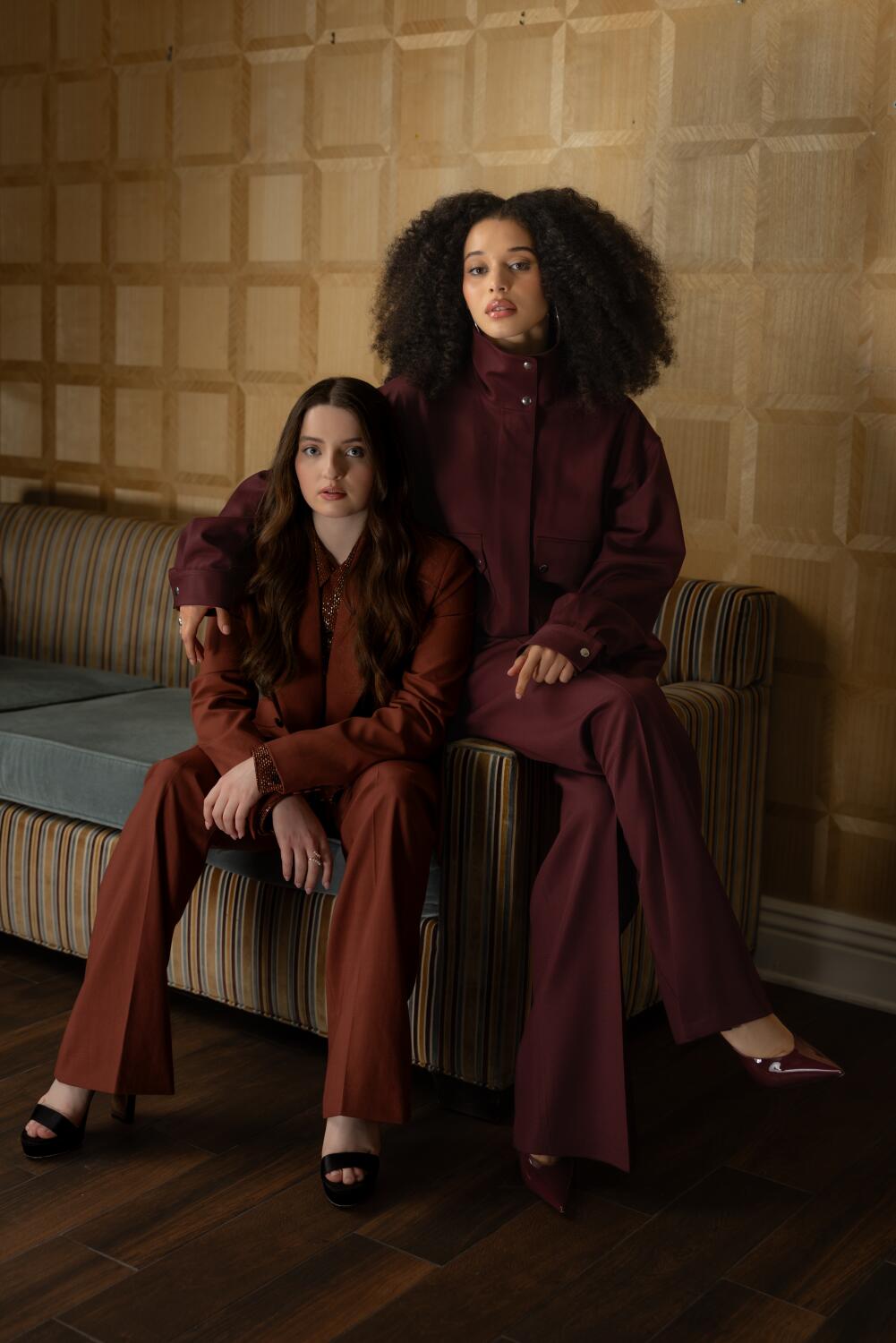
The press junket for Hulu’s The Testaments is currently suffocating under a blanket of "rebellion" rhetoric. You’ve seen the headlines. Chase Infiniti and Lucy Halliday are being positioned as the new faces of a teenage uprising, the spiritual successors to a defiant June Osborne. The narrative is simple: young women, a dystopian regime, and the spark of revolution.
It’s a lie. Or at least, it’s a very comfortable delusion.
If you’ve spent any time in the trenches of prestige TV development or studied the actual mechanics of Margaret Atwood’s sequel, you know that The Testaments isn't about rebellion. It is about the terrifying efficiency of institutionalization. While the mainstream media wants to sell you a "girl power" anthem, the reality of the show—and the performances of Infiniti and Halliday—is far more chilling. They aren't breaking the system; they are the system’s most successful products.
The Myth of the Teenage Firebrand
The standard take suggests that youth equals volatility. We’ve been conditioned by The Hunger Games and Divergent to believe that if you put a teenager in a grey jumpsuit, they will eventually find a bow and arrow and blow up the capital.
In Gilead, that’s a fantasy.
Chase Infiniti’s character, Nicole, and Lucy Halliday’s Agnes Jemima aren't Katniss Everdeen. They are individuals who have been shaped by the most sophisticated psychological conditioning ever depicted on screen. When we talk about their "rebellion," we are usually just describing their survival instincts. There is a fundamental difference between wanting to take down a regime and simply wanting to avoid being raped or executed.
The industry loves the "rebellion" tag because it’s easy to market. It’s a trope. But by framing their journey this way, we ignore the much more interesting, much more gut-wrenching truth: The Testaments is a study of how humans adapt to horror until the horror becomes mundane.
Why 'Agency' is the Most Misused Word in Hollywood
Critics keep praising the "agency" of these young characters. This is a fundamental misunderstanding of power dynamics. In a totalizing state like Gilead, true agency doesn't exist.
What Infiniti and Halliday are portraying is Negotiated Compliance.
They operate within the tiny, claustrophobic margins the Aunts allow them. To call this a "teenage rebellion" is to insult the actual cost of their choices. Every move they make is sanctioned or manipulated by Aunt Lydia. If your revolution is being managed by the head of the secret police, you aren't a rebel. You’re an asset.
I have watched dozens of pilots where showrunners try to "modernize" historical or dystopian struggles by giving the protagonists a 2026 sensibility. It fails every time because it lacks stakes. If Agnes Jemima acted like a modern TikTok teen, she’d be on the Wall by the first commercial break. Halliday’s brilliance—which the "rebellion" narrative misses—is her portrayal of internalized suppression. She isn't fighting Gilead; she is Gilead fighting itself.
The Aunt Lydia Problem: Managing the Resistance
If you want to understand why the "rebel" narrative is flawed, look at the puppet master. Aunt Lydia in The Testaments is the ultimate middle manager. She knows that a system with zero pressure valves will eventually explode.
Lydia doesn't suppress the "rebellion" of Nicole and Agnes; she cultivates it. She needs them to be just "rebellious" enough to execute her own agenda against the Commanders. This isn't a story of youth rising up; it’s a story of a seasoned bureaucrat using the next generation as high-stakes leverage in a corporate takeover.
When Infiniti and Halliday talk about their characters’ "strength," they aren't talking about muscles or snappy dialogue. They are talking about the stamina required to remain a person while being treated as a biological commodity.
The Data of Dystopia
Let’s look at the numbers. In literary and cinematic history, "rebellions" led by those born within a regime have a success rate that borders on zero. Why? Because the language of the resistance is still the language of the state.
- 1984: Winston Smith thinks he’s a rebel. He’s actually a lab rat for O’Brien.
- Brave New World: John the Savage can’t exist within the system, so he dies.
- The Testaments: The "fall" of Gilead is a slow, decades-long erosion of administrative efficiency, not a sudden explosion of teenage angst.
By focusing on the "rebellion," the media ignores the logistical reality of the story. The fall of Gilead is a data leak. It’s a failure of filing systems. It’s a corruption of the elite. Nicole and Agnes are the couriers of that failure, not the architects of a new world.
Stop Asking "How Do They Fight?"
The "People Also Ask" sections are filled with variations of "How does Agnes escape?" or "How does Nicole fight back?"
These are the wrong questions. They assume a level of physical combat that isn't the point of the narrative. The right question is: "What parts of their soul do they have to kill to stay alive?"
Infiniti’s performance is a masterclass in this. She has to portray a character who is an outsider forced into an insider’s role. That’s not a rebellion; that’s a performance. She is an actress playing a character who is also playing a character. It’s layers of masks.
When we boil that down to "teenagers fighting the man," we lose the nuance of the psychological trauma. We turn a complex exploration of human endurance into a generic YA thriller.
The Danger of Dystopian Fatigue
There is a real risk here that the industry doesn't want to admit. We are reaching a point of "misery porn" saturation. If The Testaments is marketed purely as "more of the same, but with younger leads," it will fail.
The only way the show succeeds is if it leans into the uncomfortable parts of the book—the parts where the girls actually agree with Gilead. Agnes, at various points, finds comfort in the structure of the Aunts. She finds safety in the rules.
That is the true "rebellion" against the viewer's expectations. We want her to hate it. But she was raised in it. To her, the "free world" is the frightening, chaotic unknown.
If Infiniti and Halliday have the guts to play the seduction of the system, then we have a show. If they just play "grumpy teens who hate their parents' weird religion," we have a CW reboot with better cinematography.
The Professional Price of Compliance
In my years analyzing media trends, I've seen this cycle happen with The Walking Dead, The Boys, and Westworld. A show starts with a radical premise, but the marketing team gets scared. They default to the "hero’s journey." They try to make the protagonists "relatable" by giving them modern motivations.
But Nicole and Agnes shouldn't be relatable. They are products of a theological fascist state. Their motivations should be alien to us. Their version of "bravery" should look like "betrayal" to a modern audience.
- Agnes becoming an Aunt isn't a "girlboss" moment. It’s a tragic surrender.
- Nicole’s mission isn't a "spy thriller." It’s a child being used as a political pawn.
If we keep calling this a rebellion, we are participating in the same gaslighting that Gilead uses. We are pretending that these girls have a choice.
Trusting the Silence
The most powerful moments in Halliday’s and Infiniti’s performances aren't the speeches. They are the silences. The moments where they don't react. In Gilead, a reaction is a death sentence.
The competitor's article spends far too much time on the "fire" of these actresses. They don't need fire. They need ice. They need the ability to go completely blank while their world burns.
The industry insiders who actually understand the source material aren't looking for a "rebellion." We are looking for a autopsy. We want to see how the spirit of a child is systematically dismantled and reassembled into a tool for the state.
If you want a teenage rebellion, go watch Stranger Things. If you want to see the terrifying reality of how a regime survives by eating its own children, watch The Testaments. Just don't call it a revolution.
It’s an onboarding process. And it’s working.
Stop looking for the spark and start looking at the cold, hard logic of the machine. The girls aren't the fire. They are the fuel.
And fuel doesn't rebel. It burns because it’s told to.


