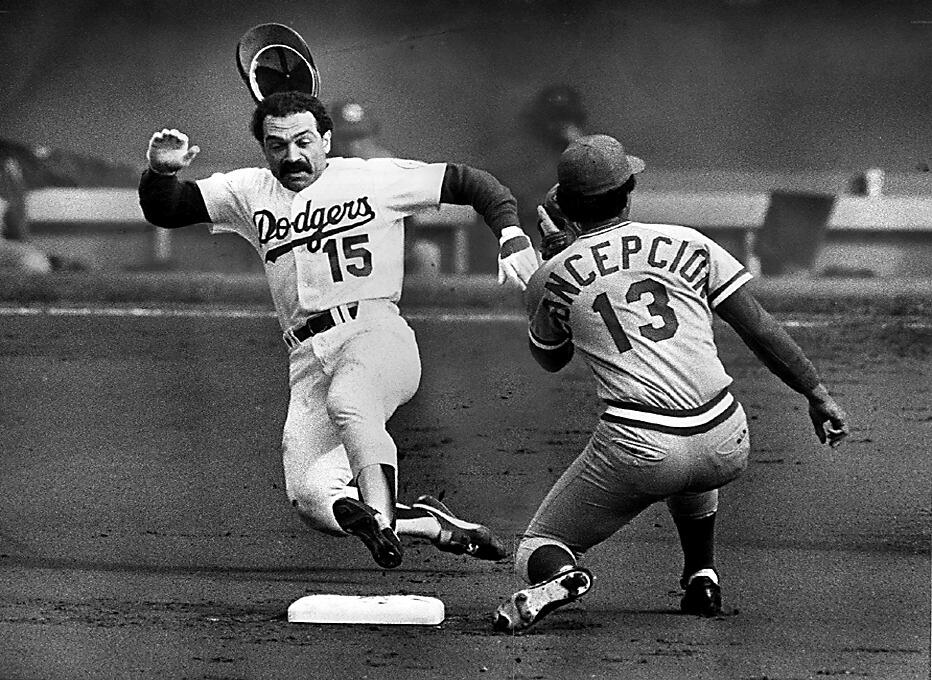
Davey Lopes was never supposed to be the anchor of the longest-running infield in baseball history. He was too small, too old by the time he arrived, and perhaps too aggressive for the buttoned-down sensibilities of 1970s management. Yet, his passing at age 80 marks more than just the loss of a Los Angeles Dodgers legend. It represents the final shuttering of a specific era of professional grit that the modern game has essentially regulated out of existence. Lopes was the spark plug for a quartet that stayed together for eight and a half seasons—Garvey, Cey, Russell, and Lopes—a feat of organizational stability that seems impossible in the current era of free agency and data-driven roster churn.
Lopes didn't just steal bases; he weaponized the basepaths. In 1975, he swiped 38 consecutive bags without being caught, a record that stood for decades. But to view him through the lens of a spreadsheet is to miss the psychological warfare he conducted against every pitcher he faced. He was the chaotic element in a Dodgers lineup that otherwise valued consistency and "the L.A. Way." While Steve Garvey was the golden-boy face of the franchise, Lopes was the engine. He brought a playground edge to the dirt of Dodger Stadium, a reminder that baseball, for all its pastoral beauty, is fundamentally a game of theft and intimidation.
The Architecture of the Infallible Infield
To understand the magnitude of Lopes’ career, you have to look at the statistical improbability of the Dodgers’ 1970s infield. From June 1973 to October 1981, the four men occupied the same four spots. In the 21st century, a single hamstring tweak or a lucrative contract offer from a mid-market team would have dismantled that group within three years.
The Dodgers of that era functioned as a laboratory for player development. Lopes was the outlier in the lab. He didn't make his Major League debut until he was 27. In the modern scouting system, a 27-year-old in Triple-A is considered "organizational depth," a body used to fill out a roster rather than a future All-Star. Lopes defied the aging curve. He played until he was 42. He wasn't just surviving; he was thriving, leading the league in stolen bases in his mid-30s. This longevity speaks to a level of physical maintenance and mental toughness that predates the modern era of sports science and specialized recovery teams.
The Art of the Modern Heist
Lopes’ success rate on the basepaths was staggering. He finished his career with a stolen base percentage of 83.01%. For context, many of the game’s greatest burners, including Rickey Henderson, operated with a higher volume but lower efficiency. Lopes was a tactician. He studied pitchers' pickoff moves with the intensity of a safecracker.
He understood that a stolen base isn't just about foot speed. It’s about the "jump"—the split-second decision to commit before the pitcher has even released the ball. This required a profound understanding of body mechanics. Lopes could see the slight dip of a shoulder or the tension in a pitcher’s lead leg. He wasn't guessing; he was reading code.
Beyond the Box Score
The 1981 World Series victory was the crowning achievement of this group, a cathartic release after years of falling short against the New York Yankees. Lopes was the veteran presence by then, the man who had seen the heartbreak of '77 and '78. His role in that clubhouse was often described as the "conscience" of the team. He was vocal, often blunt, and never satisfied with the status quo.
This friction was necessary. A team of four distinct personalities—the stoic Garvey, the "Penguin" Ron Cey, the quiet Bill Russell, and the fiery Lopes—required a balance of energies. Lopes provided the heat. When the Dodgers finally toppled the Yankees, it wasn't just a win for Los Angeles; it was a validation of a decade-long experiment in loyalty and continuity.
The Lost Art of Base Running
Today’s game has seen a slight resurgence in stolen bases due to rule changes—larger bases and limits on pitcher disengagements. However, the mentality Lopes brought to the game remains rare. He viewed the space between first and second base as his personal territory.
- Aggression as Strategy: Lopes didn't wait for a sign from the dugout. He took what the defense gave him.
- The Psychological Toll: He forced pitchers to focus on him rather than the hitter, leading to more fastballs and more mistakes for his teammates to exploit.
- Durability: Playing 150+ games a year while constantly sliding into hard dirt is a physical toll few modern players are willing or able to endure.
The Post-Playing Legacy
When Lopes moved into coaching, he didn't just teach technique; he taught a philosophy of fearlessness. As a first-base coach for the Phillies and later the Dodgers, his influence was immediately visible in the way his players approached the game. He transformed average runners into threats and turned stars like Chase Utley into elite basestealers.
He was a bridge between the old-school era of "playing through the dirt" and the new era of high-speed cameras and exit velocity. He respected the data, but he trusted the eyes. He knew that you could clock a player's 60-yard dash, but you couldn't measure the fear a runner puts into a pitcher’s heart.
A Career Defined by Defiance
Lopes was a second baseman who played with the chip of an undrafted free agent on his shoulder every single day. He was a four-time All-Star, a Gold Glove winner, and a World Series champion, but his true legacy is the standard he set for the lead-off spot. He redefined what a table-setter looked like, proving that power and speed weren't mutually exclusive—he hit 28 home runs in 1979, an incredible number for a middle infielder of that era.
He was the personification of the "Dodger Blue" identity, yet he was never afraid to challenge the organization or his teammates if he felt the intensity was flagging. That honesty is what made him a leader. In a sport that often buries its head in tradition, Lopes was a forward-thinking disruptor who happened to play in a classic uniform.
The passing of Davey Lopes is the end of a specific lineage. We will see faster players, and we will certainly see more expensive players, but we are unlikely to see another 27-year-old rookie who becomes the heartbeat of a dynasty. He was a reminder that in baseball, as in life, it isn't just about how fast you run, but when you choose to go.
The dirt on his uniform was never an accident; it was a signature. He played the game as if he were trying to reclaim something that had been stolen from him, and in doing so, he became one of the most efficient thieves the sport has ever known. The modern game, with its pitch clocks and restricted shifts, feels sterile compared to the organized chaos Lopes thrived in. He didn't need a rule change to make the game exciting; he just needed a ninety-foot path and a pitcher who blinked first.