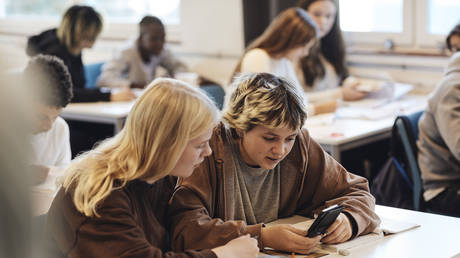
The classroom is no longer a theater of learning; it has become a battleground for the most precious resource on earth: human attention. Removing smartphones from schools is not merely a policy shift or a nostalgic attempt to return to the 1990s. It is an emergency intervention. To understand why bans are sweeping across global districts, we must look past the obvious distractions of social media and examine the physiological hijacking of the developing brain. Schools that remove these devices see an immediate, measurable uptick in academic performance, particularly among students who were previously struggling.
The evidence is no longer anecdotal. When we hand a child a smartphone, we are handing them a dopamine delivery system designed by the world’s most sophisticated engineers to ensure they never put it down. Expecting a fourteen-year-old to exercise "digital citizenship" while a pocket-sized supercomputer vibrates with notifications is not just optimistic; it is a fundamental misunderstanding of human biology.
The Cognitive Price of Peripheral Vision
Most discussions about school phone bans focus on cheating or cyberbullying. These are symptoms. The underlying disease is cognitive load. Even when a phone is face down on a desk, or tucked inside a backpack, it exerts a "brain drain" effect. Research into cognitive capacity shows that the mere presence of a smartphone reduces available mental energy. The brain is forced to actively work to not check the device, leaving fewer neurons available for the actual task of learning geometry or analyzing literature.
This is a quiet crisis. We are seeing a generation of students who can multitask between tabs but cannot sustain deep, linear thought for more than ninety seconds. By removing the device from the physical environment, schools are not just stopping "bad behavior." They are lowering the baseline of anxiety and freeing up the mental bandwidth required for complex problem-solving.
The Myth of the Digital Native
For two decades, educational "visionaries" pushed the idea that students were digital natives who needed technology integrated into every second of their day. This was a gift to hardware manufacturers and software conglomerates. It was also a lie. Being able to swipe on a TikTok feed does not equate to technical literacy. In fact, the constant use of simplified, high-frictionless interfaces has left many students less capable of navigating traditional file structures or understanding how hardware actually functions.
We traded the ability to focus for the illusion of connectivity.
The "digital native" narrative served as a convenient shield for Silicon Valley to enter the public education market. By the time administrators realized that 1-to-1 device programs were leading to plummeting test scores and increased social isolation, the contracts were already signed. Reversing this trend requires more than just a new rule in the student handbook. It requires a total rejection of the idea that more "screen time" equals better preparation for the workforce.
The Socioeconomic Gap in Silence
There is a bitter irony in the way technology is distributed in the modern world. The executives who design these devices and the algorithms that power them often send their own children to low-tech private schools. They understand, perhaps better than anyone, that deep work is the ultimate competitive advantage in the modern economy.
When public schools hesitate to ban phones, they widen the achievement gap. Wealthier families can afford to hire tutors, clinicians, and coaches to manage their children's digital habits. Students in underfunded districts are often left to navigate a constant stream of algorithmic manipulation without any buffer. A blanket ban is the only way to level the playing field. It ensures that for seven hours a day, every child, regardless of their home life, has access to an environment designed for concentration rather than consumption.
The Hidden Costs of Constant Documentation
Social development has shifted from an organic process to a performative one. In a school where phones are permitted, every mistake, every awkward social interaction, and every moment of vulnerability is a potential viral video. This creates a state of permanent surveillance.
Students are under constant pressure to curate their lives in real time. This stunts emotional growth. If you are always worried about how you look on a classmate's "Story," you never learn how to be truly present in a conversation. Removing the cameras and the microphones allows children to be messy, to fail, and to grow without the fear of a digital footprint that follows them forever.
Implementation and the Pushback Loop
Policy is easy; enforcement is the hard part. The most successful bans do not ask students to keep phones in their pockets. They utilize physical barriers, such as signal-shielding pouches or locked central lockers. Any policy that relies on a teacher constantly policing "off-task" behavior is doomed to fail. It turns the educator into a security guard, further eroding the teacher-student relationship.
The pushback often comes from parents, not just students.
"What if there is an emergency?" is the standard refrain. It is a powerful emotional argument, but it collapses under scrutiny. In the event of a genuine school emergency, the last thing first responders need is hundreds of students making uncoordinated calls, clogging cellular networks, and spreading unverified information on social media. Schools have landlines. Teachers have radios. Parents and children lived through decades of schooling without instant, 24/7 communication, and the world did not end. The "emergency" argument is often a mask for parental anxiety—a desire to maintain a tether that is ultimately counterproductive to a child's developing independence.
Relearning the Art of Boredom
We have reached a point where a gap of ten seconds in a hallway is filled by pulling out a phone. We are losing the capacity for productive boredom. Boredom is the precursor to creativity. It is the moment when the mind begins to wander, to synthesize information, and to form original thoughts.
When a school bans phones, the first week is often characterized by a palpable sense of withdrawal. Students are restless. They are irritable. But by the third week, something remarkable happens. The noise level in the cafeteria rises because students are actually talking to one another. Eye contact increases. The "zombie walk" in the hallways disappears.
This isn't just about grades. It is about reclaiming the human experience from an industry that views our attention as a commodity to be harvested.
Beyond the Ban
A phone ban is a tactical win, but it is not the final victory. If we remove the phones but keep the same frantic, fragmented curriculum that mirrors the digital world, we haven't solved the core issue. The goal should be a "Slow Education" movement. We need to prioritize deep reading, long-form writing, and sustained physical activity.
Technology has a place in the world, but its place is not in the hands of a child trying to master the foundations of thought. We must stop treating the smartphone as a neutral tool. It is an active participant in the classroom, and it is a participant that refuses to play by the rules.
The most radical thing a school can do in 2026 is to remain an analog sanctuary. Provide the students with a place where their attention is not for sale, where their privacy is absolute, and where the only "notifications" they receive are the thoughts generated by their own minds. This is not a regressive step. It is the only way to move forward.
Ban the phones. Lock the pouches. Turn the screens off. The kids will thank you in ten years, even if they hate you today.