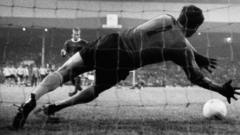
Imagine watching your team grind through 120 minutes of grueling, bone-crunching football in a major tournament. The players are cramping. The fans are exhausted. Everything has led to this moment. But instead of a definitive winner, the referee pulls a coin out of his pocket.
That’s how games used to end. It sounds like a joke, but it’s the literal truth. Before the penalty shootout became the global standard for breaking deadlocks, football relied on methods that were genuinely "cruel" and, frankly, lazy. We’re talking about a sport that prides itself on meritocracy deciding its biggest prizes with a literal 50-50 toss or, even worse, by drawing names out of a hat.
The shift to the penalty shootout wasn't just a rule change. It was a necessary evolution to save the sport's integrity. While some critics still call it a lottery, anyone who’s ever seen a coin flip decide a European Championship semi-final knows that penalties are a massive upgrade.
The Era of Literal Coin Flips
The most famous—and arguably most painful—example of the old system occurred during the 1968 European Championship. Italy was playing the Soviet Union in the semi-finals. After two hours of play, the score was 0-0. There were no penalties. There was no replay scheduled for that specific round.
Instead, the captains followed the referee into the dressing room. Why the dressing room? Because the officials didn't want the crowd to riot if they saw the coin land the wrong way on the pitch. Giacinto Facchetti, the Italian captain, came back out onto the field sprinting and cheering. He’d guessed right. Italy went to the final; the Soviets went home because of a piece of metal.
It was absurd. It wasn't sport. It was gambling with a trophy on the line.
Other tournaments used even stranger methods. Sometimes, if a match was tied, the team that had won the most corner kicks during the game was declared the winner. This led to teams ignores the goal and just trying to deflect the ball off defenders to rack up corner stats. It killed the flow of the game. It made the "beautiful game" look like a desperate scramble for set-pieces.
Why the Penalty Shootout Almost Didn't Happen
We owe the modern shootout to a few different people, but Joseph Dagan is the name usually cited by historians. After watching Israel lose a 1968 Olympic quarter-final to Bulgaria via a drawing of lots, he’d had enough. He proposed the shootout to FIFA.
But football is a traditionalist’s sport. The authorities hated the idea. They thought it was "artificial." They argued that football was a team sport and shouldn't be decided by a 1v1 duel. There was also the logistical fear. How do you manage the crowd? Where do the players stand?
Referees were also skeptical. Up until the early 1970s, many felt that a replay was the only "fair" way to settle a tie. But replays were a nightmare for television broadcasters and traveling fans. You couldn't just tell a stadium of 60,000 people to come back on Tuesday. The sport was growing too fast for its old, clunky rules.
The International Football Association Board (IFAB) finally gave in and adopted the shootout in 1970. It was first used in a major international tournament during the 1976 European Championship final. Czechoslovakia beat West Germany, and the winning goal was a chipped shot down the middle by Antonin Panenka. That single moment changed everything. It showed that penalties weren't just a way to end a game—they were a stage for incredible drama and individual genius.
The Psychological War from 12 Yards
When people call penalties a lottery, they’re usually wrong. A lottery is random. A penalty is a high-stakes psychological battle.
Data analysts have spent decades breaking down the mechanics of the shootout. We know, for instance, that the team kicking first wins roughly 60% of the time. The pressure builds on the team playing catch-up. We also know that goalkeepers who engage in "distraction behaviors"—like Bruce Grobbelaar’s "spaghetti legs" in 1984 or Emi Martinez’s antics in the 2022 World Cup—statistically increase the chance of a miss.
Why It’s Better Than the Alternatives
Some fans still hate shootouts. They suggest "Golden Goal" (where the first team to score in extra time wins) or "Silver Goal." We tried those in the 90s and early 2000s. They failed miserably. Why? Because the fear of conceding made teams play even more defensively. They were terrified to leave their half.
The shootout, for all its flaws, guarantees an ending. It provides a definitive climax.
- Physical Safety: 120 minutes is already a massive strain on the human body. Replays or endless extra time lead to injuries.
- Global Fairness: Everyone knows the rules before the whistle blows. There’s no hidden "corner kick count" or hidden coin.
- Broadcasting: In the modern era, games must fit into a TV window. A shootout provides a predictable, high-tension finale.
The Evolution of the Rules
The shootout hasn't stayed static. We’ve seen the introduction of the VAR (Video Assistant Referee) to ensure goalkeepers stay on their line. This has actually made it harder for keepers, who used to gain a sneaky advantage by inching forward before the kick.
There was also a brief experiment with the "ABBA" sequence, similar to a tennis tiebreak, to neutralize the advantage of the team kicking first. It didn't stick because it was too confusing for fans. The standard ABAB format remains the king because of its simplicity.
If you want to understand the modern game, you have to accept the shootout as its ultimate pressure cooker. It’s the moment where all the tactical preparation and physical fitness of the previous two hours boils down to a single person's ability to keep their cool.
For those who still think it's "unfair," just remember the alternative. Imagine your country being knocked out of a World Cup because a referee flipped a 50-cent coin in a dark tunnel while you weren't even looking.
Next time your team faces a shootout, pay attention to the order of the takers. The best coaches put their most resilient players first and fifth. The first sets the tone; the fifth handles the ultimate pressure. Study how the keepers move. If you're betting on a result or just watching for fun, look for the team that celebrates together after every made kick. That collective energy is often the difference between a win and a heartbreaking walk back to the center circle. Go watch the highlights of the 1968 Euro semi-final if you need a reminder of how lucky we are to have the spot-kick.