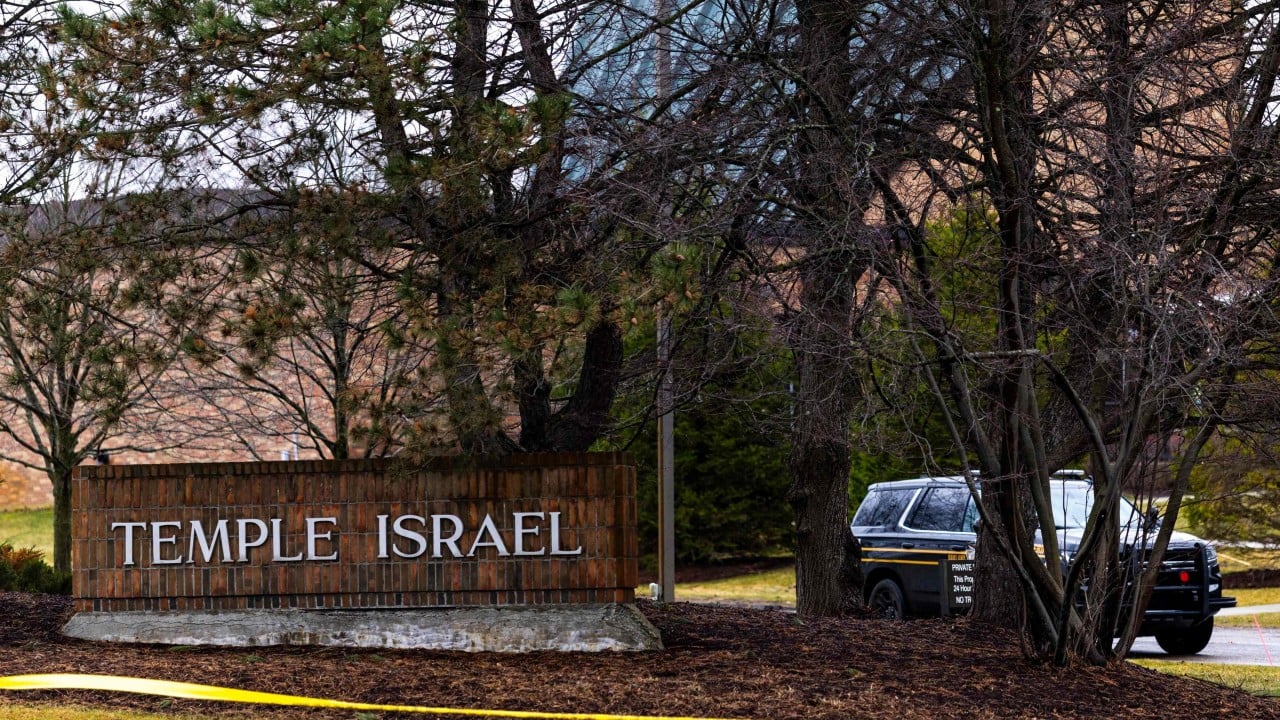
The FBI arrest of a 22-year-old Michigan man who rammed his truck into a synagogue is not just another data point in a rising tide of hate crimes. It represents a specific, dangerous evolution in how foreign terrorist organizations project power inside American borders without ever deploying a single operative. When federal agents took Nathan Lapinski into custody following the targeted attack on the Temple Beth El, they found more than just a damaged vehicle and a shattered storefront. They found a digital trail leading directly to the propaganda arm of Hezbollah, the Lebanese militant group and political party.
This case strips away the comfort of the "lone wolf" narrative. Lapinski did not act in a vacuum, nor was he a traditional recruit. He was the product of a sophisticated, high-frequency psychological operation designed to turn localized grievances into kinetic violence. The FBI’s formal complaint outlines a rapid descent from online curiosity to a physical assault, a timeline that should terrify every counter-terrorism official in the country. This is the reality of modern radicalization. It is fast, it is cheap, and it is happening in the quiet suburbs of the Midwest.
The Mechanics of a Digital Recruitment Pipeline
Foreign entities no longer need secret cells in major cities to execute attacks. Instead, they rely on a constant stream of high-production-value content that exploits domestic political tensions. Hezbollah’s media wing has spent decades refining its messaging, moving from grainy battlefield footage to slick, cinematic edits that mirror professional news broadcasts or action films.
For a young man in Michigan, the barrier to entry was non-existent. Investigators discovered that Lapinski’s consumption of extremist material increased exponentially in the weeks leading up to the crash. This was not a slow burn. It was a flash-over. He was not attending secret meetings in basements; he was sitting in his bedroom, scrolling through Telegram channels and encrypted forums where the rhetoric of "resistance" is sanitized for a Western audience.
The genius—and the horror—of this strategy lies in its ambiguity. Groups like Hezbollah provide the ideological justification and the visual "inspiration," then step back. They leave the logistics, the timing, and the target selection to the individual. This creates a massive blind spot for law enforcement. How do you track a threat that doesn't exist until the moment a truck jumps a curb?
The Michigan Synagogue Attack as a Tactical Shift
When Lapinski steered his heavy-duty pickup toward the doors of the synagogue, he was participating in a tactic that has become a hallmark of low-tech, high-impact terror. Vehicles are the perfect weapon for the unorganized extremist. They require no special permits, no background checks beyond a driver's license, and they provide a degree of protection to the perpetrator during the initial strike.
The choice of target was deliberate. Temple Beth El is a pillar of the local Jewish community, a place of worship and gathering. By attacking a religious site, the perpetrator wasn't just trying to cause property damage. He was attempting to shatter the sense of safety that allows a community to function. This is the core definition of terrorism—using violence to achieve a psychological effect far greater than the physical casualties.
Federal prosecutors are now highlighting the specific influence of Hezbollah's rhetoric regarding the ongoing conflicts in the Middle East. Lapinski’s social media posts and private messages echoed the specific phrasing used by the group's leadership. He wasn't just angry; he was programmed with a specific vocabulary of hate. This suggests that the "inspiration" the FBI mentions is actually a form of remote-control radicalization, where the actor adopts the goals of a foreign power as his own.
Why Traditional Surveillance is Failing
We are currently witnessing the limitations of the post-9/11 security apparatus. Our systems were built to catch conspirators. They were designed to flag large wire transfers, monitor travel to known conflict zones, and intercept communications between known operatives. None of those triggers were pulled in the Michigan case.
The modern extremist is "clean." They have no criminal record. They buy their equipment at the local hardware store or auto dealership. They stay off the radar by using the same platforms that millions of Americans use for gaming, shopping, and socializing. The challenge for the FBI is that the line between protected speech and "incitement to violence" has become a jagged, shifting frontier.
Critics of current domestic terror policies argue that we are focusing too much on the end of the fuse and not enough on the powder keg. While we increase physical security at synagogues and mosques, the digital infrastructure that creates attackers like Lapinski remains largely untouched. The legal hurdles to monitoring domestic digital spaces are significant, and rightfully so, but the cost of that privacy is a heightened vulnerability to the "inspired" actor.
The Myth of the Disenfranchised Youth
There is a tendency in the media to paint these attackers as victims of circumstance—jobless, uneducated, or mentally ill. This is a dangerous oversimplification. Many of those drawn to Hezbollah's ideology are tech-savvy and fully integrated into society. They are not falling through the cracks; they are jumping into them.
The allure of a group like Hezbollah for a young American male often stems from a desire for "righteous" belonging. In a fragmented culture, the militant group offers a clear binary. Good versus evil. Oppressor versus oppressed. Strength versus weakness. By aligning himself with a global movement, Lapinski likely felt he was elevating his life from the mundane to the historic. He wasn't a guy in a truck; he was a "soldier" in a global struggle.
The Geopolitical Context of Domestic Attacks
We cannot separate the Michigan crash from the broader geopolitical board. Hezbollah is a primary proxy for Iran, and their influence operations are a key component of their asymmetric warfare strategy. By inciting "low-level" attacks in the United States, they force the U.S. government to divert resources inward. It is a cost-effective way to create domestic instability and pressure the administration on its foreign policy decisions.
Every time a "Hezbollah-inspired" individual acts out in the U.S., it serves as a proof of concept for their handlers abroad. It demonstrates that their messaging is reaching the target audience and that the American heartland is not insulated from the fires of the Levant. The Michigan incident is a signal. It tells us that the battlefield has no borders and that the internet has effectively turned every driveway into a potential launchpad for an attack.
Hardening Targets is Only Half the Battle
Bollards and armed guards are necessary, but they are reactive. They address the "how" of the attack, but they do nothing to stop the "who" or the "why." If the goal is to prevent the next Lapinski, the focus must shift toward the digital vectors of radicalization. This requires a level of cooperation between tech giants and federal agencies that currently does not exist.
Furthermore, we need to address the speed of the legal system. The lag between identifying a potential threat and taking action is often wide enough for a truck to drive through. In several recent cases, the FBI had been "aware" of the individual months before they struck. Being "aware" is not the same as having the legal authority to intervene.
The Future of the Lone Actor Threat
What happened in Michigan is a precursor. As international tensions remain high, the frequency of these "inspired" incidents is likely to increase. We are moving into an era where the primary threat is not a coordinated cell of foreign agents, but a decentralized network of radicalized citizens who act on behalf of ideologies they found on their phones.
The arrest of Nathan Lapinski provides a grim blueprint. It shows a path from digital consumption to physical violence that is terrifyingly short. It reveals a recruitment strategy that bypasses traditional checkpoints and strikes at the heart of the community. We are no longer looking for the needle in the haystack. The haystack itself is being electrified by foreign actors, and all it takes is one spark to set it off.
The security of our religious and civic institutions now depends on acknowledging that the threat is internal, ideological, and incredibly agile. We cannot defend against an enemy we refuse to define. If we continue to treat these as isolated incidents of "mental health crises" or "random hate," we are ignoring the deliberate, strategic hand that is guiding the wheel. The truck in Michigan wasn't just driven by a man; it was fueled by a global insurgency that has found a way to weaponize the American basement.
Step one is admitting that the propaganda is working. Step two is dismantling the digital pipelines that deliver it. Until then, every synagogue, every church, and every public square remains a potential target for the next individual who decides that a foreign terrorist's war is his own.
Identify the platform. Disrupt the signal. Arrest the actor. The order must be absolute.