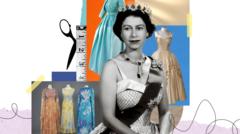
Queen Elizabeth II didn't just wear clothes. She deployed them. To her, a dress wasn't a fashion statement—it was a communication tool as sharp and precise as a diplomatic cable. As "Queen Elizabeth II: Her Life in Style" opens at The King’s Gallery in Buckingham Palace this April, it’s clear that her wardrobe remains the most significant living archive of modern fashion history.
The exhibit celebrates what would have been her 100th year. It features around 200 items, many of which haven't been seen by the public before. You'll see the sheer scale of her influence, from the early couture of her childhood to the neon "neon-at-90" coats that defined her final years. People often think royal fashion is about looking pretty. They’re wrong. It’s about soft power, and these five outfits from the exhibit prove it.
The 1934 Bridesmaid Dress That Started It All
The exhibit kicks off with a heavy dose of nostalgia. You'll find a silver lamé and tulle bridesmaid dress designed by Edward Molyneux. An eight-year-old Princess Elizabeth wore this to the 1934 wedding of her uncle, the Duke of Kent, to Princess Marina of Greece.
It’s one of the earliest surviving pieces of royal couture. What’s fascinating isn't just the craftsmanship, but how it shows the transition from the stiff, Victorian styles of her predecessors to a more streamlined, modern era. Even as a child, she was part of a carefully curated image of a "modern" British monarchy. It’s delicate, shimmering, and surprisingly small in person. It reminds you that before she was an institution, she was just a young girl thrust into a very public role.
The 1947 Wedding Gown and Post-War Hope
You can’t talk about the Queen without Norman Hartnell. His 1947 wedding dress for the then-Princess Elizabeth is a masterpiece of symbolism. Remember, Britain was still under post-war rationing. She actually had to use clothing coupons to pay for the materials.
The dress is ivory silk, decorated with 10,000 seed pearls and crystals. Hartnell took inspiration from Botticelli's Primavera, using embroidery of jasmine, smilax, syringa, and rose-like blossoms to signal rebirth and growth. It wasn't just a wedding dress; it was a national morale booster. When you see it in the gallery, the sheer weight of the history attached to those pearls is palpable.
The 1953 Coronation Gown and the Hidden Leek
This is arguably the most important piece of British dress from the 20th century. Hartnell went through eight different designs before the Queen approved the final version. She insisted on adding color to the traditional white and gold, and more importantly, she demanded the inclusion of the floral emblems of the Commonwealth.
There’s a great story behind this one. Hartnell originally wanted to use a daffodil to represent Wales. The Garter King of Arms told him no—it had to be a leek. Hartnell complained that a leek wasn't beautiful, but the Queen stood firm on the traditional emblem. The result is a gown of white satin embroidered with the Tudor rose, the thistle, the shamrock, and yes, the Welsh leek, alongside the maple leaf of Canada and the lotus of India.
It was designed to work under the glare of television cameras, which was a first for a coronation. It’s a masterclass in construction—the skirt is backed with cream taffeta and reinforced with horsehair and linen to support the massive weight of the embroidery.
The 1961 "Diplomatic" Karachi Gown
One of the coolest things about this exhibit is how it highlights "diplomatic dressing." The Queen often used her clothes to pay respect to her hosts. A standout example is the white gown Hartnell designed for a state banquet in Karachi, Pakistan, in 1961.
From the front, it looks like a classic, elegant evening dress. But it features an ingenious emerald-green pleat running down the back—a direct nod to the national colors of Pakistan. This wasn't accidental. It was a calculated move to show respect without being over-the-top. She understood that a visual gesture often spoke louder than any speech. It’s these subtle details that modern politicians still try (and often fail) to replicate.
The James Bond Stunt Double Dress
Let’s get a bit more recent and a lot more fun. The exhibit includes the peach cocktail dress designed by Angela Kelly for the 2012 London Olympics opening ceremony. But here’s the kicker: they’re displaying it alongside the identical version worn by her stunt double, Gary Connery, who "skydived" into the stadium with James Bond.
The double's dress has built-in Victorian-style bloomers and a massive zip at the back to fit over a parachute. It’s a brilliant reminder of the Queen’s sense of humor and her willingness to lean into her own icon status. It also shows the shift in her style during the later years—working closely with Angela Kelly to create a "uniform" of vibrant block colors that ensured she was always the most visible person in the room. "I have to be seen to be believed," she famously said. This outfit proved she meant it.
Why You Should Actually Go
If you think this is just a bunch of old clothes, you're missing the point. The exhibit also includes never-seen-before sketches and fabric samples, some with handwritten notes from the Queen herself. It gives you a look into her decision-making process. She was hands-on. She knew the power of a weighted hem on a windy day and the exact diameter a hat brim needed to be so people could still see her face.
If you’re in London between April and October 2026, book your tickets early. The first few weeks are already sold out. It’s at The King's Gallery at Buckingham Palace, and it’s likely the most comprehensive look at the intersection of fashion and power we'll see in our lifetime. Don't just look at the sparkle—look at the strategy.