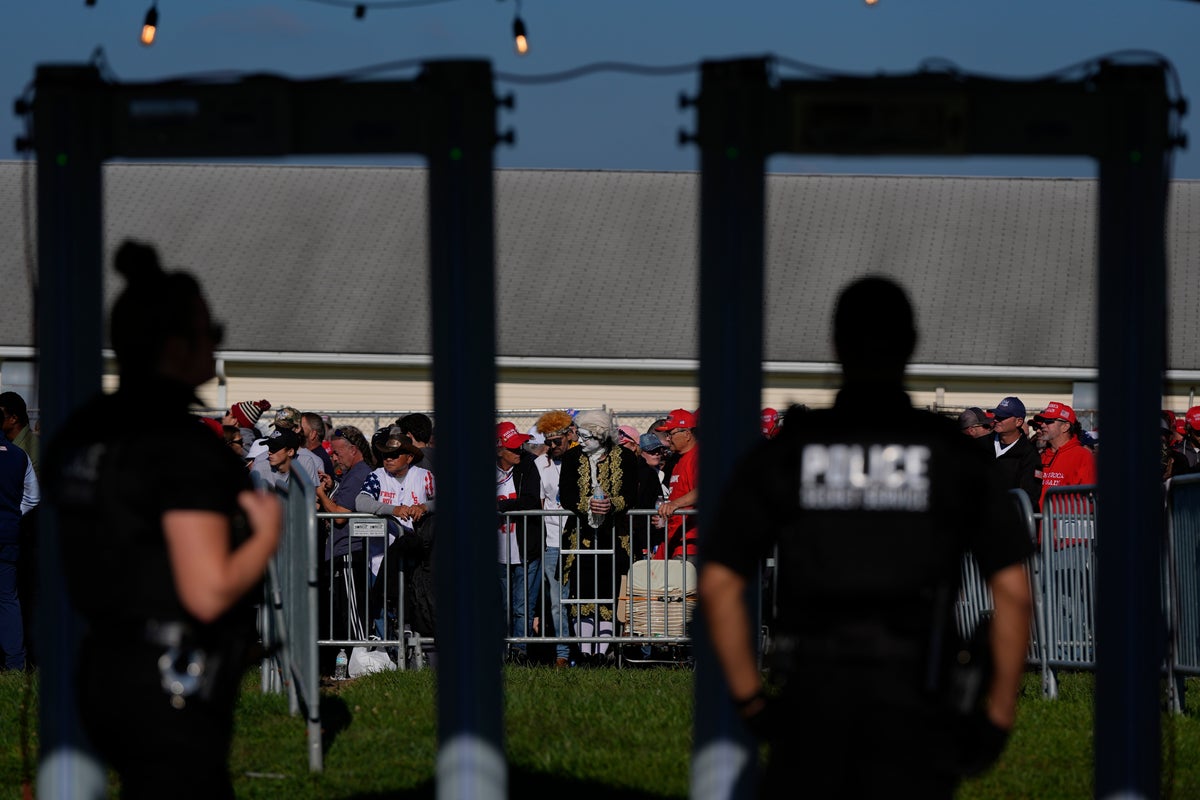
Twenty years ago, a candidate for the United States Congress could walk into a county fair with nothing but a box of buttons and a pair of comfortable shoes. They shook hands until their palms were raw. They kissed babies without looking over their shoulders. The only thing between the politician and the voter was a folding table and a shared plate of fried dough. There was a sense of accessible, almost casual, accountability.
That world is gone. Discover more on a related issue: this related article.
If you look at the 2024 election cycle, you won't see it in the stump speeches or the televised debates. You see it in the spreadsheets. A new report reveals that politicians spent five times more on security in 2024 than they did in 2016. The jump isn't a steady climb; it is a vertical spike. It represents a fundamental shift in how we interact with the people we elect to lead us. We are watching the hardening of the American political heart.
The Invisible Wall
Consider a hypothetical state representative named Sarah. In 2016, Sarah’s campaign "security" was her nephew, a college kid who carried her water bottles and made sure the microphone was plugged in. Today, Sarah doesn’t go to a town hall without a private detail of off-duty officers. She wears a Kevlar vest under her silk blazer. She has installed a $15,000 surveillance system at her private residence because people on the internet found her home address and posted photos of her children’s swing set. Further analysis by The New York Times explores similar views on this issue.
This isn't just about the money, though the money is staggering. It’s about the distance. Every dollar spent on a bodyguard is a dollar that isn't spent on outreach, research, or local organizing. But more importantly, every inch of muscle between a candidate and a constituent is a barrier to empathy. When a politician views every crowd as a collection of potential threats rather than a community of neighbors, the nature of representation changes.
The data is cold and clear. In the 2016 cycle, federal candidates and committees spent roughly $10 million on security-related expenses. By the time the 2024 cycle reached its fever pitch, that number had ballooned to over $50 million. This doesn't even account for the taxpayer dollars spent on the Secret Service or Capitol Police; this is the private money, the campaign donations from ordinary people, being funneled into armored SUVs and high-end digital "threat monitoring" services.
The Digital Spark
Why did the price of safety quintuple in eight years? The answer isn't found in the physical world. It’s found in the glowing screens in our pockets.
The 2024 election cycle was the first to fully grapple with the weaponization of geolocation and AI-driven harassment. In 2016, if someone hated a politician, they might write an angry letter or hold a sign at a rally. In 2024, that same person can use automated tools to track a candidate's every movement in real-time. They can create deepfake videos that incite immediate, visceral rage. They can "dox" a staffer in seconds.
The threat has become decentralized. It is no longer just about the lone extremist in the back of the room; it is about the thousands of digital shadows that follow a candidate home.
Security firms now offer packages that include "digital scrubbing." For a monthly fee, they hunt down a candidate’s personal data across the dark web, removing phone numbers and home addresses. This is the new overhead of democracy. Before you can even talk about healthcare or taxes, you have to pay a premium just to ensure your front door remains locked.
The Business of Fear
Money follows demand. A decade ago, the "political security" industry was a niche market, mostly reserved for presidential candidates and high-profile senators. Now, it is a booming sector of the economy. Small firms started by former Special Forces members or ex-Secret Service agents are being swallowed up by larger private equity groups.
They provide "advance teams" that scout libraries and VFW halls with the intensity of a military operation. They use software that scans social media for "sentiment shifts" in specific zip codes, alerting the candidate if the local rhetoric is turning violent.
This creates a feedback loop. As candidates spend more on security, they appear more distant and elite. This distance fuels the populist anger that made the security necessary in the first place. The armored glass becomes a mirror, reflecting the worst fears of both the politician and the public.
The Human Toll on the Trail
Behind the $50 million figure are human beings who are exhausted.
Imagine a young campaign staffer. Ten years ago, their job was to organize clipboards and coordinate carpools. Now, they are trained in "de-escalation techniques." They are taught how to spot a "fixated individual" in a crowd. They carry trauma that isn't supposed to belong to a twenty-something looking for their first break in public service.
We are losing a generation of leaders before they even start. If the cost of entry into public life is a permanent state of fear and a requirement to live behind a wall, who will choose to serve? Only the wealthiest, who can afford the protection, or the most radical, who are fueled by the conflict. The moderate, the quiet servant, the person who just wants to fix the local bridge—they see the security bills and the vitriol, and they stay home.
The Shattered Mirror
The five-fold increase in spending is a symptom of a deeper malady. We have stopped seeing our representatives as proxies for our collective will and started seeing them as targets for our collective frustration.
When you look at the 2024 spending reports, don't just see the numbers. See the empty chairs at town halls that were canceled for safety concerns. See the candidates who stopped taking unscripted questions because the risk of a "confrontation" was too high. See the loss of the casual handshake, the eye contact, and the shared space that makes a republic function.
We are paying for our own division. The $50 million isn't buying safety; it is buying a temporary, fragile silence. It is a down payment on a future where the people and their leaders live in two different worlds, separated by a line of men with earpieces and a growing sense of mutual suspicion.
The most expensive thing in Washington isn't a bill or a lobbyist. It is the simple, vanishing ability to stand in a room with a stranger and feel safe.


