The United States is placing a $250 million bet that it can rewire the physical substrate of the modern world. This week’s allocation to the Pax Silica initiative isn't just another line item in a sprawling federal budget. It is a calculated strike at the heart of global supply chain dependencies that have defined the last thirty years of tech growth. By committing these funds, Washington is attempting to anchor a massive $1 trillion investor consortium designed to move the world’s most critical minerals and semiconductors out of "unreliable" hands and into a gated garden of allied nations.
Efficiency is no longer the primary metric of the global economy. For decades, the tech sector thrived on a just-in-time model that prioritized the lowest possible cost, regardless of where the factory sat or who controlled the mine. Pax Silica signals that those days are over. The $250 million serves as seed capital for a "trust-based" investment vehicle involving Japan’s SoftBank, Singapore’s Temasek, and Abu Dhabi’s Mubadala. The goal is to ensure that the ports, refineries, and fabrication plants required for the artificial intelligence era stay within a circle of twelve "trusted" partners, including India, South Korea, and the United Kingdom.
The Fortress of Sand
The name itself is a provocation. Borrowing from the concept of Pax Romana, the initiative seeks a period of stability enforced by American-led economic statecraft. But this stability comes with a steep price tag and a high degree of geopolitical friction. While the $250 million is a modest sum compared to the billions required for a single advanced semiconductor fab, its purpose is to "de-risk" projects for private capital. It is an insurance policy for the $1 trillion in assets managed by the consortium's institutional giants.
The initiative targets the entire "silicon stack." This begins with the extraction of high-purity quartz and the refining of critical minerals like gallium and germanium. Currently, China controls approximately 90% of the refining capacity for many of these materials. If Pax Silica succeeds, it will create a parallel, bifurcated supply chain where allied nations trade within their own "secure" ecosystem. If it fails, it risks creating a fragmented market where costs skyrocket and innovation slows due to resource scarcity.
Selective Membership and the Taiwan Question
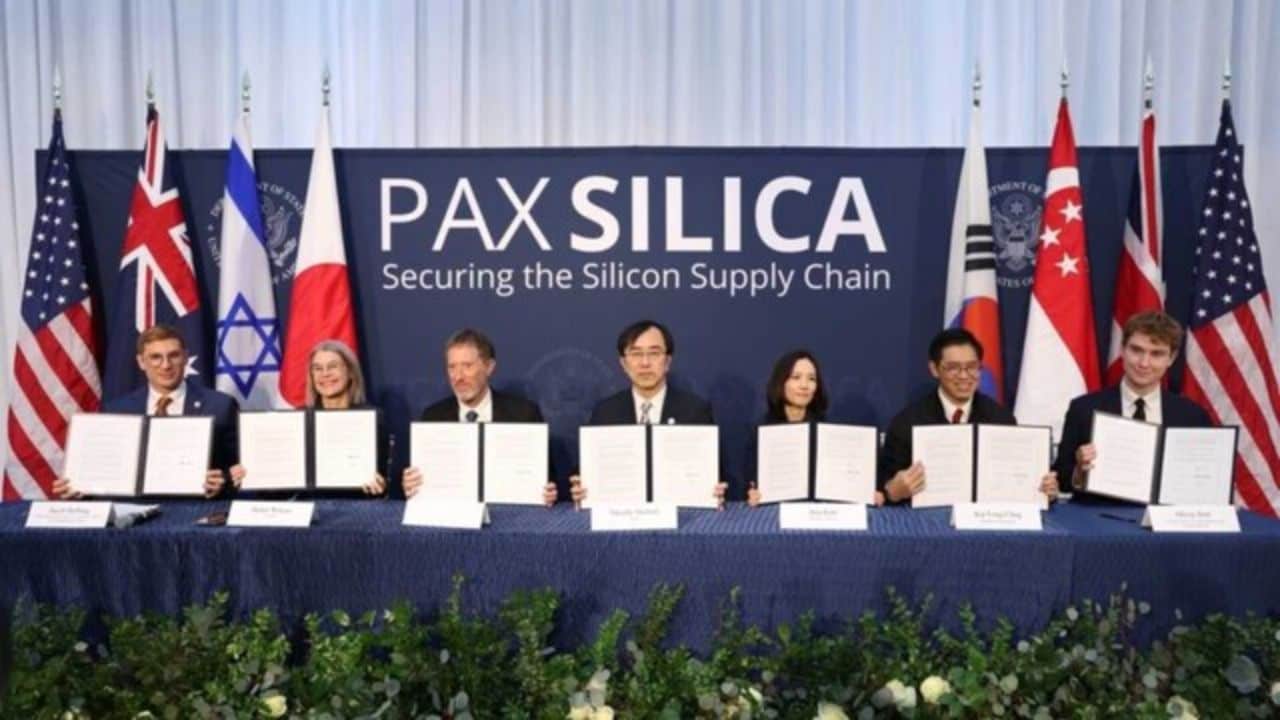
Critics point to a glaring inconsistency in the Pax Silica roster. While India recently joined the fold in a high-profile signing ceremony in New Delhi, other central players remain in the wings. Taiwan, the world’s undisputed leader in advanced chip manufacturing, and the Netherlands, home to lithography giant ASML, are currently categorized as "guest participants" rather than core signatories.
This hierarchy suggests that Pax Silica is as much about political loyalty as it is about technical capacity. The exclusion of major European powers like Germany and Italy from the inner circle indicates a strategy that rewards deep policy alignment over existing industrial contributions. Washington is effectively asking its partners to choose: embed your industrial strategy within a U.S.-led bloc or risk being left out of the next generation of capital flows.
The Costs of Decoupling
Building a parallel supply chain is an exercise in redundancy. Redundancy is expensive. We are looking at a future where "trusted" chips might cost 20% to 30% more than those produced in unaligned regions. This is the "security tax" that Pax Silica expects the global market to pay.
- Infrastructure Battlegrounds: The State Department has explicitly identified undersea cables, shipping lanes, and energy grids as the new front lines.
- The Iran Precedent: Official rhetoric frequently cites the recent tensions in the Strait of Hormuz as a warning. The administration argues that if a single chokepoint can paralyze global oil, a single mineral embargo could kill the AI revolution.
- Trade Not Aid: Under Secretary Jacob Helberg and Secretary Marco Rubio are pivoting toward a model that uses private investment to achieve security goals, rather than traditional foreign assistance.
The Retaliation Risk
Beijing has already signaled its displeasure, viewing Pax Silica as a violation of previous trade truces. By creating a closed loop of "trusted entities," the U.S. is effectively building a technological moat. This invites retaliation. We have already seen export restrictions on graphite and other battery materials from the East. As Pax Silica gains momentum, the "tit-for-tat" cycle of resource nationalism is likely to accelerate.
The $250 million is the first domino. It is designed to trigger a cascade of private investment that will fundamentally change how your smartphone is made, how your data is stored, and who profits from the transition to an AI-driven economy. The gamble is that the world's largest investors will value security more than they value the razor-thin margins of the old globalized order.
The era of the borderless internet and the truly global chip is dying. In its place, we are seeing the rise of an industrial order where the origin of the silicon is just as important as the code running on it.
Would you like me to analyze the specific mineral refining projects currently being reviewed by the Pax Silica Investor Consortium?