The Spectacle is Not the Strategy
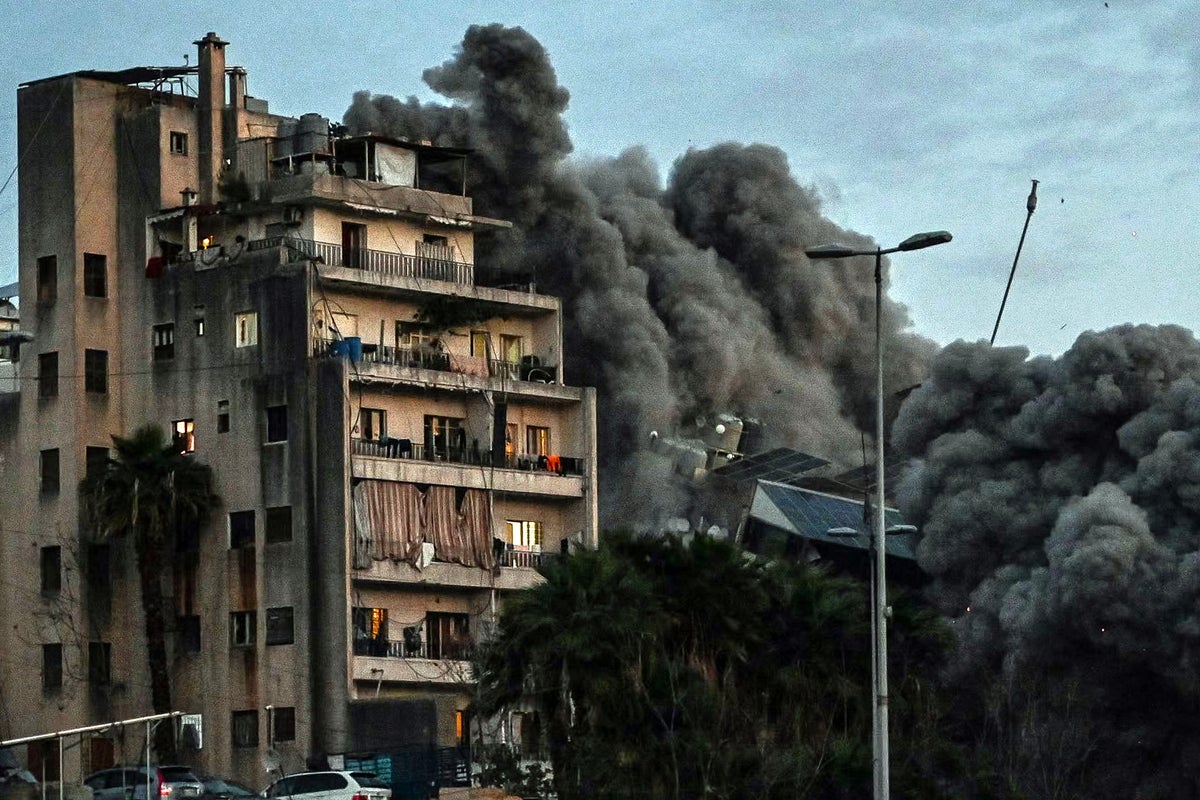
The footage is everywhere. A silver missile tracks a perfect vertical line. A residential block in Beirut shudders, pauses for a heartbeat, and then folds into itself like a tired accordion. The internet reacts with the usual binary of horror or clinical detachment. But if you are watching that collapse and seeing a "military success" or a "humanitarian catastrophe" in isolation, you are falling for the oldest trick in the book of psychological operations.
You are watching a physics experiment, not a war.
The media treats these collapses as spontaneous acts of God. They report on the "moment of impact" as if the story starts when the fuse ignites. It doesn't. What you are seeing is the culmination of a weeks-long architectural audit. Modern urban warfare is no longer about who has the biggest bomb; it is about who has the best structural engineer and the most invasive signal intelligence.
When a building falls in a controlled-looking heap, it isn't "luck" that it didn't tip over onto the neighboring pharmacy. It is a calculated demolition performed under the guise of an airstrike. To understand what is actually happening in Beirut, you have to stop looking at the fire and start looking at the skeletons of the city itself.
The Myth of the Precision Strike
The term "precision strike" is a marketing term designed to make the public feel better about the inevitable collateral. Let’s kill that lie right now. I have spent years analyzing urban combat zones, and I can tell you that precision is a relative concept when you are dealing with 2,000-pound munitions.
A Joint Direct Attack Munition (JDAM) is precise in its GPS coordinates, but it is blunt in its physics. The "lazy consensus" among analysts is that these strikes are meant to take out a single room or a basement. That is a fundamental misunderstanding of the objective.
The objective is Structural Overload.
When an Israeli strike hits the base of a high-rise, they aren't aiming for a person. They are aiming for the load-bearing columns. They are using the weight of the building as a secondary weapon. By compromising the structural integrity of the lower floors, the kinetic energy of the floors above does the rest of the work. This isn't an attack on a target; it's the weaponization of gravity.
- The Goal: Total suppression of a geographic point.
- The Cost: The permanent alteration of the urban "nervous system"—the water lines, the power grids, and the fiber optics that run through the basement.
If you think the damage stops at the footprint of the rubble, you don't understand how cities breathe.
Intelligence is the Real Munition
People ask: "How do they know which building to hit?"
They think it’s a spy in a trench coat or a single phone call. It isn't. It is the result of Pattern-of-Life (POL) analysis that would make your local data broker blush. We are talking about the "Internet of Things" (IoT) being turned into a targeting suite.
Imagine a scenario where every smart fridge, every Wi-Fi router, and every CCTV camera in a three-block radius is being pinged 1,000 times a second. Intelligence agencies aren't looking for a "terrorist"; they are looking for anomalies in the building's digital signature.
- Why is the basement drawing 400% more power than the penthouse?
- Why does the elevator stop at the second floor for exactly 14 seconds every Tuesday?
- Why is the structural vibration frequency of the pillar in the parking garage slightly off?
The strike is just the final click of a mouse. The "war" happened months ago when the digital twin of that building was mapped, simulated, and destroyed in a virtual environment. By the time the missile hits the screen, the outcome was already a statistical certainty.
The Fallacy of the Warning Shot
The "knock on the roof" or the 45-minute warning call is often framed as a humanitarian gesture. This is a naive interpretation.
In the world of high-stakes urban conflict, a warning is a forced-choice mechanism. It is designed to clear the area of "unintended" casualties, yes, but it serves a much more cold-blooded military purpose: it flushes the system. When a warning goes out, communication spikes. People call their families. Commanders call their subordinates. Equipment is moved.
Every single one of those signals is intercepted. The warning isn't just to save lives; it’s to light up the network one last time before it goes dark. It’s a diagnostic tool. If you move, they see where you go. If you stay, they know who you are.
To call it "humane" misses the point. It is tactical optimization. It is about clearing the "clutter" so the damage assessment post-strike can be as clean as possible.
The Rubble Economy
The competitor pieces will tell you about the cost of rebuilding. They’ll cite billions of dollars and decades of labor. They are wrong. They are thinking in terms of 20th-century construction.
The reality of 21st-century Beirut—and any city facing this kind of attrition—is the emergence of the Rubble Economy.
When a building collapses, it doesn't just disappear. It becomes a resource. The steel is scavenged. The concrete is crushed for aggregate. The space it occupied becomes a tactical void that changes the line of sight for every sniper and drone operator in the vicinity.
We see a "collapsed building" as a tragedy of loss. A military strategist sees it as a "terrain modification." You have effectively turned a vertical obstacle into a horizontal vantage point. This is why the strikes are often clustered. You aren't just hitting targets; you are redesigning the map to suit your surveillance needs.
Why "Why?" is the Wrong Question
The "People Also Ask" sections of the internet are obsessed with the why.
- "Why this building?"
- "Why now?"
These questions assume there is a singular, logical trigger. Often, there isn't. In modern asymmetrical warfare, the "why" is frequently secondary to the "because we can."
It is a concept known as Reflexive Control.
By dropping a high-profile building in the middle of a capital city, you are forcing the adversary to react. You are dictating their news cycle, their emergency response, and their internal politics. The collapse of the building is the physical manifestation of a psychological dominance. You aren't just breaking concrete; you are breaking the expectation of safety.
If you can’t trust the ground beneath your feet or the roof over your head, the war is already over, regardless of how many missiles are left in the silo.
The Brutal Reality of "Surgical" War
We have been sold a version of war that looks like a video game. We expect clean lines and clear villains. But when a 15-story building disappears in a cloud of grey dust, there is nothing surgical about it.
The "surgical" part is the intent; the "butcher's" part is the execution.
The sheer weight of a collapsing structure creates a seismic event that can be felt for miles. It ruptures gas lines. It shatters windows in a three-block radius. The dust alone—a toxic cocktail of pulverized concrete, asbestos, and lead—will kill people decades after the peace treaties are signed.
If you want to understand the Beirut strikes, stop looking at the moment of impact. Stop reading the sanitized reports about "terrorist infrastructure."
Look at the dust. Look at the way the city's silhouette is being systematically edited. We are witnessing the first era of Architectural Attrition.
It’s time to stop being surprised that buildings fall. Start being terrified of the math that decided they had to.
Go look at the satellite imagery from six months ago. Compare it to today. Don't look for the craters; look for the gaps. Those gaps are the new borders of the Middle East. They aren't drawn in ink. They are drawn in the absence of weight.
Get used to it. The sky isn't falling, but the floor certainly is.