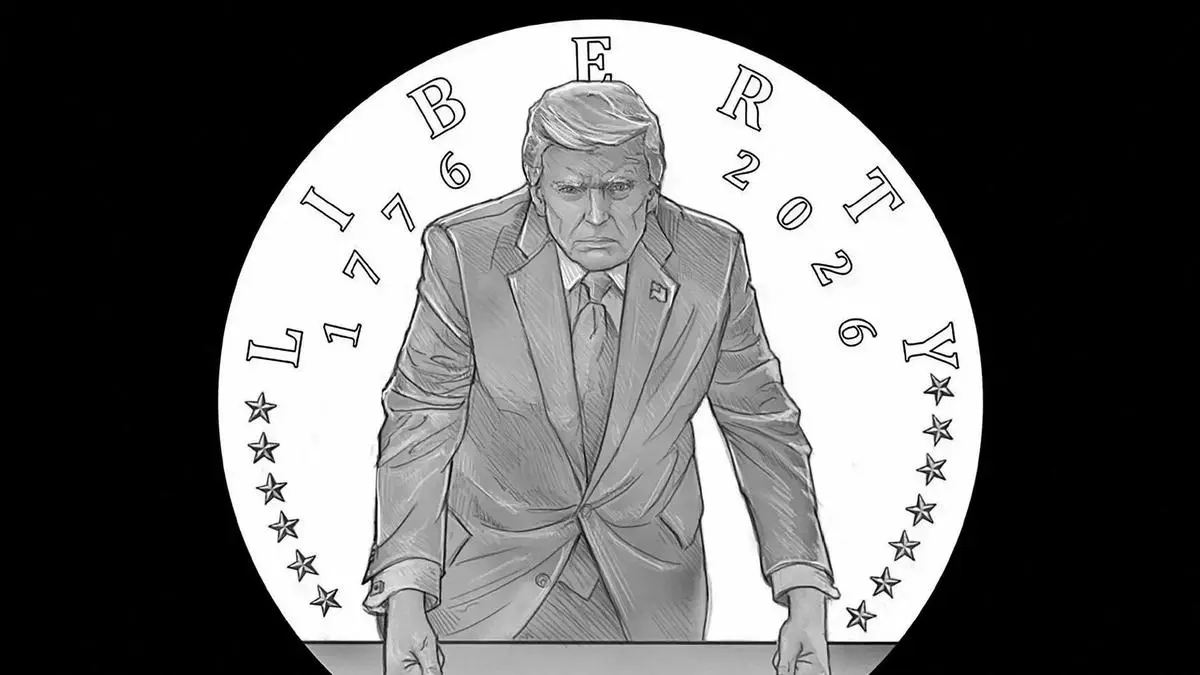
The intersection of political iconography and the bullion market creates a unique asset class where the value proposition diverges sharply from the spot price of gold. With the announcement of a gold coin featuring Donald Trump to commemorate the 250th anniversary of the United States, the asset must be evaluated through three distinct lenses: its function as a store of value, its utility as a political signaling mechanism, and the speculative premium associated with limited-run commemorative mintage.
The Tri-Factor Valuation Model
Traditional bullion coins, such as the American Gold Eagle or the Canadian Maple Leaf, trade at a thin margin above the London Fix spot price. In contrast, commemorative political medallions operate under a different cost function. The valuation of this specific issue depends on the interplay between three primary variables:
- Intrinsic Metallic Basis: The floor price determined by the troy ounce weight and fineness (typically .999 or .9999) of the gold content.
- Mintage Scarcity: The inverse relationship between the total number of units produced and the long-term numismatic premium.
- Narrative Beta: The volatility of the coin’s secondary market value relative to the political relevance and historical legacy of the figure depicted.
Supply Chain and Production Mechanics
The production of a high-relief commemorative coin involves significant capital expenditure before the first unit is struck. For a private or semi-private minting operation, the "Proof" finish—characterized by mirrored fields and frosted devices—requires specialized dies and multiple strikes under immense pressure.
The 250th anniversary of the United States, or the Semiquincentennial, provides a fixed historical anchor. This temporal constraint creates a "hard cap" on the relevance of the issue. Unlike standard bullion, which can be minted indefinitely, a commemorative coin tied to a specific anniversary loses its primary marketing hook once the calendar year passes. This creates a front-loaded demand curve where the majority of transactions occur within a 12-to-18-month window.
The Premium Paradox
A fundamental friction exists in the commemorative coin market: the gap between the purchase price and the immediate resale value. High-profile political coins often carry a "marketing premium" that can range from 20% to 100% over the melt value. This premium covers:
- Intellectual Property and Licensing: Costs associated with the use of the likeness and branding.
- Specialized Packaging: Display cases and Certificates of Authenticity (COAs) which, while possessing negligible intrinsic value, are critical for maintaining the numismatic grade.
- Customer Acquisition Costs: The high expense of targeted political advertising across digital and broadcast channels.
Investors must recognize that the secondary market often fluctuates. While the gold content provides a safety net, the premium is highly illiquid. A buyer purchasing at a 50% premium requires either a 50% increase in the gold spot price or a corresponding surge in collector demand just to reach a break-even point.
Political Signaling as a Market Driver
The issuance of a Trump-themed gold coin serves as a "Veblen good"—a product for which demand increases as the price rises because it acts as a status symbol. In this context, the coin is not merely a financial instrument; it is a proof-of-stake in a political movement.
This creates a secondary market driven by sentiment rather than technical analysis. The price of the coin becomes decoupled from the Consumer Price Index (CPI) and instead tracks with political cycles. We observe a "Rally Effect" where positive political developments for the depicted individual correlate with increased bid prices on auction platforms like eBay or specialized numismatic exchanges.
Comparative Analysis: Historical Precedents
To understand the trajectory of the Trump 250th anniversary coin, one must analyze the performance of similar modern commemoratives. The 1986 Statue of Liberty Centennial coins and the various presidential medals issued by the US Mint provide a baseline.
Historical data suggests that coins issued by private mints—even those with authorized likenesses—frequently struggle to maintain premiums compared to official government-tender coins. The distinction lies in "legal tender" status. A coin with a face value (e.g., $50) is classified as currency, which carries different tax and transport regulations than a "medal" or "round" which has no face value. If the Trump 250th coin lacks a legal tender denomination, it will be classified by professional graders (like PCGS or NGC) as a medal, which traditionally attracts a narrower base of institutional collectors.
Technical Specifications and Grading Potential
The long-term appreciation of this asset is heavily dependent on the "Grade" assigned by third-party services. A coin kept in its original mint capsule is protected, but "Proof-70" (P70) specimens—indicating a perfect strike with no visible flaws under 5x magnification—command exponential premiums.
The manufacturing bottleneck for this specific coin will be the quality of the die. As dies wear down over a production run, the "frosting" on the portrait (the Trump likeness) becomes less distinct. Early-strike coins, often marketed as "First Day of Issue," capture the highest level of detail and, consequently, the highest resale potential.
Risk Vectors in Commemorative Bullion
The primary risk is "Premium Erosion." As the 250th-anniversary celebrations conclude in late 2026, the urgency to own the coin may diminish. This is a common phenomenon in the "Sovereign Series" or "Anniversary Sets" where the exit liquidity dries up once the news cycle shifts.
A second risk is "Market Saturation." If multiple versions of the coin are released (e.g., 1 oz, 1/4 oz, and silver versions), the exclusivity of the flagship 1 oz gold coin is diluted. High-net-worth collectors typically gravitate toward the largest, most expensive unit, leaving the smaller fractions to struggle in the secondary market.
Strategic Allocation and Execution
For those viewing this through a tactical lens, the acquisition should not be framed as a core "gold hedge." It is a speculative numismatic play. The optimal strategy involves:
- Direct Procurement: Purchasing directly from the primary distributor to ensure the lowest possible initial premium and to secure "First Strike" eligibility.
- Immediate Grading: Sending the coin to a reputable grading service (NGC/PCGS) immediately upon receipt to lock in a numeric grade. A certified "MS-70" or "PF-70" is significantly more liquid than an uncertified coin in a plastic flip.
- Exit Window Management: Identifying peak political windows—such as the height of the 2026 anniversary festivities—to liquidate the asset. Holding past the 250th-anniversary window risks the coin reverting to its base metallic value.
The success of this issue depends on the ability of the distributors to maintain a "limited edition" narrative. If the mintage numbers remain undisclosed or "minted to demand," the scarcity component of the valuation model collapses, leaving the investor holding a high-cost gold asset that mimics the performance of a low-cost bullion bar.
Focus on the mintage limits. If the total production is capped under 5,000 units, the scarcity premium has a high probability of holding. If the mintage exceeds 25,000, the coin will likely trade as a commodity within three years of issuance. Monitor the "Sell-Out" velocity as the primary indicator of secondary market heat.