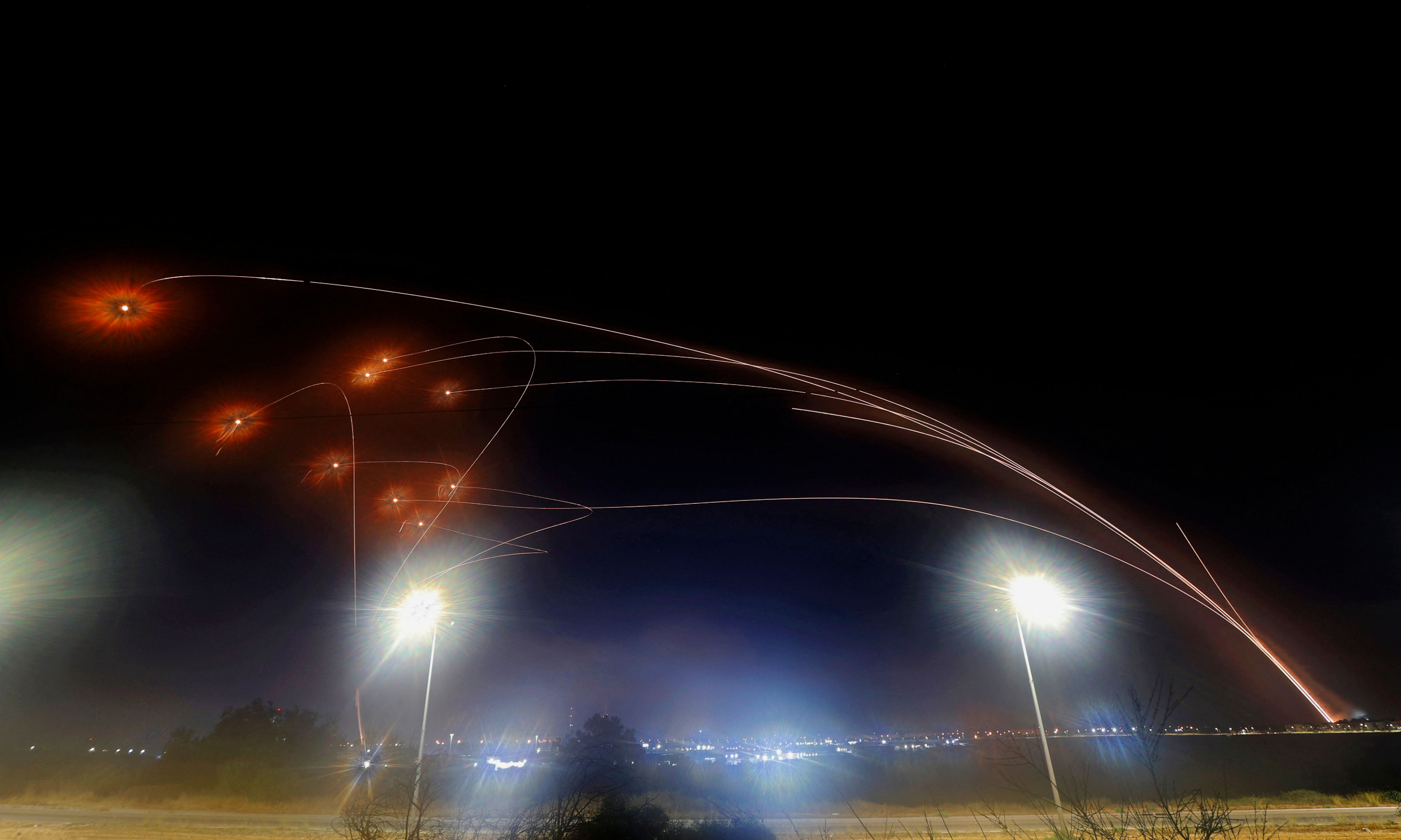
The sky over Tel Aviv usually belongs to the hum of air conditioners and the distant salt-spray of the Mediterranean. But when the sirens wail, the sky changes ownership. It becomes a theater of physics, a high-stakes geometry lesson where the variables are measured in human lives. For years, the world watched the "Iron Dome" with a sense of awe, seeing those characteristic curves of light—the interceptors—meeting the crude rockets of Gaza in a burst of defensive fire. We grew comfortable. We started to believe in the myth of the impenetrable bubble.
That myth died on a Tuesday night. Expanding on this topic, you can find more in: Why the Green Party Victory in Manchester is a Disaster for Keir Starmer.
Imagine a father, let’s call him Elias, standing in a stairwell in central Israel. He is holding his daughter's hand. He has done this dozens of times before. Usually, there is a dull thud in the distance, a vibration in the concrete, and then the "all clear." But this time, the sound was different. It wasn't a thud. It was a roar that tore through the atmosphere, a sound so heavy it felt like the air itself was being bruised.
This wasn't the usual rain of short-range projectiles. This was a calculated, hypersonic deluge of Iranian ballistic missiles. And for the first time, the math didn't favor the defender. Observers at USA Today have shared their thoughts on this matter.
The Illusion of the Shield
To understand why the shield buckled, we have to look past the glowing streaks in the news footage. Most people think of missile defense like a goalkeeper catching a ball. In reality, it is more like trying to hit a speeding bullet with another bullet, while both are traveling at several times the speed of sound.
Israel’s defense is a tiered cake. The Iron Dome handles the small, low-flying stuff. David’s Sling takes the middle ground. The Arrow-2 and Arrow-3 systems are the heavy hitters, designed to reach into the edges of space to kill long-range ballistic missiles before they even re-enter the atmosphere. On paper, it is the most sophisticated defensive grid ever constructed.
But every shield has a saturation point.
When Iran launched nearly 200 missiles in a concentrated wave, they weren't just aiming for buildings; they were aiming for the system’s brain. They used a tactic known as "swarming." If a radar system can track 100 targets but you send 150, those 50 extra streaks of fire are essentially invisible to the interceptors. The defense becomes overwhelmed, not by lack of technology, but by the sheer, brutal arithmetic of the attack.
The Crack in the Porcelain
As the dust settled at sites like the Nevatim Airbase, the satellite imagery began to tell a story the official briefings tried to soften. We saw craters. We saw hangars with holes punched through their roofs. These weren't the "scratches" of intercepted debris falling from the sky. These were direct hits.
The cold truth is that several Iranian missiles, including the newer Fattah-1 models, moved too fast and too erratically for the current generation of interceptors to guarantee a kill. A ballistic missile doesn't just fall; it screams down from the heavens at Mach 5 or higher. At those speeds, even a slight maneuver by the missile can cause an interceptor to miss by a few meters. In the world of supersonic warfare, a miss by a meter is as good as a miss by a mile.
Consider the cost. A single Arrow interceptor costs roughly $3.5 million. The missile it is trying to stop might cost a fraction of that. This creates a terrifying economic asymmetry. You can't just keep building shields if the enemy can build more "swords" for cheaper and faster than you can replenish your quiver.
Elias, still in that stairwell, didn't know about the Mach numbers or the unit cost of an Arrow-3. He only knew that the flash he saw through the narrow window was brighter than anything he’d ever seen. He felt the heat. That is the human element the analysts miss: the psychological armor is thinner than the physical one. Once people stop believing the sky is safe, the entire social fabric of a nation begins to stretch.
The Architecture of Fear
We often treat technology as a final solution, but history suggests it is merely a temporary advantage. The "impenetrable" walls of Constantinople stood for a thousand years until the Ottoman cannons turned them to dust. The Maginot Line was a masterpiece of engineering until the tanks simply drove around it.
The Iranian attack proved that "defense-only" is a losing hand. If the interceptors have a 90% success rate—which is staggeringly high—and the enemy fires 200 missiles, 20 will still hit. If those 20 carry conventional warheads, you have a disaster. If they carry something worse, you have an apocalypse.
The military planners are now staring at the data with a grim realization. To stay ahead, the defense must evolve. This likely means moving toward laser-based systems like the "Iron Beam," which uses light to melt incoming threats. Light doesn't run out of ammunition. It doesn't cost $3.5 million per shot. But that technology is still in its infancy, a promise of safety that hasn't yet arrived.
The Weight of the Aftermath
Walking through a neighborhood that has been touched by a "leak" in the defense system is a surreal experience. It isn't just the shattered glass or the twisted rebar. It is the silence. People look at the sky differently the next day. They don't look up with confidence; they look up with a question.
The doubt isn't just about whether the machines work. It’s about the limit of human ingenuity. We have reached a point where our ability to destroy has outpaced our ability to protect. We are living in an era of "offset" where the attacker only has to be lucky once, while the defender has to be perfect every single time.
Perfection is not a human trait.
As the sun rose over the Mediterranean the morning after the strike, the sirens were quiet, but the air felt heavy. The debris had been cleared, the craters were being filled with fresh concrete, and the politicians were already drafting speeches about resilience. But in the homes, in the stairwells, and in the minds of those who watched the gold flashes pierce the dark, something had shifted.
The shield isn't gone, but it is no longer invisible. We can see the cracks now. And once you see the cracks in the ceiling, it’s very hard to sleep soundly through the rain.
The math of war is moving faster than the heart can follow.
In the end, we are left with a simple, haunting image: a streak of light in the dark, a hand gripping another hand in a concrete room, and the terrifying realization that even the most advanced stars we build for ourselves can be blinked out by a faster, hungrier fire.
Would you like me to analyze the specific technical specs of the Fattah-1 missile and how it challenges current radar tracking?