The collapse of the Sheikh Hasina administration was not merely a change in government. It was the total demolition of a decade-long geopolitical architecture that anchored New Delhi’s eastern security flank. Within hours of the former Prime Minister fleeing to India, the vacuum she left behind began filling with elements that have been suppressed, jailed, or exiled for fifteen years. The most visible shift is the sudden, bold presence of hardline Islamist clerics and political organizations with deep historical and ideological ties to Pakistan.
For India, this is the worst-case scenario. The "Golden Chapter" of Indo-Bangladeshi relations has been replaced by a chaotic, unpredictable transition where anti-Indian sentiment is being used as a primary tool for political legitimacy. While the world focuses on the student-led protests that sparked the movement, the real story is who is moving in to harvest the political crop. This is not a shift in leadership. It is a fundamental realignment of the state's identity. Don't forget to check out our earlier article on this related article.
The Vacuum and the New Occupants
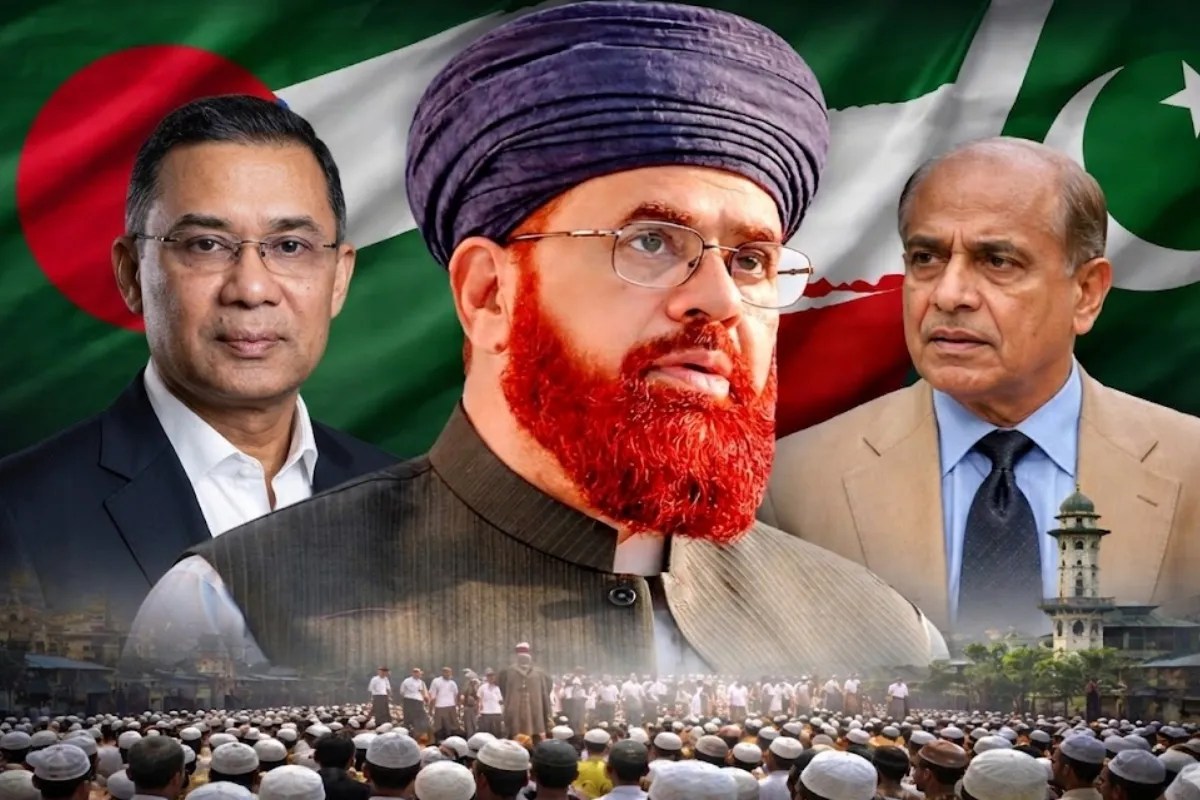
The speed at which the Awami League's apparatus disintegrated left a massive opening. In politics, nature hates an empty space. This space was immediately occupied by the Bangladesh Nationalist Party (BNP) and the Jamaat-e-Islami, but more importantly, by a wave of influential Deobandi clerics and "Maulanas" who had spent the last decade in the shadows. These figures are not just religious leaders; they are political gatekeepers.
Many of these clerics have longstanding intellectual and theological ties to the Pakistani religious establishment. These are not secret meetings in dark rooms. They are public displays of strength. Large-scale gatherings and street-side sermons now openly challenge the secular framework of the 1971 independence. They frame the previous fifteen years as a period of "Indian occupation," and their rhetoric is finding a receptive audience among a youth population that feels the Awami League used secularism as a shield for corruption. To read more about the background of this, The New York Times provides an informative breakdown.
The immediate arrival and public rehabilitation of figures previously banned or restricted is a clear signal. These groups aren't just looking for a seat at the table. They are rebuilding the table.
The Pakistani Connection Reborn
The shift toward Pakistan is more than symbolic. For years, the Inter-Services Intelligence (ISI) and the Pakistani establishment were marginalized in Dhaka. That marginalization has ended. Intelligence circles in New Delhi are tracking a significant uptick in communications between Dhaka-based religious leaders and their counterparts in Lahore and Karachi. This isn't just about religion. It’s about creating a counter-balance to India.
The "India Out" campaign, which gained momentum months before the fall of Hasina, provided the ideological bridge. It allowed religious hardliners to merge their theological agenda with a nationalist fervor that portrays India as a hegemon. By painting Hasina as an Indian puppet, her opponents successfully framed her removal as a "Second Independence." In this new narrative, Pakistan is no longer the historical antagonist of 1971 but a potential strategic partner in resisting Indian "interference."
We are seeing a resurgence of the "Two-Nation Theory" in a modern context. This ideological shift creates a fertile environment for regional actors who want to see India’s influence curtailed. If Dhaka tilts back toward Islamabad, the security implications for India’s Northeast—specifically the Siliguri Corridor—are profound.
The Security Crisis on India's Eastern Flank
For a decade, India enjoyed a "safe" eastern border. Security cooperation between New Delhi and Dhaka was at an all-time high. Hasina’s government systematically handed over insurgents from India’s North Eastern states who had been hiding in Bangladesh. This cooperation was the backbone of stability in states like Assam and Tripura.
That cooperation is now in a state of paralysis. If the new power centers in Dhaka—especially those influenced by the BNP and Jamaat—decide to use these insurgent groups as leverage, India faces a two-front security challenge. The nightmare for the Indian Home Ministry is a return to the 1990s, where Bangladesh served as a sanctuary for groups like ULFA.
The concern isn't just about armed insurgents. It’s about radicalization. The porous 4,096-kilometer border is impossible to seal completely. If the clerical establishment in Bangladesh succeeds in pushing a more radicalized version of Islam into the border districts, the communal balance in West Bengal and Assam could be destabilized. New Delhi isn't just worried about who is in the Prime Minister's office; they are worried about who is in the mosques in the border villages.
The Student Movement and the Religious Pivot
One of the most complex aspects of this transition is the relationship between the student leaders and the religious hardliners. The students started the fire, but they may not be the ones who control the flame. While the initial protest movement was about government jobs and authoritarianism, it was quickly co-opted.
The students wanted reform. The hardliners want a total overhaul of the social and legal fabric. Currently, there is a tenuous alliance between the two. The students provide the moral authority and the "revolutionary" face to the international community, while the religious organizations provide the street muscle and the grassroots mobilization that the students lack.
As the interim government struggles to restore order, the influence of these clerics grows. They are acting as mediators, moral arbiters, and in some cases, the only functioning authority in local neighborhoods. This grassroots dominance is something that the urban, liberal student leaders cannot compete with over the long term.
The Economic Leverage Trap
India’s primary tool for influence has always been its economic and geographic proximity. Bangladesh is India's largest trading partner in South Asia, and India is Bangladesh's second-largest. However, this economic dependency is now being framed as a liability by the new political players.
There is a concerted effort to diversify Bangladesh’s economic dependencies. This means looking toward China and the Middle East with renewed vigor. China, which had a pragmatic but cautious relationship with Hasina, now sees an opportunity to expand its "String of Pearls" strategy. By offering infrastructure projects and financial support without the political baggage of "cultural proximity" that India carries, Beijing can present itself as a more attractive partner for a nationalist-leaning Dhaka.
If the "India Out" sentiment translates into trade barriers or the cancellation of transit agreements, the economic cost to both nations will be high. But in the current atmosphere of ideological fervor, economic logic often takes a backseat to political posturing.
The Clerical Dominance in the New Order
The most telling sign of the times is the public rehabilitation of Maulana Mamunul Haque and other leaders of Hefazat-e-Islam. These figures were once considered the biggest threat to the state's secular identity. Today, they are being greeted as heroes. Their rhetoric is increasingly focusing on the "liberation" of Bangladesh from external cultural influences.
This is where the "Pakistani Maulana" narrative takes hold. The Deobandi school of thought, which is dominant in both Pakistan and among the hardliners in Bangladesh, provides a shared ideological language. When these leaders call for a state governed by religious principles, they are echoing the platform of their counterparts in Pakistan. This creates a natural axis that bypasses the traditional diplomatic channels that India has spent decades building.
New Delhi is now forced to deal with a Bangladesh that is not only less friendly but is fundamentally changing its internal operating system. The old guards of the diplomatic corps, who relied on personal relationships with the Awami League elite, find themselves without a phone number to call.
The Myth of a Managed Transition
There was an early hope in some diplomatic circles that the transition could be "managed"—that the military would step in, stabilize the situation, and call for quick elections that would return a moderate government. That hope was misplaced. The military itself is under immense pressure from within to distance itself from the "pro-India" legacy of the previous era.
The transition is not being managed; it is being fought over. Every appointment in the interim administration, every change in the police force, and every judicial reform is a battleground. The religious hardliners are winning many of these battles because they are the most organized and the most vocal.
India’s policy of putting "all its eggs in the Hasina basket" has left it with zero leverage among the rising political forces. The sudden shift isn't just a failure of intelligence; it’s a failure of a decades-long diplomatic strategy that prioritized the survival of a single regime over engagement with the broader political spectrum of the country.
The Regional Ripple Effect
What happens in Dhaka doesn't stay in Dhaka. The success of a religiously-driven popular uprising in Bangladesh is being watched closely across South Asia. In Pakistan, it is seen as a blueprint for how a deeply unpopular establishment can be toppled by a mix of street power and religious mobilization. In the Maldives, the "India Out" movement is already a reality.
India is finding itself increasingly isolated in its own neighborhood. The "Neighborhood First" policy is in tatters. The rise of a pro-Pakistan, anti-India administration in Dhaka would complete a circle of unfriendly or indifferent regimes surrounding India. This isn't a temporary setback. It is a tectonic shift that will require New Delhi to rethink its entire security and foreign policy framework for the next twenty years.
The most dangerous element is the unpredictability. When a state's foreign policy is driven by religious ideology rather than economic interest or traditional diplomacy, the standard rules of engagement don't apply. New Delhi can offer electricity and trade, but if the preachers in Dhaka are telling the people that those wires are chains, the trade deals won't matter.
The Hard Reality for New Delhi
The time for "wait and watch" has passed. India is now dealing with a neighbor that is actively seeking to dismantle the relationship that defined the last fifteen years. The presence of Pakistani-aligned clerics in the center of Dhaka’s power structure is a reality that cannot be ignored or wished away.
New Delhi must now decide if it can find a way to work with a hostile Dhaka or if it must prepare for a long period of containment. The border is no longer just a line on a map; it is a front line. The "tension" mentioned in news reports is not a temporary spike. It is the new baseline.
The strategy of the last decade is dead. The question now is whether India can adapt to a reality where its most important neighbor is no longer a partner, but a primary source of strategic anxiety. This is the new normal. The "Golden Chapter" is closed, and the next one is being written by people who have no interest in India’s friendship.