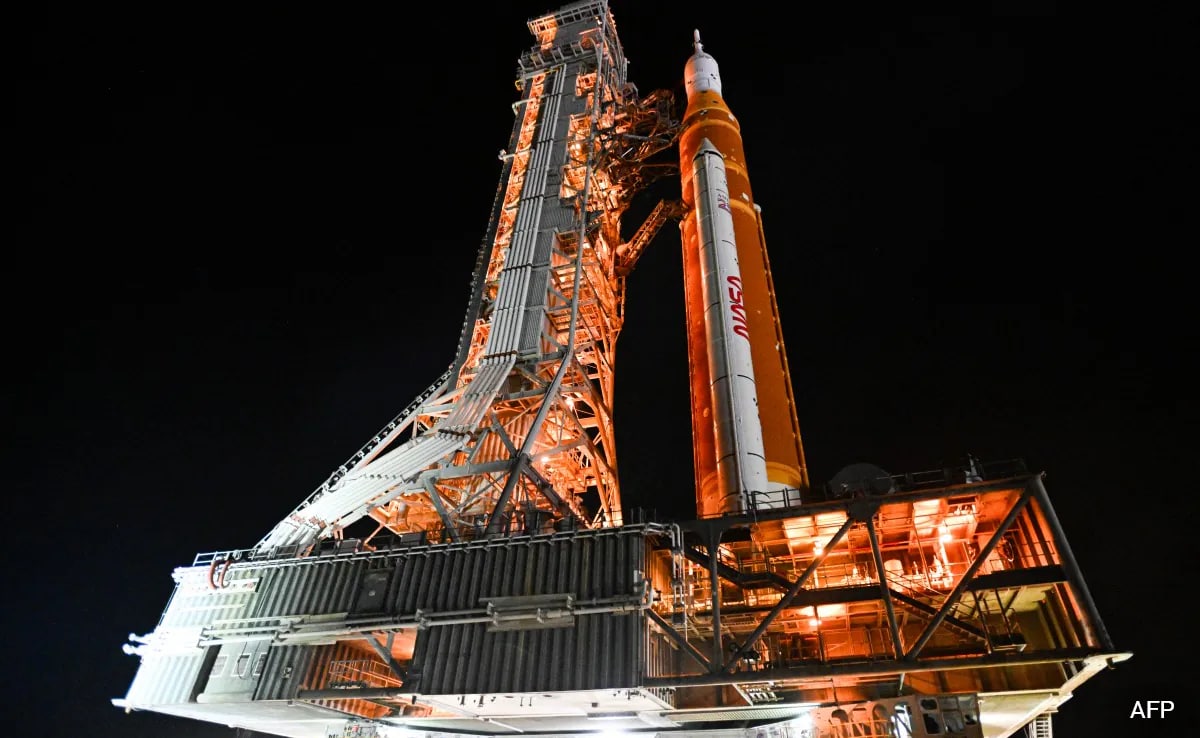
The Space Launch System (SLS) is crawling back to Pad 39B, a four-mile journey that takes nearly twelve hours and costs more than most small-market airports. While NASA officials frame this rollout as a triumphant step toward an April launch window, the heavy-lift rocket represents a precarious gamble. The agency is not just moving hardware; it is attempting to prove that a vehicle built on forty-year-old Space Shuttle technology can still anchor a modern deep-space program. This April flight, known as Artemis II, will be the first time humans have circled the Moon in over half a century, yet the mission remains haunted by the procurement ghosts of the 1970s.
The "why" behind this rollout is simple on the surface: NASA needs to verify that the mobile launcher and the rocket can communicate flawlessly after months of storage and minor repairs. But the deeper reality involves a brutal fight against mechanical degradation. Every time this 5.75-million-pound stack moves, it is subjected to vibrations and structural stresses that the hardware was never originally designed to endure over multiple decades of "heritage" iterations.
The High Cost of Heritage Hardware
Washington loves the word "heritage" because it sounds safe. In the aerospace world, it often means expensive. The SLS is frequently criticized as a "jobs program" because it utilizes the RS-25 engines and solid rocket boosters derived directly from the Space Shuttle program. While this should have saved money, the reality has been a spiraling budget that now sees each launch costing roughly $2 billion.
NASA is essentially building a Ferrari out of vintage parts and wondering why the maintenance bill keeps climbing. These engines, once designed to be reusable, are now being tossed into the ocean after a single use. It is a disposal of high-end engineering that feels increasingly out of sync with the private sector's push for rapid reusability. The April launch window is not just a target; it is a deadline to justify this immense expenditure before auditors start asking why the agency isn't just buying rides from commercial providers.
The technical hurdles are significant. During previous tests, the umbilical lines—the "veins" that feed liquid hydrogen and oxygen into the rocket—have shown a frustrating tendency to leak. Hydrogen is the smallest molecule in the universe. It finds every microscopic gap. When you are dealing with cryogenic temperatures, those gaps expand and contract in ways that defy even the most sophisticated modeling.
The Liquid Hydrogen Problem
Engineers at Kennedy Space Center have spent months chasing "ghost leaks" in the seals. The transition back to the pad is the ultimate stress test for these fixes. If the seals hold during the April countdown, the SLS becomes a viable, if expensive, moon ship. If they fail again, the entire Artemis timeline crumbles.
Private competitors have moved toward methane-based fuels, which are easier to handle and less prone to the "searching" leaks inherent to hydrogen. NASA, however, is locked into its architecture. They have billions invested in the infrastructure at Pad 39B specifically designed for this volatile fuel mix. They cannot pivot. They have to make this old-school chemistry work, or they lose the decade.
The sheer scale of the hardware is its own enemy. The SLS stands 322 feet tall. It is a skyscraper that must be balanced on a moving platform and then accelerated to 17,500 miles per hour. The margin for error is non-existent.
The Invisible Risks of the Van Allen Belts
While the media focuses on the launch, the real danger for the April mission lies in the trajectory. Artemis II will take its crew further from Earth than any humans in history. This involves two passes through the Van Allen radiation belts.
NASA has spent years hardening the Orion capsule's avionics. But shielding humans is different from shielding chips. The April mission will test a new generation of radiation vests and monitoring equipment. The data gathered here is the only thing that will make a Mars mission possible, yet the risk to the crew remains the primary "known unknown." We are sending people into a high-radiation environment using a flight computer architecture that, while upgraded, still shares DNA with systems designed before the internet was a household utility.
Logistics of the Rollout
The Crawler-Transporter 2, the massive tracked vehicle carrying the rocket, is a mechanical marvel in itself. It was built in the 1960s. It has been upgraded with modern engines and control systems, but it remains a relic. Watching it move the SLS is a lesson in patience. It moves at a maximum speed of 0.8 miles per hour.
- Fueling: Takes over 8 hours of precise thermal management.
- Weather: The rocket cannot be on the pad if lightning or high winds are predicted beyond a specific threshold.
- The Window: April offers a specific "alignment" where the Earth, Moon, and Sun allow for optimal return trajectories in case of an abort.
If the launch misses the April window, the mechanics of orbital debris and solar positioning force a delay of weeks, if not months. Every day the rocket sits on the pad, it is exposed to the salty, corrosive air of the Florida coast. This isn't a garage-kept machine. It is a giant metal tower sitting in a swamp, fighting chemistry and physics simultaneously.
The Credibility Gap
NASA’s leadership is under immense pressure to deliver. The Artemis program has seen its share of skeptics, many of whom point to the success of the Starship program in Texas as a sign that the SLS is obsolete before it even reaches its second flight. But Starship hasn't carried humans yet. The SLS has.
The agency is banking on the fact that "proven" tech—even if it is expensive and slow—is the only way to ensure the safety of the four astronauts scheduled for this mission. It is a conservative approach in a radical era. The April flight is intended to silence the critics by proving that the SLS can do what no other rocket currently can: put a human-rated capsule into a lunar injection orbit with enough life support for a multi-week journey.
The hardware is at the pad. The teams are in the bunkers. The politics of space are currently balanced on the integrity of a few hydrogen seals and the reliability of 1980s engine designs.
Hardware is Not Policy
The most overlooked factor in the April launch isn't the rocket itself, but the ground software. NASA has completely rewritten the launch control code to handle the specific telemetry of the Artemis stack. This software must process millions of data points per second during the ascent. In previous "wet dress rehearsals," the software triggered several false-positive aborts.
Engineers have spent the winter "tuning" the sensitivity of these sensors. If the sensors are too sensitive, the rocket never leaves the ground. If they aren't sensitive enough, the mission ends in a fireball. This delicate calibration is what actually happens during the weeks the rocket sits at the pad before the public sees the engines light.
The move to the pad is the start of the "long count." It is a period of intense, invisible labor where technicians crawl through the interstage sections, checking for the slightest hint of moisture or vibration damage. They are the ones holding the mission together with torque wrenches and sheer persistence.
The SLS is a bridge between two eras. It uses the muscles of the Shuttle to carry the dreams of a new generation. Whether that bridge is sturdy enough to support the weight of a permanent lunar presence will be decided the moment the hold-down bolts release in April.
The countdown doesn't start at T-minus ten seconds. It started the moment the Crawler’s tracks began to turn toward the horizon. Verify the torque on every bolt and watch the telemetry for any sign of a pressure drop in the helium tanks.