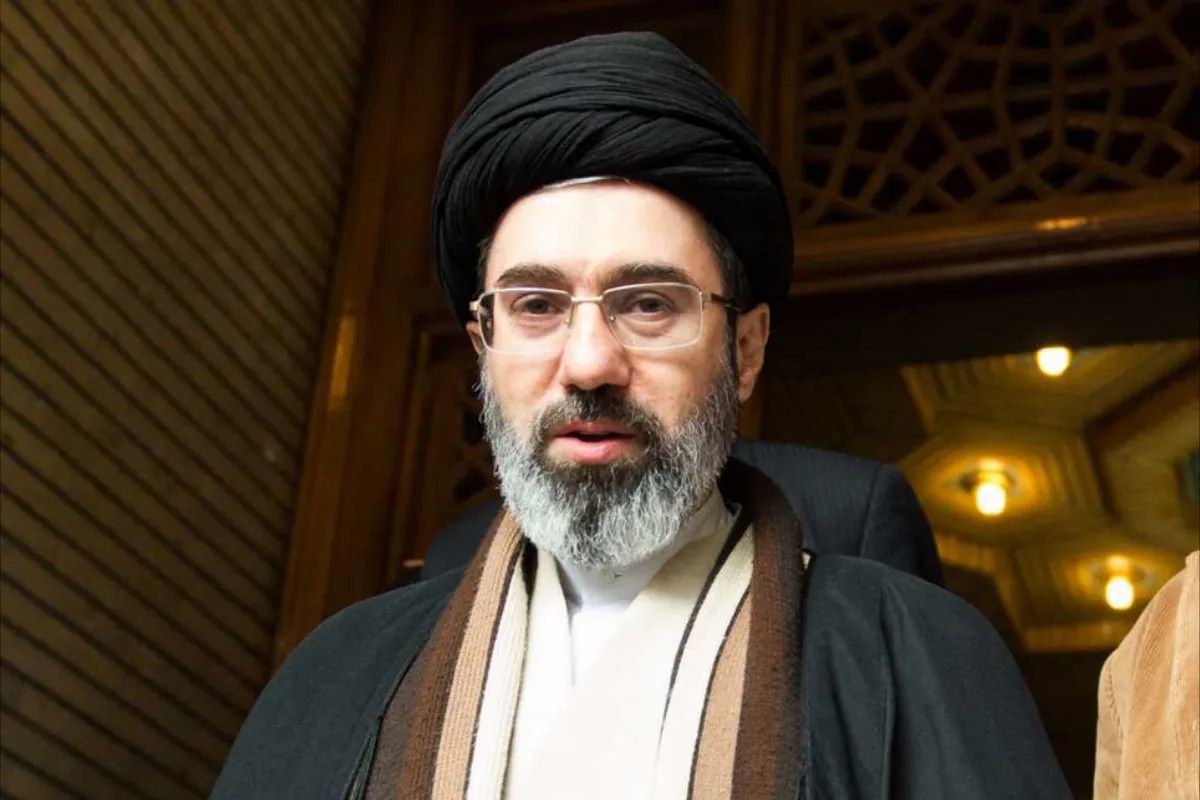
The shadow play in Tehran has officially moved into the light. For decades, Mojtaba Khamenei, the second son of Iran’s Supreme Leader, operated in the high-stakes periphery of the Islamic Republic’s power structure. He was the whisperer in the ear of the Basij, the strategist behind the scenes of the 2009 crackdown, and the silent arbiter of clerical succession. But the recent targeted killing of Ali Larijani—a heavyweight of the pragmatic conservative wing and a fixture of the Iranian establishment—has forced Mojtaba to abandon his customary silence. His recent vow that "every drop of Larijani’s blood" would be exacted from the United States and Israel is not merely a standard rhetorical flourish of the regime. It is a calculated political debut designed to consolidate the hardline base and eliminate any remaining doubt about who intends to steer Iran after his father, Ali Khamenei, vacates the seat.
This is a turning point for the Middle East. By positioning himself as the primary voice of vengeance, Mojtaba is attempting to bridge the gap between his perceived status as a "hereditary" successor and the revolutionary requirement of being a fierce, uncompromising defender of the Republic. The assassination of Larijani serves as the perfect, albeit bloody, catalyst for this transformation.
The Calculated Emergence of a Successor
The timing of Mojtaba’s escalation cannot be viewed in isolation. Iran is currently grappling with a hollowed-out middle management within its security apparatus. The precision of the strike against Larijani suggests a level of intelligence penetration that has left the Islamic Revolutionary Guard Corps (IRGC) reeling. When the state’s traditional defenders look vulnerable, the populace and the paramilitary factions look for a focal point of strength.
Mojtaba’s rhetoric is a direct grab for that mantle. By using the death of a man who was often his political rival, he creates a facade of national unity. It is a classic move from the autocrat’s handbook. He is signaling to the IRGC leadership that he is not just a cleric’s son, but a commander-in-waiting who speaks their language of kinetic retaliation and asymmetric defiance.
History shows that in the Iranian political ecosystem, the person who defines the terms of "revenge" usually controls the policy that follows. If Mojtaba dictates how Iran responds to the loss of Larijani, he effectively dictates Iran’s foreign policy toward the West for the next decade.
Why the Larijani Hit Changed the Internal Calculus
Ali Larijani was never a true dissident, but he represented a specific brand of Iranian "realism." He was a man of the system who understood that the survival of the Republic required occasional engagement with the outside world. His removal from the board does more than just eliminate a voice for diplomacy; it creates a vacuum that only the most radical elements can fill.
For Mojtaba, the Larijani assassination provides a convenient solution to a persistent problem. For years, critics within the Qom theological circles argued that Mojtaba lacked the "revolutionary scars" necessary to lead. They saw him as a technocrat of repression rather than a soldier of the faith. By tethering his public identity to the promise of a bloody response against Tel Aviv and Washington, he is attempting to earn those scars post-facto through rhetoric.
The danger here is not just in the words, but in the necessity of fulfilling them. To maintain his newfound standing, Mojtaba must oversee a response that matches his threats. This pushes Iran closer to a direct confrontation than it has been in years. The "gray zone" warfare that Iran has mastered—using proxies to do the dirty work—may no longer suffice if Mojtaba needs a clear, undeniable victory to cement his claim to the Supreme Leadership.
The Intelligence Failure and the Blame Game
We must address the elephant in the room: how was Larijani reached? The strike indicates that the "inner circle" in Tehran is no longer a fortress. There is a deep-seated paranoia currently gripping the Iranian intelligence community. Every official is looking at their subordinates with suspicion.
Mojtaba’s aggressive posturing serves a secondary, more pragmatic purpose. It diverts attention from the monumental security failure that allowed the assassination to happen in the first place. By focusing the national ire outward toward the "Great Satan" and the "Zionist Entity," he shields the IRGC and the Ministry of Intelligence from a domestic inquiry into their own incompetence.
It is far easier to promise a missile strike on a foreign base than it is to explain how an enemy operative managed to track a high-level official through the heart of the capital’s secure zones.
The Regional Ripple Effect
The implications of Mojtaba’s rise as the "Vengeance Architect" extend far beyond the borders of Iran. Lebanon, Yemen, and Iraq are watching. The leaders of Hezbollah and the Houthi movement do not take their cues from the elected President of Iran; they look to the Office of the Supreme Leader.
If Mojtaba is indeed the one holding the leash, we should expect a shift in proxy behavior. We are likely to see:
- Increased Sophistication in Maritime Attacks: Moving beyond simple drone strikes to more complex, multi-vector engagements in the Red Sea and the Persian Gulf.
- Targeted Retaliation: A shift from attacking military assets to targeting individuals within the Western intelligence community, mirroring the "eye for an eye" logic Mojtaba has invoked.
- The End of Backchannel Diplomacy: With Mojtaba at the helm of the narrative, the secret meetings in Oman or Qatar become politically toxic for any Iranian official.
The Mirage of Stability
There is a tempting but flawed argument that a Mojtaba Khamenei succession would bring stability to Iran because it represents continuity. This is a dangerous misunderstanding of the current climate. Continuity in a failing system only accelerates the collapse.
The Iranian public is exhausted. The economy is in a state of permanent "emergency," and the social contract is shredded. Mojtaba’s reliance on the language of war and blood is a sign of weakness, not strength. It is the language of a regime that has run out of ideas and is falling back on the only thing it has left: the ability to manufacture external crises to justify internal misery.
Larijani’s death was a spark, but Mojtaba is trying to turn it into a controlled burn that clears the path for his own coronation. The problem with fire is that it rarely stays where you put it.
The international community must stop treating Mojtaba as a secondary figure. He has signaled his intent. He has identified his enemies. He has staked his future on a promise of violence. When a man in his position tells you he intends to spill blood, the only mistake is not believing him.
The era of the "quiet" Mojtaba is over. The era of a more aggressive, desperate, and unconstrained Iran has begun. The response from the West cannot be more of the same sanctions and strongly worded letters. It requires a fundamental reassessment of who is actually calling the shots in Tehran and what they are willing to sacrifice to stay in power.
If you want to understand where the next conflict in the Middle East will start, stop looking at the map and start looking at the internal power struggle in Tehran. The Larijani assassination wasn't just an end; it was the opening bell for a much more dangerous round of the Great Game.