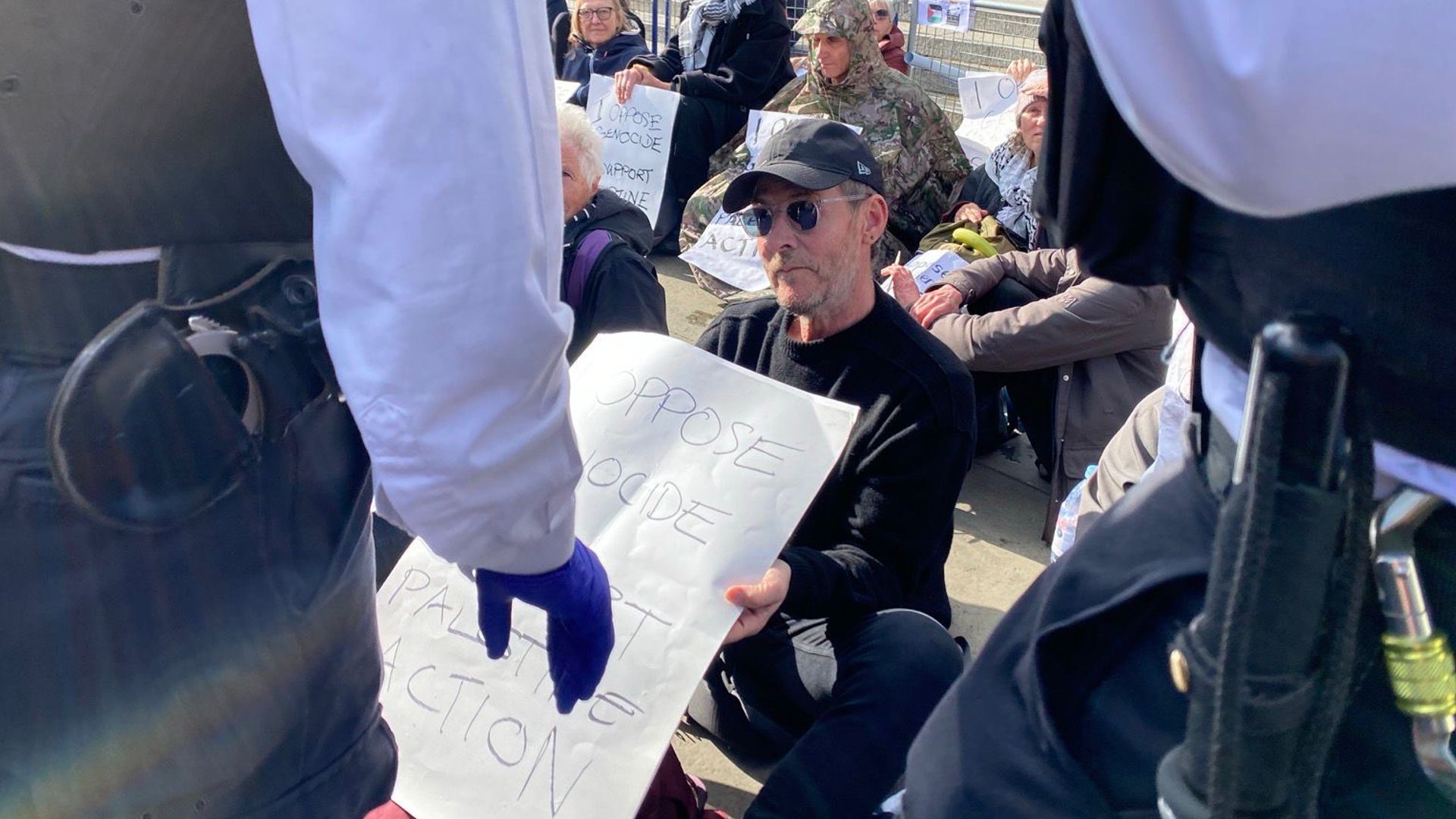
The arrest of over 500 individuals, including high-profile cultural figures like singer Baby Queen (Bella Latham), during the Palestine Action "Siege" on Elbit Systems represents a shift from symbolic protest to a strategy of industrial attrition. While media coverage focuses on the celebrity presence, the actual mechanics of the event reveal a calculated attempt to create a "bottleneck effect" within both the private defense supply chain and the public judicial infrastructure. This operation functioned on the principle of mass-arrest saturation, where the volume of detainees is used as a tool to overwhelm the processing capacity of the state, thereby extending the duration of the operational shutdown at the target facility.
The Operational Mechanics of the Palestine Action Siege
The protest targeted Elbit Systems’ facilities, specifically the manufacturing hubs in the UK that produce components for the Hermes 450 drone. To analyze the efficacy of this action, one must look at the Supply Chain Interruption Variable. Direct action groups operate on the hypothesis that the cost of securing a facility against a mass-incursion eventually exceeds the profit margins of specific contracts. Meanwhile, you can find other events here: The Palestine Action Ban is Backfiring in Trafalgar Square.
The siege used a three-tier disruption model:
- Physical Access Denial: Using human chains and lock-on devices to prevent the movement of raw materials and finished goods.
- Logistical Saturation: Forcing the deployment of massive police resources, which diverts public funds and creates a political cost for the host government.
- Reputational Contagion: Utilizing recognizable figures to bridge the gap between niche activism and mainstream visibility, thereby pressuring institutional investors to divest.
[Image of supply chain disruption model] To see the bigger picture, we recommend the detailed report by BBC News.
The arrest of 500 people is not merely a legal consequence; it is a logistical data point. In the UK legal system, the "Time-to-Process" for a single detainee involves custody sergeants, medical assessments, legal counsel consultations, and formal interviews. When 500 individuals are arrested simultaneously, the police force faces a Throughput Crisis. The sheer volume necessitates the use of multiple custody suites across several counties, stretching the administrative capacity of the regional constabulary to its breaking point.
The Role of Cultural Capital in High-Risk Activism
The participation of Bella Latham (Baby Queen) serves a specific function within the Activist Attention Economy. In standard direct action, the "cost" to the participant is high (criminal records, potential incarceration), while the "reach" is often limited to specific echo chambers. By integrating a "high-status" individual into the mass-arrest cohort, the group achieves a Media Multiplier Effect.
This creates a paradox for law enforcement. The arrest of a celebrity ensures that the specific grievances of the group—in this case, the allegation of UK-made components being used in Gaza—receive a level of scrutiny that 499 anonymous arrests would not generate. This is a strategic application of Social Proof. If a successful commercial artist is willing to risk their career and freedom, the movement gains a veneer of legitimacy that shifts the public perception of the group from "radical fringe" to "principled dissenters."
However, there is a diminishing return on this strategy. If the legal repercussions for high-profile individuals are perceived as lenient, it may embolden further mass-action. Conversely, if the state pursues maximum sentencing, it risks turning these individuals into martyrs, further fueling the recruitment cycle of the organization.
The Cost Function of Industrial Sabotage
Palestine Action operates on a model of Direct Action Insurgency. Unlike traditional protest groups that seek to influence policy through voting or lobbying, this group seeks to physically prevent the production of goods. This is analyzed through the Net Disruption Value (NDV).
$$NDV = (C_p + C_l) - (R_a)$$
Where:
- $C_p$ is the cost of physical damage and cleaning.
- $C_l$ is the lost revenue from production downtime.
- $R_a$ is the total resource cost of the activist group.
When the NDV remains positive for an extended period, the target corporation faces pressure from insurance providers. The insurance premiums for a facility that is frequently the site of "Saturative Protests" eventually become a significant line item on the balance sheet. In some instances, the inability to secure affordable insurance for specific sites can lead to the "Managed Exit" of a company from a region—a primary objective of the Palestine Action strategy.
The 500 arrests signify that the group has reached a critical mass of volunteers willing to accept the personal risks of the $R_a$ variable. For the state, the challenge is that the cost of policing these events ($C_{police}$) is borne by the taxpayer, while the protection is afforded to a private entity (Elbit Systems). This creates a friction point in public discourse regarding the allocation of state resources to protect the interests of international defense contractors during a domestic cost-of-living crisis.
Legal Thresholds and the Judicial Bottleneck
The specific charges leveled against the detainees—typically aggravated trespass, criminal damage, or conspiracy to commit a crime—determine the speed of the judicial response. The UK's Police, Crime, Sentencing and Courts Act 2022 was designed to streamline the removal of protesters, but it did not account for the Parallel Processing Limitation of the courts.
When 500 cases enter the system at once, several things happen:
- Evidence Chain Dilution: Police must prove the specific actions of each of the 500 individuals. Video evidence must be cross-referenced with specific arrest times and locations.
- Legal Aid Strain: Finding 500 defense solicitors who are not conflicted and are available for simultaneous interviews is a functional impossibility in many regions.
- Sentencing Inconsistency: With so many defendants, the likelihood of varying outcomes for the same offense increases, which can be used on appeal to challenge the severity of the sentences.
This judicial backlog is a feature, not a bug, of the Palestine Action strategy. By creating a multi-year legal tail for a single week of action, they ensure that the issue remains in the news cycle and continues to drain the resources of the Crown Prosecution Service (CPS).
The Strategic Shift to "The Siege"
The transition from "hit-and-run" raids to "The Siege" represents an evolution in activist doctrine. In a raid, the goal is maximum damage in minimum time. In a siege, the goal is Persistent Occupancy. This forces a different tactical response from the police. Instead of a reactive patrol, the police must maintain a 24/7 perimeter, which involves massive overtime costs and the deployment of specialized units (e.g., rope access teams to remove protesters from roofs).
The "Siege" also allows for the construction of a Micro-Community of Resistance. By maintaining a presence for several days, activists can organize logistics—food, water, power, and communications—that make the protest sustainable. This infrastructure serves as a proof-of-concept for other groups, demonstrating that it is possible to hold ground against the state for significant periods.
Quantifying the Impact on Elbit Systems
Elbit Systems, as Israel’s largest private defense contractor, has a diversified global presence. However, their UK operations are a vital node for their international exports. The impact of 500 arrests and the associated disruption can be categorized into three levels of severity:
- Level 1: Operational Delay: Short-term pauses in production. These are usually mitigated by overstocking parts or shifting production to other sites.
- Level 2: Contractual Default: If a siege lasts long enough to prevent the fulfillment of a delivery window, the company may face financial penalties or the cancellation of contracts.
- Level 3: Strategic Relocation: The decision to close a site entirely due to the persistent threat of disruption. This has already occurred at Elbit’s former sites in Oldham and London.
The 500 arrests suggest that the "Siege" reached Level 1 and potentially touched Level 2 for specific sensitive contracts. The ultimate success of the action, from the activists' perspective, is measured by whether it moves the needle toward Level 3.
The Response of the Defense Sector
The defense industry's response to this escalating tactic is the implementation of Hardened Perimeter Logistics. This includes:
- Enhanced Surveillance: Using AI-driven motion detection to identify incursions before they reach the building envelope.
- Legal Injunctions: Pre-emptive "high-court injunctions" that make even stepping on certain patches of land a contempt of court, which carries more immediate and severe penalties than simple trespass.
- Private Security Escalation: Increasing the ratio of private security guards to employees, effectively turning factories into "Green Zones."
This hardening, while necessary for the company’s survival, further reinforces the activists' narrative of a "militarized" industry that is separated from and hostile to the local community.
Future Projections of Mass-Arrest Tactics
The data from the Palestine Action siege suggests that the movement is not yet at its peak. The ability to mobilize 500 people for high-risk activity indicates a robust recruitment pipeline. We can expect the following developments in the near-term:
- Geographic Dispersion: To avoid the concentration of police resources, future sieges may happen simultaneously across multiple sites in different police jurisdictions.
- Technological Sabotage: A shift away from physical occupation toward the disruption of digital infrastructure and internal communication systems of defense contractors.
- Increased Cross-Border Collaboration: Activists from other European nations joining UK-based actions to further complicate the legal processing and deportation logistics.
The current legal framework is poorly equipped to handle "saturated" protest models. If the state chooses to escalate through longer prison sentences, it will likely increase the radicalization of the remaining activist base. If it chooses to be lenient, the frequency of these actions will increase. The strategic play for the defense industry is not more security, but a radical overhaul of their public-facing "Corporate Social Responsibility" (CSR) and a decoupling of their UK production lines from the most controversial international theaters of conflict—though the feasibility of such a move remains low given the integrated nature of global defense manufacturing.