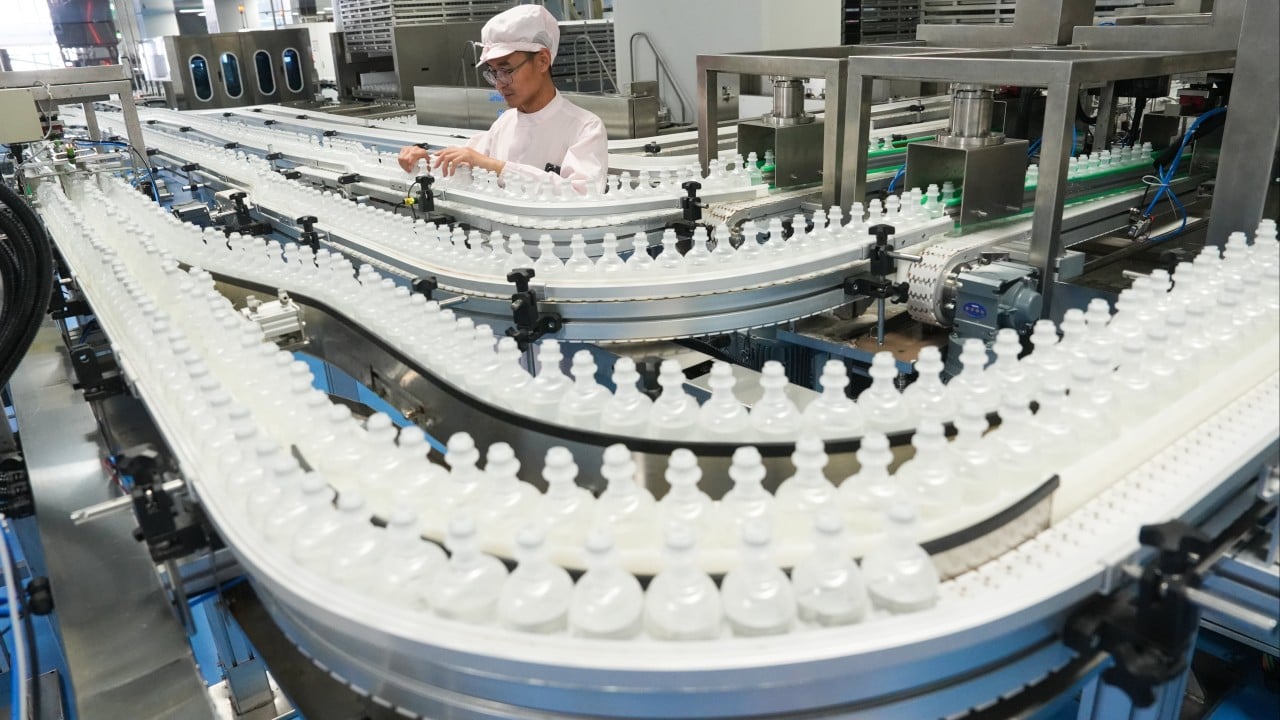
A glass vial sits on a sterile assembly line in Wuxi. It is smaller than a thumb, clear as a mountain stream, and carries the weight of a billion-dollar hope. Inside that glass, molecules are being coached to fight cancer. The scientists watching the line wear white lab coats and blue nitrile gloves. They speak the universal language of titration and cellular response. They are the invisible engine of the global medicine cabinet.
For twenty years, this was the undisputed rhythm of the world. Western biotech firms dreamed up the cures; Chinese contract manufacturers built them. It was a marriage of convenience that became a marriage of necessity. But the vows are fraying.
The geopolitical chill has finally reached the cleanrooms. What was once a matter of supply chain efficiency is now a matter of national security. When the United States signals a move toward "reshoring"—the act of bringing manufacturing back to its own soil—it isn't just moving bricks and mortar. It is rewriting the DNA of how we stay alive.
The Architect and the Equation
Consider a hypothetical executive named Sarah. She runs a mid-sized biotech firm in Boston. Sarah has a molecule that could potentially stop Alzheimer’s in its tracks. To test it, she needs thousands of doses produced to exacting standards.
She looks at her spreadsheet. On one side is a Contract Development and Manufacturing Organization (CDMO) in China. They are fast. They are cheaper. They have scaled their facilities at a pace that seems to defy the laws of physics. On the other side is a nascent push by the U.S. government to build that same capacity in Ohio or North Carolina.
The gap isn't just financial. It's temporal.
If Sarah sticks with her Chinese partners, she risks running into a wall of new American legislation. The Biosecure Act looms like a storm cloud on the horizon. It suggests that doing business with certain Chinese giants could eventually bar her from U.S. government contracts. But if she moves her production to a yet-to-be-built facility in the States, she loses years.
Years.
In the world of drug development, a year is a lifetime. For a patient waiting for that vial, it is the only time that matters.
The Ghost in the Supply Chain
We often talk about "reshoring" as if it were as simple as moving a chess piece. We imagine a factory closing in Shanghai and an identical one opening in Indianapolis. This is a fantasy.
The reality is a tangled web of specialized knowledge. Over the last two decades, China didn't just build factories; they cultivated an ecosystem. They trained an army of specialized chemists. They built the secondary industries that provide the filters, the reagents, and the specialized glass.
When an analyst says the U.S. reshoring drive "casts a shadow," they aren't talking about a cloudy day. They are talking about a total eclipse of the current business model.
The American push is driven by a fear of "single-point failure." If the world’s supply of essential medicines flows through a single geographic bottleneck, any friction—be it a pandemic, a trade war, or a literal war—could empty the shelves of every pharmacy in Maryland. It is a logical, prudent fear.
But prudence has a price tag.
Building a biologics plant in the United States takes roughly five years and upwards of $2 billion. That is $2 billion not spent on research. That is five years of a molecule sitting in a freezer instead of a patient's bloodstream. We are trading the speed of innovation for the security of the infrastructure.
The Quiet Panic in the Boardroom
Behind the stoic press releases of companies like WuXi AppTec or GenScript, there is a frantic recalibration. These giants have seen their market valuations swing wildly based on a single subcommittee hearing in Washington D.C.
They are reacting the only way they can: by becoming less "Chinese."
They are investing in facilities in Singapore, Europe, and even the U.S. itself. It is a strange, mirrors-and-smoke dance. To keep their American clients, they must prove they are physically separated from the very country that gave them their start.
Meanwhile, the smaller biotech startups—the ones operating on "burn rates" and venture capital—are caught in the crossfire. They don't have the luxury of a ten-year geopolitical strategy. They have enough cash to last eighteen months. If they are forced to pivot to more expensive, domestic manufacturing, their runway shortens.
The math is brutal. Less runway means fewer experiments. Fewer experiments mean fewer cures.
The Human Cost of Sovereignty
Imagine a father in a suburb of Chicago. He doesn't care about the Biosecure Act. He doesn't know what a CDMO is. He only knows that his daughter’s rare disease treatment is part of a clinical trial.
That trial relies on a steady supply of a specific protein manufactured in a facility outside of Suzhou. If that facility is suddenly "de-risked" out of the supply chain, the trial pauses. The data becomes inconsistent. The FDA requires a new study to ensure the "reshored" version of the drug is identical to the original.
The father watches the calendar. The diplomats watch the polls. The analysts watch the stock tickers.
This is the invisible stake. We are attempting to dismantle a globalized brain and replace it with a nationalized one. It might be necessary. It might even be the right thing to do for the long-term stability of the West. But we cannot pretend it is a "seamless" transition. It is a mechanical heart transplant performed while the patient is running a marathon.
The New Map of Medicine
The map is being redrawn in real-time. We are moving toward a "bifurcated" world. One supply chain for the East, one for the West.
In this new world, the U.S. will regain its manufacturing muscle. We will see the return of the "Company Town," centered not around coal or steel, but around high-capacity bioreactors. There will be jobs. There will be pride. There will be the comfort of knowing that our insulin and our oncology drugs are made within driving distance.
But the shadow cast over China’s contract makers is also cast over the pace of human discovery.
When you break a global network, you lose the "synergy"—a word often overused but here quite literal—of collective intelligence. You lose the ability to tap into the 24-hour cycle of global labor. You introduce friction. And in medicine, friction is the enemy.
The scientists in Wuxi still put on their blue nitrile gloves every morning. They still look through the same microscopes as their peers in Cambridge or San Diego. They are searching for the same truths in the same cells.
But for the first time in a generation, the vials they fill are no longer just medicine. They are political statements. They are risks to be managed. They are pieces of a puzzle that no longer fits together.
The vial on the assembly line continues to move. It glints under the fluorescent lights, a tiny beacon of science trapped in a storm of statecraft. We are building walls around our laboratories, hoping that by securing the bottle, we don't accidentally lose the cure.
The cost of independence is always paid in the currency of time. We are betting that we have enough of it to spare.